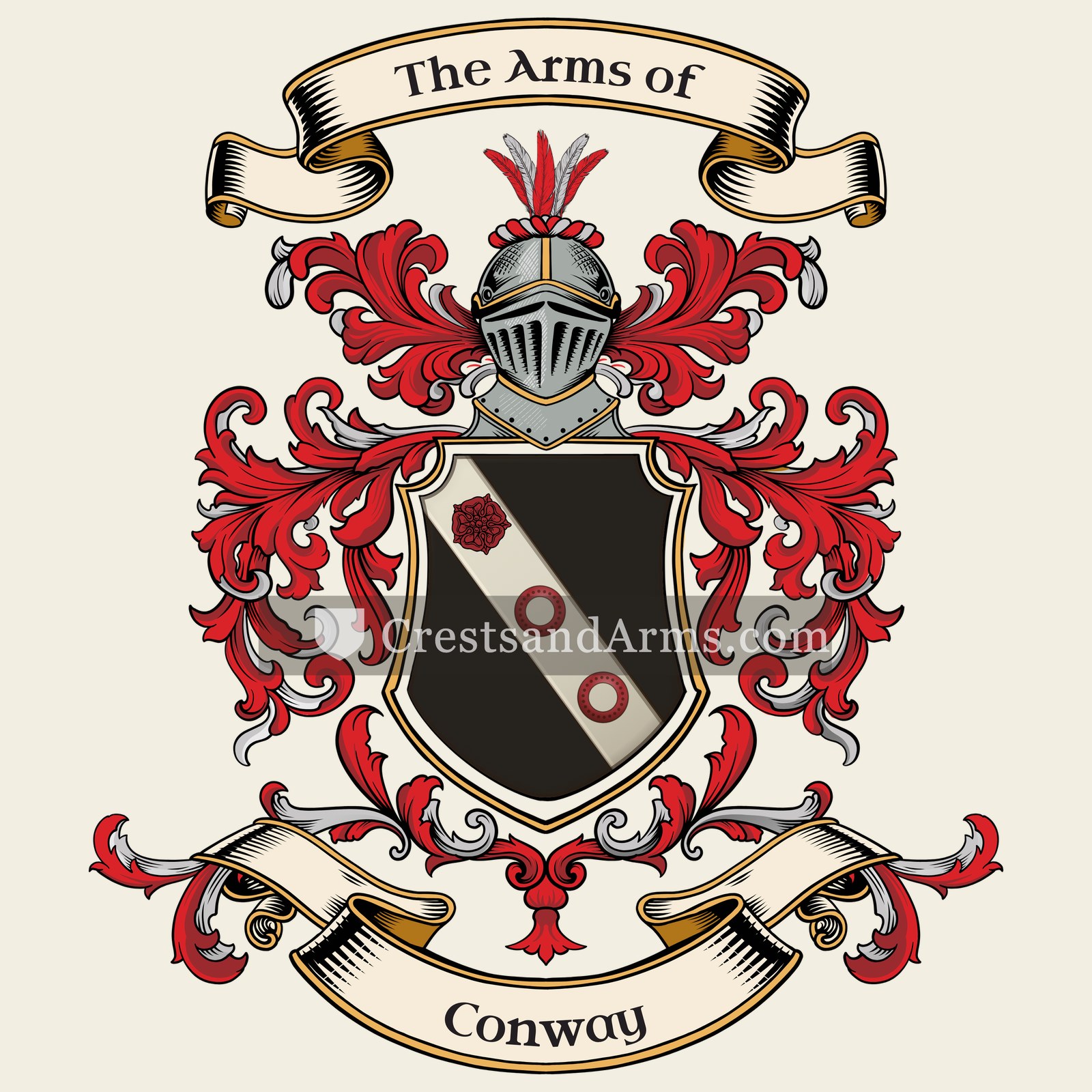
A record of documented arms, meaning and origin, researched for the Conway family lines. Documented in 3 countries.
Reg. 5729 · Belgian, A–C
Coat of Arms & Family Crest Details
Symbols on this shield
bendDefence, and the scarf of a commander
roseThe seventh son, and beauty with grace
ringFidelity, and a promise kept
Colours
Black (Sable)Means: Constancy
Silver (Argent)Means: Peace and sincerity
Red (Gules)Means: Military strength
Historical info
Source
J. B. Rietstap, Armorial Général, Gouda: G. B. van Goor Zonen, 1884–87
Blazon (the actual original written record)
“De sa. à la bande coticée d'arg., ch. d'une rose de gu. et de deux annelets du même. C.: un buste de More, posé de profil, tort. d'arg. et d'azur. T.: deux Mores, hab. d'or, à la jupe de gu., ceints de plumages de sin., tort. d'or et de sa., la main appuyée sur un bouclier d'azur orné d'or, celui à dextre ch. d'un soleil d'or et celui à sen. d'un croiss. du même. D.: FIDE ET AMORE.”
Belgiumc. 1624
Digital archive packCoat of arms PNG, gold border print PDF, vector SVG and the certificate of authenticity. Sent to your email in minutes.
Map of Belgium showing where the Conway arms are recorded
The Conway arms were recorded in Belgium, c. 1624.
Arms such as these were typically recorded in Brabant.
Brabant lay at the heart of the Low Countries, where the trade routes met. Its towns were wealthy and its landowners many, and both kinds of family kept arms, which is why the region is so heavily represented.
This is where the arms were entered in the register. Families often moved to other parts of the country, so the same name can turn up in more than one region.
The body that granted and recorded arms in Belgium in this period.
Philip IV of Spain
Sovereign of the period
Philip IV of Spain
1621–1665
Reigning in Belgium when the Conway arms are first recorded.
How Arms Worked in Belgium
In Belgium, a coat of arms is considered personal property that is passed down through the male line to legitimate descendants. Families often use the same shield design across generations to show their shared heritage. If a branch of the family wants to change the design, they must apply for an official update to their specific version of the arms.
Granting authority
The Conseil héraldique is the official body that regulates and approves all coats of arms in Belgium.
How they got arms
Families obtain their coats of arms through formal royal grants or by confirming their historical right to use existing designs.
Where arms were recorded
All approved coats of arms are officially recorded in the public registers of the Conseil héraldique since 1844.
The family's standing
Recorded among the armigerous families of Belgium.
Origin & History of the Conway Family in Belgium
The history of the Conway name in Belgium is deeply connected to the political and religious shifts of the seventeenth century. By 1624, members of the family were established in the Duchy of Brabant, a region that served as a vital crossroads for trade and military activity in the Low Countries. During this period, the family likely integrated into the local administrative and merchant classes, benefiting from the stability of the region under the rule of the Spanish Habsburgs. Because the name originated from Gaelic roots, its presence in Brabant suggests that these early ancestors were likely part of the wave of political exiles or soldiers who sought refuge or employment on the continent during a time of intense European conflict. Living in Brabant allowed the family to navigate the complex social structures of the era, moving between the roles of military officers and local citizens while maintaining their distinct identity in a rapidly changing landscape.
Coat of Arms & Family Crest Details
Symbols on this shield
bendDefence, and the scarf of a commander
roseThe seventh son, and beauty with grace
ringFidelity, and a promise kept
Colours
Black (Sable)Means: Constancy
Silver (Argent)Means: Peace and sincerity
Red (Gules)Means: Military strength
Historical info
Source
Sir Bernard Burke, The General Armory of England, Scotland, Ireland and Wales, London: Harrison & Sons, 1884
Blazon (the actual original written record)
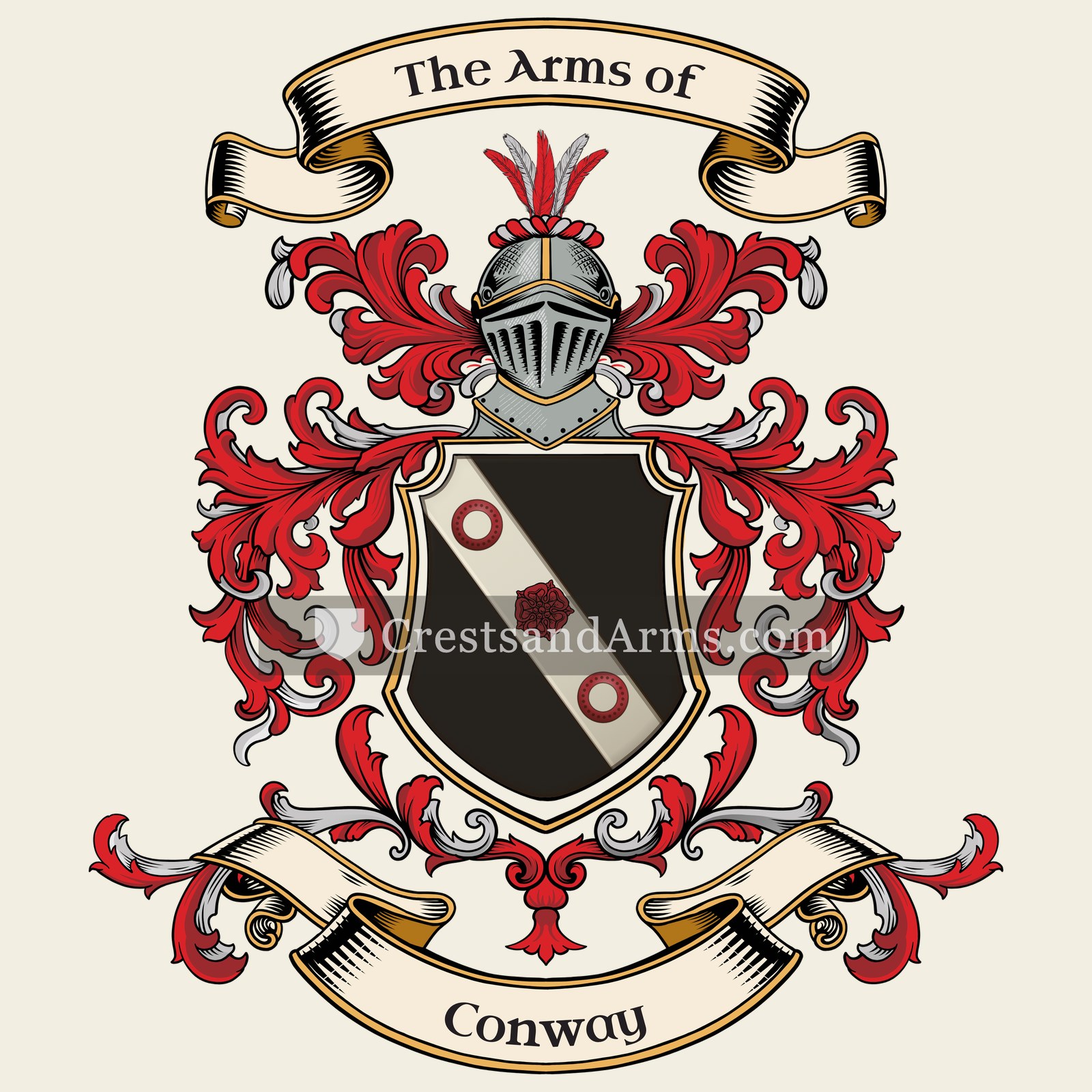
“Sa. on a bend cotised ar. a rose betw. two annulets gu”
BuckinghamshireBuckinghamshire, c. 1620
Digital archive packCoat of arms PNG, gold border print PDF, vector SVG and the certificate of authenticity. Sent to your email in minutes.
Map of England showing where the Conway arms are recorded
The Conway arms were recorded in Buckinghamshire, c. 1620.
This is where the arms were entered in the register. Families often moved to other parts of the country, so the same name can turn up in more than one region.
The body that granted and recorded arms in England in this period.
James VI and I
Sovereign of the period
James VI and I
1603–1625
Reigning in Belgium when the Conway arms are first recorded.
How Arms Worked in England
English heraldry allowed arms to be shared by all legitimate descendants of the original owner. These symbols were treated as personal property that moved through the generations to all children. While the eldest son kept the original design, other family members could use the same shield without needing to change it or register their own unique versions.
Granting authority
The College of Arms in London has regulated the use of coats of arms throughout England and Wales since 1484.
How they got arms
Families typically obtained their coats of arms through a formal grant from the Crown or by proving their ancient right to them.
Where arms were recorded
All official coats of arms are recorded in the registers kept at the College of Arms, which date back to the fifteenth century.
The family's standing
Recorded among the armigerous families of Buckinghamshire.
Origin & History of the Conway Family in England
The family name Conway has deep roots in England, where it originated as a locative surname derived from the town of Conwy in North Wales. Over time, families migrated from these Welsh borders into various English counties, seeking new opportunities in trade and land ownership. By the year 1620, historical records confirm that members of the Conway family were well-established in Buckinghamshire. During this period, the family was part of the growing middle class that helped shape local community life through farming and regional commerce. As they settled into the English countryside, they became integrated into the social fabric of the seventeenth century, moving away from their Welsh origins to become a recognized part of the Buckinghamshire population.
Coat of Arms & Family Crest Details
Symbols on this shield
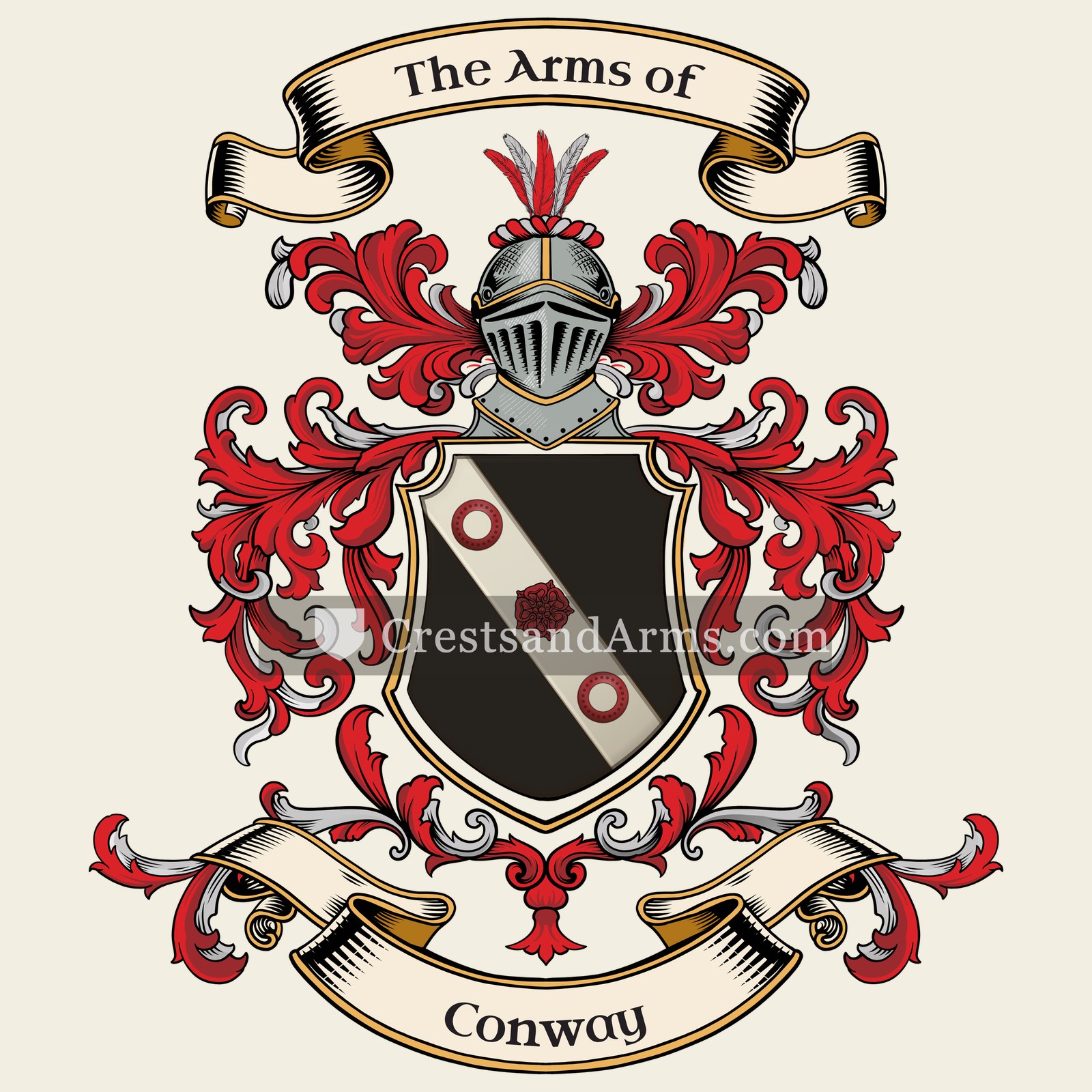
bendDefence, and the scarf of a commander
roseThe seventh son, and beauty with grace
ringFidelity, and a promise kept
Colours
Black (Sable)Means: Constancy
Silver (Argent)Means: Peace and sincerity
Red (Gules)Means: Military strength
Historical info
Source
Sir Bernard Burke, The General Armory of England, Scotland, Ireland and Wales, London: Harrison & Sons, 1884
Blazon (the actual original written record)
“Sa. on a bend cotised ar. a rose betw. two annulets gu”
BreconBrecon, c. 1647
Digital archive packCoat of arms PNG, gold border print PDF, vector SVG and the certificate of authenticity. Sent to your email in minutes.
Map of Wales showing where the Conway arms are recorded
The Conway arms were recorded in Brecon, c. 1647.
Brecon was mid-Welsh hill country, held in small estates by families who stayed for generations. Land was worth less than in the lowlands, but holding it still brought arms.
This is where the arms were entered in the register. Families often moved to other parts of the country, so the same name can turn up in more than one region.
The body that granted and recorded arms in Wales in this period.
Charles I of England
Sovereign of the period
Charles I of England
1625–1649
Reigning in Belgium when the Conway arms are first recorded.
How Arms Worked in Wales
English heraldry allowed arms to be shared by all legitimate descendants of the original owner. These symbols were treated as personal property that moved through the generations to all children. While the eldest son kept the original design, other family members could use the same shield without needing to change it or register their own unique versions.
Granting authority
The College of Arms in London has regulated the use of coats of arms throughout England and Wales since 1484.
How they got arms
Families typically obtained their coats of arms through a formal grant from the Crown or by proving their ancient right to them.
Where arms were recorded
All official coats of arms are recorded in the registers kept at the College of Arms, which date back to the fifteenth century.
The family's standing
Recorded among the armigerous families of Brecon.
Origin & History of the Conway Family in Wales
The surname Conway holds deep roots in the rugged landscape of Wales, where it evolved from a place-based name into a family identifier. The name is derived from the River Conwy in North Wales, which served as a natural landmark for those who lived along its banks. While the name originated in the north, by the mid-seventeenth century, the family had established a notable presence in the southern town of Brecon. Records from 1647 confirm that members of the Conway family were active participants in the local community during this period of significant political and social change in Wales. This migration from the northern river valleys to the southern market towns shows how the family moved across the Welsh countryside over several generations. By settling in Brecon, these early ancestors became part of the local history of the region, contributing to the growth and development of the area long before the modern era.
Conway Meaning & Related Branches
Root word
Connmhagh
Derived from Gaelic words meaning hound of the plain.
This name
ConwayAn anglicized form of an Irish surname signifying a warrior or hound from the field.
also spelled
Conwey
Conwaye
Conwayy
Conwy
Related arms
Conwyvariant spelling
Hownd, or Houndrecorded with Conway, same area
Documented Sources
J. B. Rietstap, Armorial Général, Gouda: G. B. van Goor Zonen, 1884–87
Algemeen Rijksarchief, Registers van de Raad van Brabant (1624)
Stadsarchief Leuven, Stadsrekeningen en Poorterboeken (1624)
Duerloo, Luc and Marc Vanhaelst, Collegium Trilingue Lovaniense: De Zuidelijke Nederlanden in de zeventiende eeuw (1998)
Loomis, Richard, The Irish in the Low Countries: Soldiers and Exiles (1992)
Digital archive packCoat of arms PNG, gold border print PDF, vector SVG and the certificate of authenticity. Sent to your email in minutes.


 bendDefence, and the scarf of a commander
 roseThe seventh son, and beauty with grace
 ringFidelity, and a promise kept
 bendDefence, and the scarf of a commander
 roseThe seventh son, and beauty with grace
 ringFidelity, and a promise kept