Map of England showing where the Coogan arms are recorded
The Coogan arms were recorded in Somerset, c. 1620.
Somerset was rich farming country with a thick scattering of manor houses. Its gentry were numerous and long-settled, and a settled landed family almost always ended up with arms.
This is where the arms were entered in the register. Families often moved to other parts of the country, so the same name can turn up in more than one region.
The body that granted and recorded arms in England in this period.
James VI and I
Sovereign of the period
James VI and I
1603–1625
Reigning in England when the Coogan arms are first recorded.
How Arms Worked in England
English heraldry allowed arms to be shared by all legitimate descendants of the original owner. These symbols were treated as personal property that moved through the generations to all children. While the eldest son kept the original design, other family members could use the same shield without needing to change it or register their own unique versions.
Granting authority
The College of Arms in London has regulated the use of coats of arms throughout England and Wales since 1484.
How they got arms
Families typically obtained their coats of arms through a formal grant from the Crown or by proving their ancient right to them.
Where arms were recorded
All official coats of arms are recorded in the registers kept at the College of Arms, which date back to the fifteenth century.
The family's standing
Recorded among the armigerous families of Somerset.
Origin & History of the Coogan Family in England
The Coogan family name has deep roots in the English county of Somerset, where records confirm members of the family were established by the early 17th century. While the name is often associated with Irish origins, its presence in the West Country of England suggests that families bearing this surname were well-integrated into local rural communities during the Stuart period. In Somerset, these early ancestors likely lived as tenant farmers or tradespeople, contributing to the local economy through agriculture and the wool trade that defined the region at the time. Life in this part of England during the 1620s was marked by significant social and religious change, and the Coogan family would have navigated these shifting times while maintaining their presence in the local parish records. These records serve as the primary evidence of their existence, showing how the family name became a part of the local landscape long before the modern era.
Meaning of the Coogan family crest colors & symbols
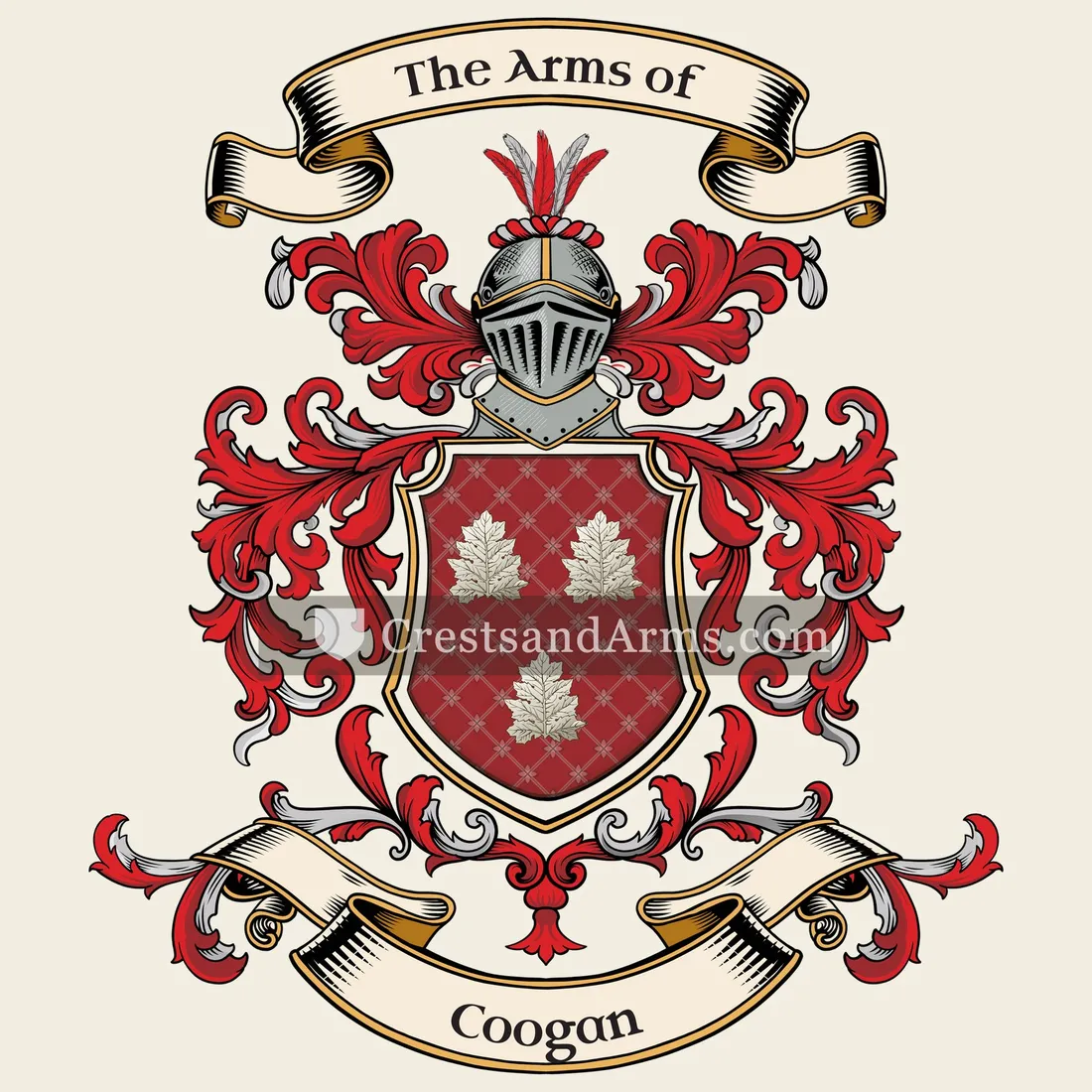
Symbols on this shield
leafHappiness and abundance
Colours
Red (Gules)Means: Military strength
Silver (Argent)Means: Peace and sincerity
Historical info
Source
Sir Bernard Burke, The General Armory of England, Scotland, Ireland and Wales, London: Harrison & Sons, 1884
Blazon (the actual original written record)
“Gu. three oak leaves ar”
Irelandc. 1645
Digital archive packCoat of arms PNG, gold border print PDF, vector SVG and the certificate of authenticity. Sent to your email in minutes.
Map of Ireland showing where the Coogan arms are recorded
The Coogan arms were recorded in Ireland, c. 1645.
Arms such as these were typically recorded in Dublin.
Dublin was the seat of government in Ireland and the place where grants were sought and recorded. Families with business at the castle or the courts settled nearby, and settling there put their arms on record.
This is where the arms were entered in the register. Families often moved to other parts of the country, so the same name can turn up in more than one region.
The body that granted and recorded arms in Ireland in this period.
Charles I of England
Sovereign of the period
Charles I of England
1625–1649
Reigning in England when the Coogan arms are first recorded.
How Arms Worked in Ireland
The Ulster King of Arms granted coats of arms to individuals who proved their social standing and good character. These symbols were typically inherited by all legitimate descendants of the original holder. If a family branch wanted a unique look, they could apply for a specific change to their design through the office to ensure their identity remained distinct.
Granting authority
The Ulster King of Arms acted as the official body that regulated and issued all coats of arms throughout Ireland.
How they got arms
Families obtained their arms through formal grants issued by the office after proving their eligibility and paying the required fees.
Where arms were recorded
All official grants were recorded in the registers held by the Ulster King of Arms starting from the year 1552.
The family's standing
Recorded among the armigerous families of Ireland.
Origin & History of the Coogan Family in Ireland
The surname Coogan is an anglicized version of the Gaelic name Ó Cuagáin, which originated in the western regions of Ireland before spreading across the country. While the family roots are deeply tied to the Irish language, by the mid-seventeenth century, members of the family had established a notable presence in the urban environment of Dublin. Records from 1645 confirm that the Coogan family was active in the capital during a time of significant political and social upheaval in Ireland. As the family integrated into the life of the city, they transitioned from their rural origins into the administrative and commercial heart of the nation. This movement reflects the broader patterns of Irish history, where families often relocated to major centers like Dublin to seek new opportunities or respond to the changing landscape of the era.
Meaning of the Coogan family crest colors & symbols
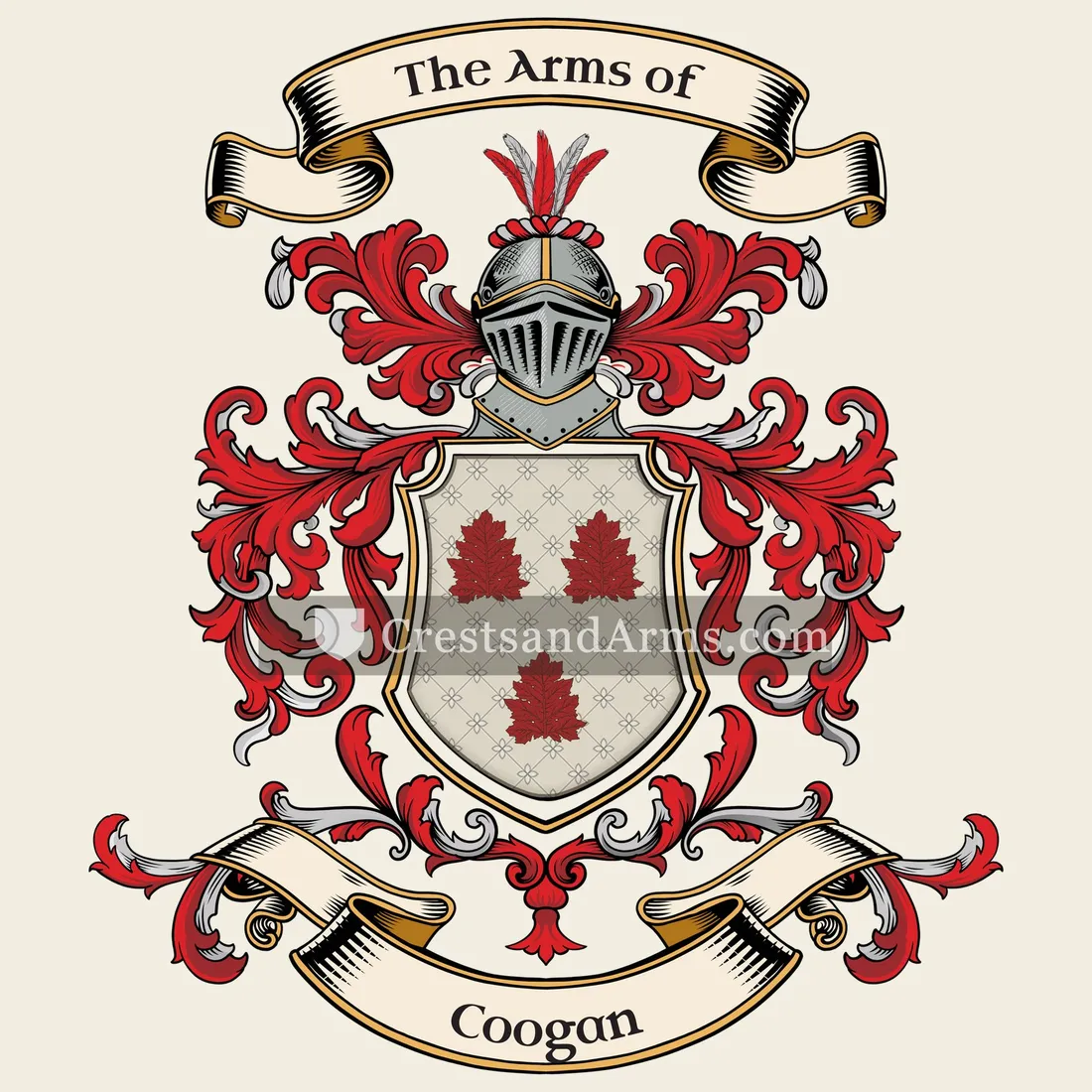
Symbols on this shield
leafHappiness and abundance
Colours
Silver (Argent)Means: Peace and sincerity
Red (Gules)Means: Military strength
Historical info
Source
Sir Bernard Burke, The General Armory of England, Scotland, Ireland and Wales, London: Harrison & Sons, 1884
Blazon (the actual original written record)
“Ar. three aspin leaves gu. (another, slipped ar.)”
Walesc. 1647
Digital archive packCoat of arms PNG, gold border print PDF, vector SVG and the certificate of authenticity. Sent to your email in minutes.
Map of Wales showing where the Coogan arms are recorded
The Coogan arms were recorded in Wales, c. 1647.
Arms such as these were typically recorded in Denbigh.
Denbighshire was north Welsh country of hills and small estates. Land was held by a great many families rather than a few, and each holding brought its own claim to a coat of arms.
This is where the arms were entered in the register. Families often moved to other parts of the country, so the same name can turn up in more than one region.
The body that granted and recorded arms in Wales in this period.
Charles I of England
Sovereign of the period
Charles I of England
1625–1649
Reigning in England when the Coogan arms are first recorded.
How Arms Worked in Wales
English heraldry allowed arms to be shared by all legitimate descendants of the original owner. These symbols were treated as personal property that moved through the generations to all children. While the eldest son kept the original design, other family members could use the same shield without needing to change it or register their own unique versions.
Granting authority
The College of Arms in London has regulated the use of coats of arms throughout England and Wales since 1484.
How they got arms
Families typically obtained their coats of arms through a formal grant from the Crown or by proving their ancient right to them.
Where arms were recorded
All official coats of arms are recorded in the registers kept at the College of Arms, which date back to the fifteenth century.
The family's standing
Recorded among the armigerous families of Wales.
Origin & History of the Coogan Family in Wales
The Coogan family name has deep roots in the historical landscape of North Wales, particularly within the county of Denbighshire. By the year 1647, records confirm that members of the family were firmly established in the town of Denbigh. During this period, Denbigh was a significant center for trade and local government, serving as a hub for families who were often involved in the agricultural or merchant life of the Vale of Clwyd. While the name itself is often associated with broader Celtic origins, its presence in Denbigh suggests that these early ancestors were integrated into the local Welsh community during a time of great political transition in Britain. Living in a town dominated by its medieval castle and stone walls, the Coogan family would have navigated the complex social structure of seventeenth-century Wales, likely contributing to the local economy and the development of the region during the post-Civil War era.
Coogan Meaning & Related Branches
Root word
Cúgan
A diminutive form of the Gaelic word for hound.
This name
CooganDerived from a nickname meaning little hound, often used as a term of endearment.
also spelled
Coggan
Kogan
Coggins
Documented Sources
Sir Bernard Burke, The General Armory of England, Scotland, Ireland and Wales, London: Harrison & Sons, 1884
Somerset Heritage Centre, Quarter Sessions Records, Q/SR
Somerset Heritage Centre, Bishop’s Transcripts of Parish Registers
TNA: The National Archives, Prerogative Court of Canterbury and Related Probate Jurisdictions: Will Registers, PROB 11
Digital archive packCoat of arms PNG, gold border print PDF, vector SVG and the certificate of authenticity. Sent to your email in minutes.


 leafHappiness and abundance
 leafHappiness and abundance