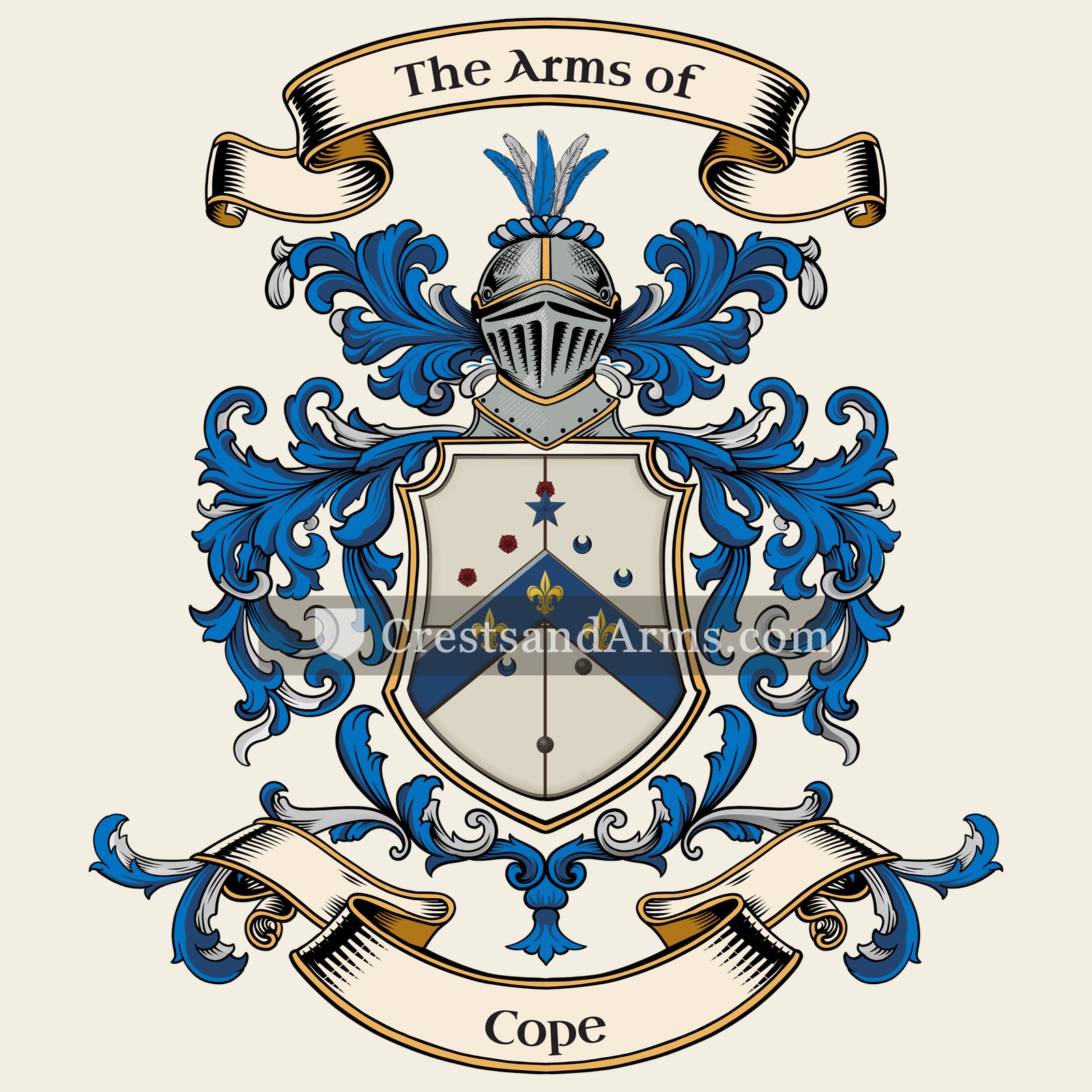
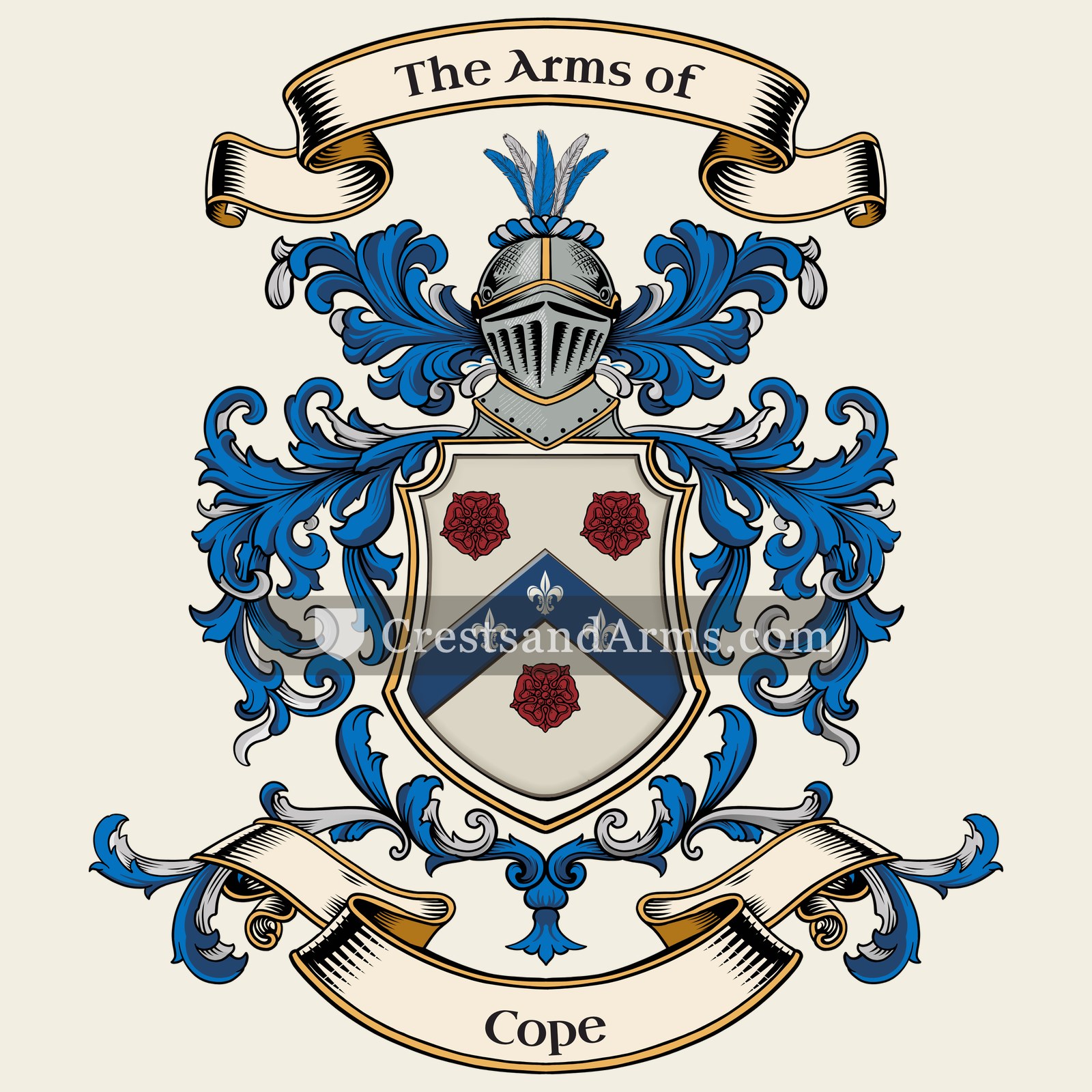
A record of documented arms, meaning and origin, researched for the Cope family lines. Documented in 2 countries.
Reg. 0848 · Irish, A–C
Coat of Arms & Family Crest Details
Symbols on this shield
chevronProtection, and faithful service completed
roseThe seventh son, and beauty with grace
fleur de lisPurity, light, and the sixth son
mulletThe third son, and a divine quality from above
crescentHonour by the sovereign, and the second son
roundelA coin, and one who has been to the crusades
Colours
Silver (Argent)Means: Peace and sincerity
Blue (Azure)Means: Loyalty and truth
Red (Gules)Means: Military strength
Gold (Or)Means: Generosity
Black (Sable)Means: Constancy
Historical info
Source
Sir Bernard Burke, The General Armory of England, Scotland, Ireland and Wales, London: Harrison & Sons, 1884
Blazon (the actual original written record)
“Quarterly, 1st and 4th, COPE, ar. on a chev. az. betw. three roses gu. stalked and leaved vert, as many fleurs-de-lis or, a mullet of the second for diff.; 2nd and 3rd, DOOLAN, ar. three crescents in pale az. betw. two pellets in fess”
ArmaghLoughgall · Armagh, c. 1844
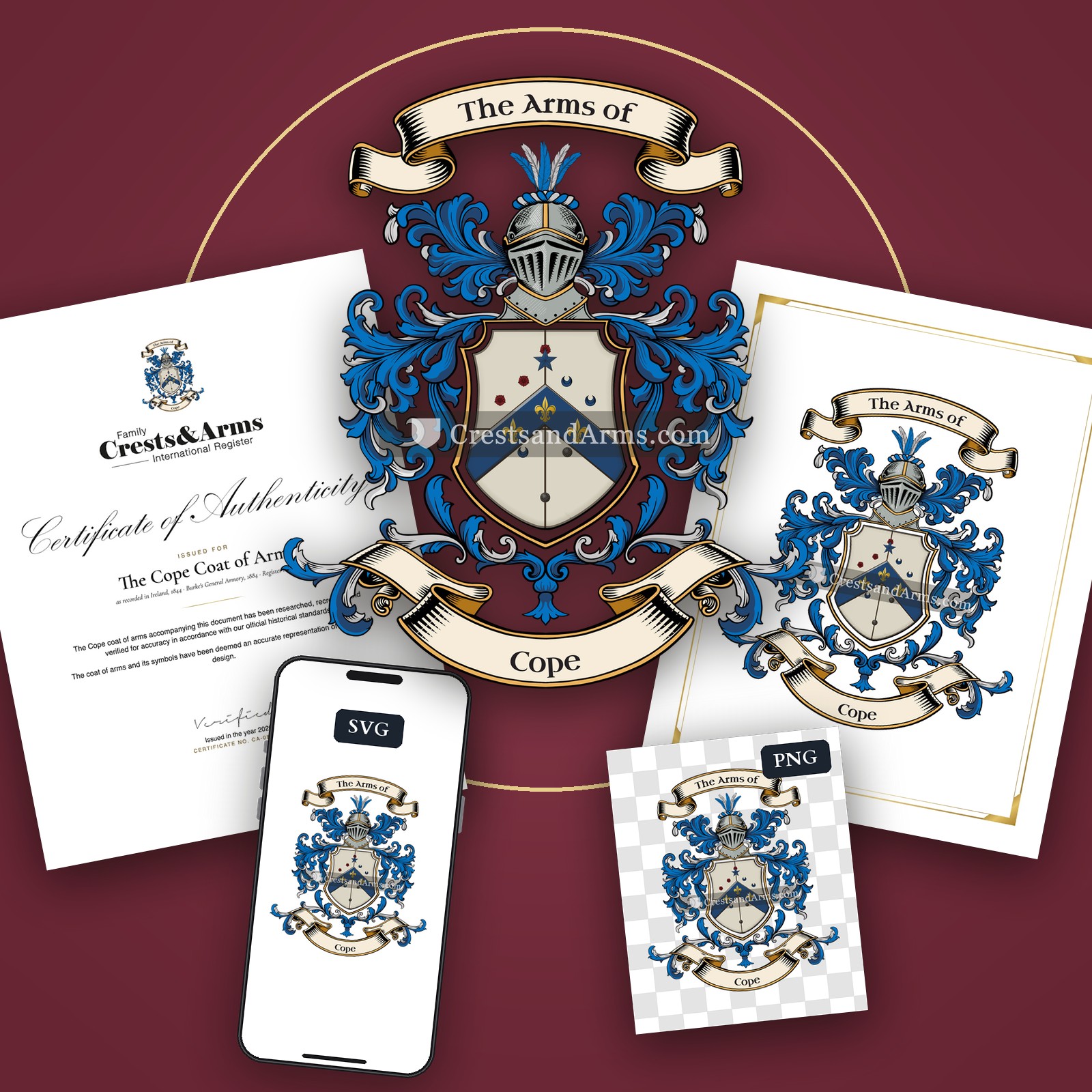
Digital archive packCoat of arms PNG, gold border print PDF, vector SVG and the certificate of authenticity. Sent to your email in minutes.
Map of Ireland showing where the Cope arms are recorded
The Cope arms were recorded in Armagh, c. 1844.
Armagh was the church capital of Ireland with good farmland around it. Church office and landholding both brought standing, and standing was marked with arms.
This is where the arms were entered in the register. Families often moved to other parts of the country, so the same name can turn up in more than one region.
The body that granted and recorded arms in Ireland in this period.
Victoria
Sovereign of the period
Victoria
1837–1901
Reigning in Ireland when the Cope arms are first recorded.
How Arms Worked in Ireland
The Ulster King of Arms granted coats of arms to individuals who proved their social standing and good character. These symbols were typically inherited by all legitimate descendants of the original holder. If a family branch wanted a unique look, they could apply for a specific change to their design through the office to ensure their identity remained distinct.
Granting authority
The Ulster King of Arms acted as the official body that regulated and issued all coats of arms throughout Ireland.
How they got arms
Families obtained their arms through formal grants issued by the office after proving their eligibility and paying the required fees.
Where arms were recorded
All official grants were recorded in the registers held by the Ulster King of Arms starting from the year 1552.
The family's standing
Recorded among the armigerous families of Armagh.
Origin & History of the Cope Family in Ireland
The surname Cope has roots that stretch back to medieval England, but its presence in Ireland is most notably tied to the plantation and settlement patterns of the seventeenth and eighteenth centuries. By the time the family was firmly established in County Armagh by 1844, they had become deeply integrated into the local social and economic fabric of the region. Many families with this name arrived in Ulster as part of the broader movement of settlers who sought new opportunities in the north of Ireland. Over the generations, these settlers transitioned from being newcomers to becoming landowners and community leaders who played a significant role in the development of Armagh. The history of the Cope family in this area reflects the broader story of how families adapted to the Irish landscape, eventually putting down permanent roots that lasted well beyond their initial arrival.
Coat of Arms & Family Crest Details
Symbols on this shield
chevronProtection, and faithful service completed
roseThe seventh son, and beauty with grace
fleur de lisPurity, light, and the sixth son
Colours
Silver (Argent)Means: Peace and sincerity
Blue (Azure)Means: Loyalty and truth
Red (Gules)Means: Military strength
Historical info
Source
Sir Bernard Burke, The General Armory of England, Scotland, Ireland and Wales, London: Harrison & Sons, 1884
Blazon (the actual original written record)
“Ar. on a chev. az. betw. three roses gu. stalked and leaved vert, as many fleurs-de-lis of the field”
MiddlesexMiddlesex, c. 1620
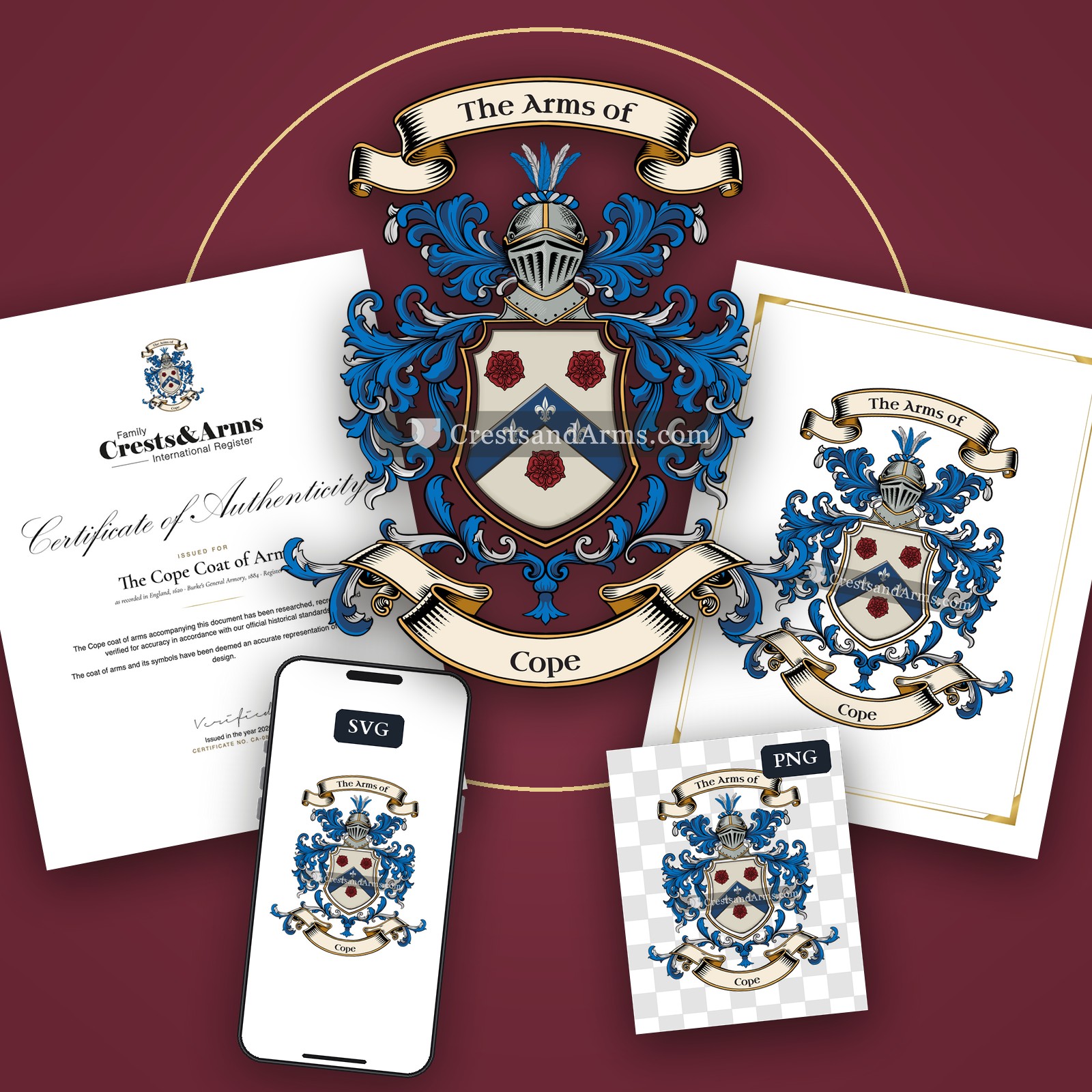
Digital archive packCoat of arms PNG, gold border print PDF, vector SVG and the certificate of authenticity. Sent to your email in minutes.
Map of England showing where the Cope arms are recorded
The Cope arms were recorded in Middlesex, c. 1620.
Middlesex was the county around London, and City money flowed straight into it. Merchants and officials bought estates within reach of the capital, and a new estate brought a coat of arms with it.
This is where the arms were entered in the register. Families often moved to other parts of the country, so the same name can turn up in more than one region.
The body that granted and recorded arms in England in this period.
James VI and I
Sovereign of the period
James VI and I
1603–1625
Reigning in Ireland when the Cope arms are first recorded.
How Arms Worked in England
English heraldry allowed arms to be shared by all legitimate descendants of the original owner. These symbols were treated as personal property that moved through the generations to all children. While the eldest son kept the original design, other family members could use the same shield without needing to change it or register their own unique versions.
Granting authority
The College of Arms in London has regulated the use of coats of arms throughout England and Wales since 1484.
How they got arms
Families typically obtained their coats of arms through a formal grant from the Crown or by proving their ancient right to them.
Where arms were recorded
All official coats of arms are recorded in the registers kept at the College of Arms, which date back to the fifteenth century.
The family's standing
Recorded among the armigerous families of Middlesex.
Origin & History of the Cope Family in England
The family name Cope has deep roots in English history, emerging as a locational surname that likely identified individuals who lived near a specific hill or mountain. By the early seventeenth century, the family had established a notable presence in the county of Middlesex, which served as a central hub for trade and government near London. During this period, members of the family were often involved in the shifting social landscape of England as the country transitioned toward a more global influence. Records from 1620 confirm that the Copes were already well-integrated into the local community, participating in the daily life and legal structures of the region. This early residency in Middlesex suggests that the family was part of the growing middle class that helped shape the development of the English capital during the reign of King James I.
Cope Meaning & Related Branches
Root word
Cappa
A Latin term referring to a hooded cloak or cape.
This name
CopeAn occupational name for a maker or seller of capes and cloaks.
also spelled
Coap
Coape
Related arms
Coapesame arms
Brownerecorded with Cope, same area
Daviesrecorded with Cope, same area
Harringtonrecorded with Cope, same area
Documented Sources
Sir Bernard Burke, The General Armory of England, Scotland, Ireland and Wales, London: Harrison & Sons, 1884
Bell, Robert, The Book of Ulster Surnames, 1988
MacLysaght, Edward, The Surnames of Ireland, 1985
Public Record Office of Northern Ireland, D1606: Records of the Cope Family of Loughgall, County Armagh
Digital archive packCoat of arms PNG, gold border print PDF, vector SVG and the certificate of authenticity. Sent to your email in minutes.


 chevronProtection, and faithful service completed
 roseThe seventh son, and beauty with grace
 fleur de lisPurity, light, and the sixth son
 mulletThe third son, and a divine quality from above
 crescentHonour by the sovereign, and the second son
 roundelA coin, and one who has been to the crusades