Map of England showing where the Copeland arms are recorded
The Copeland arms were recorded in Cumberland, c. 1620.
Cumberland was rough border country in the north-west, facing Scotland across a disputed line. Its families held land in return for keeping it defended, and men who fought carried shields of their own.
This is where the arms were entered in the register. Families often moved to other parts of the country, so the same name can turn up in more than one region.
The body that granted and recorded arms in England in this period.
James VI and I
Sovereign of the period
James VI and I
1603–1625
Reigning in England when the Copeland arms are first recorded.
How Arms Worked in England
English heraldry allowed arms to be shared by all legitimate descendants of the original owner. These symbols were treated as personal property that moved through the generations to all children. While the eldest son kept the original design, other family members could use the same shield without needing to change it or register their own unique versions.
Granting authority
The College of Arms in London has regulated the use of coats of arms throughout England and Wales since 1484.
How they got arms
Families typically obtained their coats of arms through a formal grant from the Crown or by proving their ancient right to them.
Where arms were recorded
All official coats of arms are recorded in the registers kept at the College of Arms, which date back to the fifteenth century.
The family's standing
Recorded among the armigerous families of Cumberland.
Origin & History of the Copeland Family in England
The surname Copeland originates from the historic county of Cumberland in Northwest England. The name is locative, meaning it was derived from a specific place rather than a trade or a personal characteristic. It is believed to come from the Old Norse word kaup, which means a purchase or a market, and the Old English word land. This suggests that the earliest families bearing this name were likely associated with a market town or a piece of land used for trade. By the early 17th century, the family was firmly established in the rugged landscape of Cumberland. During this period, the region was defined by its proximity to the Scottish border and its unique cultural blend of English and Norse influences. The families living there were often involved in local agriculture and the management of rural estates, which helped the name spread throughout the northern counties as the population grew and moved for work.
Coat of Arms & Family Crest Details
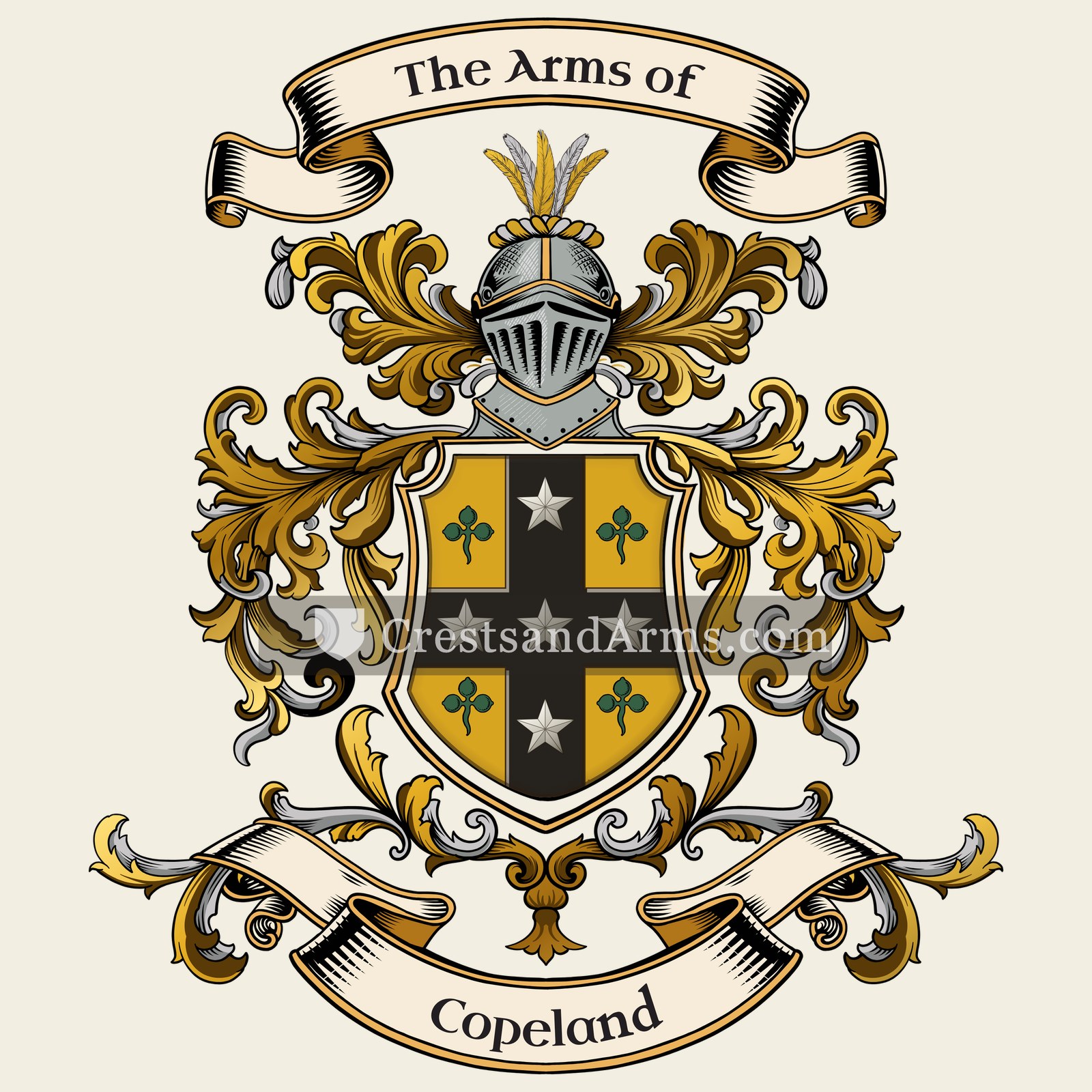
Symbols on this shield
cross symbolChristian faith and service
trefoilPerpetuity, and the Trinity
mulletThe third son, and a divine quality from above
Colours
Gold (Or)Means: Generosity
Black (Sable)Means: Constancy
Green (Vert)Means: Hope
Silver (Argent)Means: Peace and sincerity
Historical info
Source
Sir Bernard Burke, The General Armory of England, Scotland, Ireland and Wales, London: Harrison & Sons, 1884
Blazon (the actual original written record)
“Or, on a cross sa. betw. four trefoils slipped vert, five mullets ar”
MeathMeath, c. 1744
Digital archive packCoat of arms PNG, gold border print PDF, vector SVG and the certificate of authenticity. Sent to your email in minutes.
Map of Ireland showing where the Copeland arms are recorded
The Copeland arms were recorded in Meath, c. 1744.
Meath was the best farmland in Ireland and the old seat of its high kings. Norman families took it early and held it, and land of that quality kept the same families on it for centuries.
This is where the arms were entered in the register. Families often moved to other parts of the country, so the same name can turn up in more than one region.
The body that granted and recorded arms in Ireland in this period.
George II of Great Britain
Sovereign of the period
George II of Great Britain
1727–1760
Reigning in England when the Copeland arms are first recorded.
How Arms Worked in Ireland
The Ulster King of Arms granted coats of arms to individuals who proved their social standing and good character. These symbols were typically inherited by all legitimate descendants of the original holder. If a family branch wanted a unique look, they could apply for a specific change to their design through the office to ensure their identity remained distinct.
Granting authority
The Ulster King of Arms acted as the official body that regulated and issued all coats of arms throughout Ireland.
How they got arms
Families obtained their arms through formal grants issued by the office after proving their eligibility and paying the required fees.
Where arms were recorded
All official grants were recorded in the registers held by the Ulster King of Arms starting from the year 1552.
The family's standing
Recorded among the armigerous families of Meath.
Origin & History of the Copeland Family in Ireland
The Copeland family name has deep roots in the British Isles, with its origins typically traced back to the Old Norse word for a merchant or a buyer. By the time the family established a presence in County Meath in 1744, they were part of a long tradition of families moving across the Irish Sea. During the eighteenth century, Meath was a region defined by agricultural development and shifting land ownership, which likely influenced the family’s decision to settle there. Families with this name often integrated into the local community through farming, trade, and regional administration. As they settled into the landscape of eastern Ireland, the Copelands became part of the broader social fabric of the province of Leinster, contributing to the local economy and the evolving history of the region during a period of significant demographic change.
Copeland Meaning & Related Branches
Root word
kaup-land
Old Norse for a purchased piece of land or trade land.
This name
CopelandRefers to a person who lived on or owned a piece of purchased land.
also spelled
Copland
Coupland
Related arms
Coplandsame arms
Couplandvariant spelling
Documented Sources
Sir Bernard Burke, The General Armory of England, Scotland, Ireland and Wales, London: Harrison & Sons, 1884
Ekwall, Eilert. The Concise Oxford Dictionary of English Place-Names. 1960
Reaney, P.H. A Dictionary of British Surnames. 1958
Cumbria Archive Service, Kendal Archive Centre, Records of the Parish of Cumberland, 1620
Digital archive packCoat of arms PNG, gold border print PDF, vector SVG and the certificate of authenticity. Sent to your email in minutes.


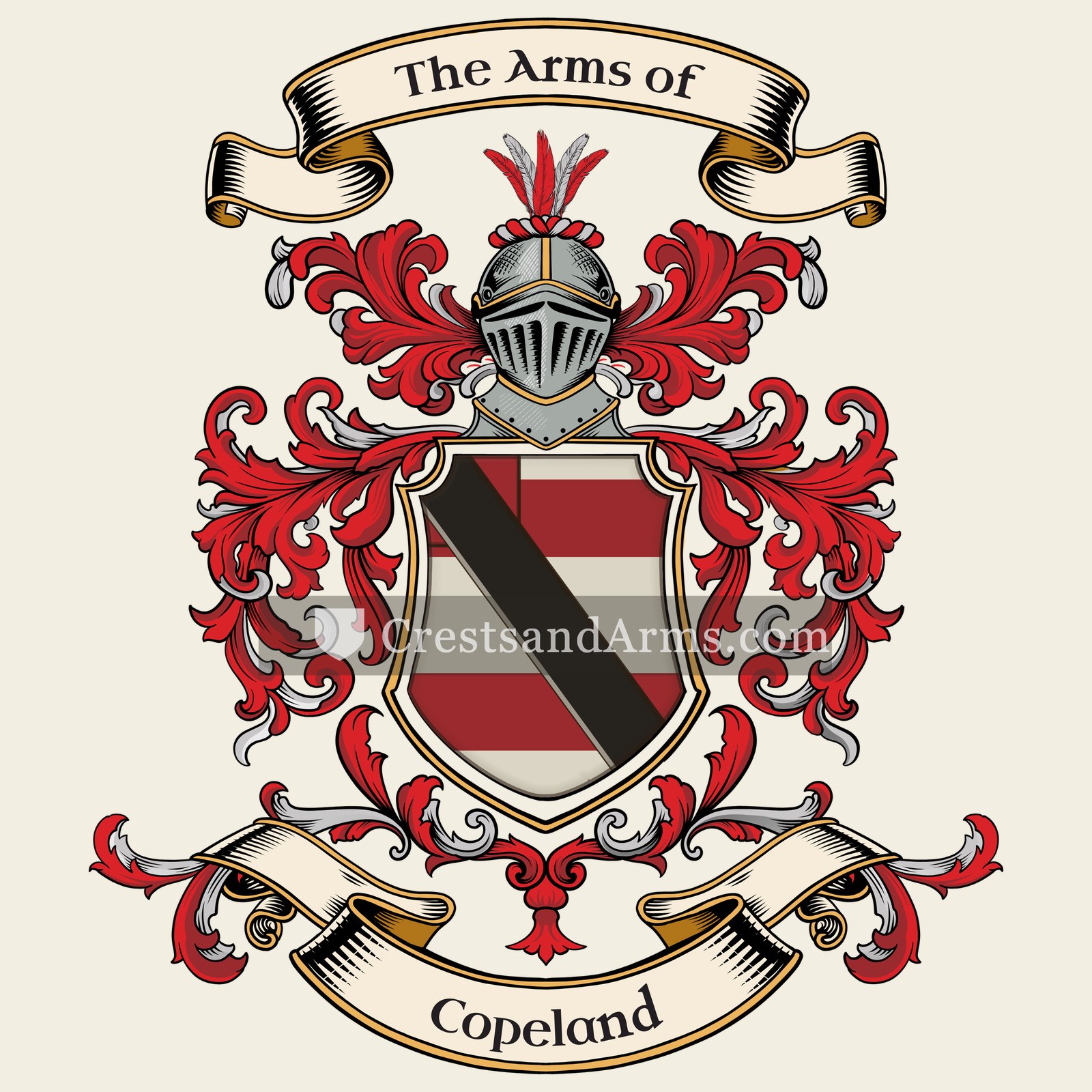
 bendDefence, and the scarf of a commander
 cantonA mark of honour granted by the sovereign
 bendDefence, and the scarf of a commander
 cantonA mark of honour granted by the sovereign


 cross symbolChristian faith and service
 trefoilPerpetuity, and the Trinity
 mulletThe third son, and a divine quality from above