Map of Netherlands showing where the Copp arms are recorded
The Copp arms were recorded in Amsterdam, c. 1815.
This is where the arms were entered in the register. Families often moved to other parts of the country, so the same name can turn up in more than one region.
Region
Amsterdam
Town
Amsterdam
First recorded
1815
Granting Authority for the Copp Arms
Hoge Raad van Adel
Photograph made by me · CC BY-SA 3.0
The body that granted and recorded arms in Netherlands in this period.
William I of the Netherlands
Sovereign of the period
William I of the Netherlands
1815–1840
Reigning in Netherlands when the Copp arms are first recorded.
How Arms Worked in Netherlands
In the Netherlands, coats of arms were often used by noble families and those who held specific public offices. These arms were passed down through the generations to legitimate descendants. Younger branches of a family usually kept the original design without needing to add special marks. This system ensured that the family identity remained clear and consistent over many years.
Granting authority
The Hoge Raad van Adel is the official body that regulates and manages noble titles and coats of arms in the Netherlands.
How they got arms
Families typically obtained their coats of arms through official royal grants or by proving their long-standing historical use of the symbols.
Where arms were recorded
Coats of arms are officially recorded in the registers held by the Hoge Raad van Adel, which began its work in 1814.
The family's standing
Recorded among the armigerous families of Netherlands.
Origin & History of the Copp Family in Netherlands
The history of the Copp family in the Netherlands is deeply connected to the urban development of Amsterdam during the early nineteenth century. By 1815, members of the family were established residents of the city, a time when Amsterdam was transitioning from the Napoleonic era into the newly formed Kingdom of the Netherlands. The name itself likely originated as a descriptive term or a shortened form of a longer occupational title, reflecting the practical nature of naming conventions common in Dutch trade centers. As the city served as a major hub for commerce and shipping, families like the Copps often integrated into the local economy through skilled labor or mercantile activities. Their presence in the city records during this period highlights a transition toward formalized civil registration, which became mandatory under the influence of French administrative reforms. This era marked a shift where family identities became permanently anchored in official municipal archives, allowing us to trace their residence and social standing within the bustling streets of Amsterdam.
Meaning of the Copp family crest colors & symbols
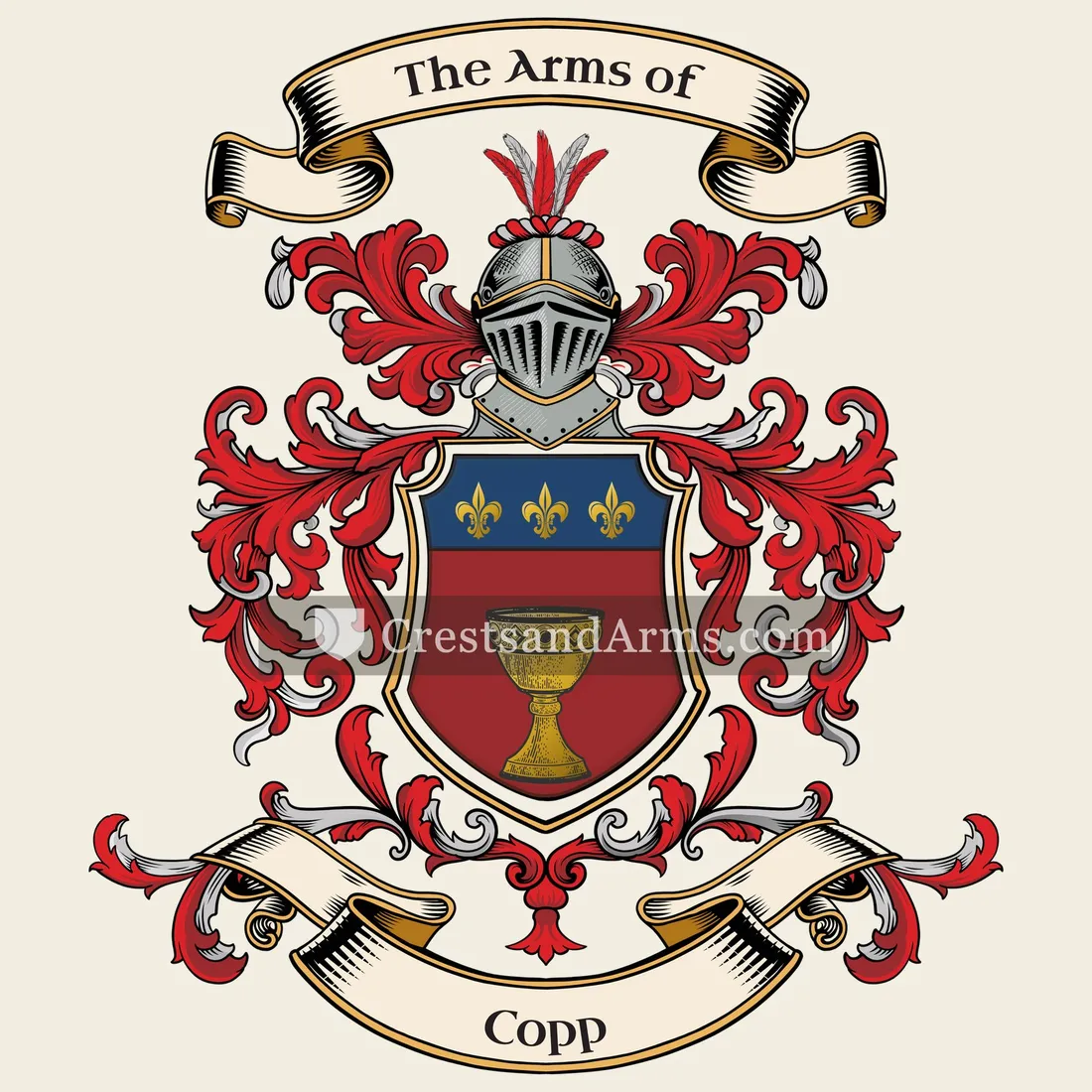
Symbols on this shield
chiefAuthority, wisdom and dominion
cupFaith, office, and a trust discharged
fleur de lisPurity, light, and the sixth son
Colours
Red (Gules)Means: Military strength
Blue (Azure)Means: Loyalty and truth
Gold (Or)Means: Generosity
Historical info
Source
J. B. Rietstap, Armorial Général, Gouda: G. B. van Goor Zonen, 1884–87
Blazon (the actual original written record)
“De gu. à une coupe d'or; au chef d'azur, ch. de trois fleurs-de-lis du sec.”
SwitzerlandGenève, c. 1745
Digital archive packCoat of arms PNG, gold border print PDF, vector SVG and the certificate of authenticity. Sent to your email in minutes.
Map of Switzerland showing where the Copp arms are recorded
The Copp arms were recorded in Genève, c. 1745.
This is where the arms were entered in the register. Families often moved to other parts of the country, so the same name can turn up in more than one region.
The body that granted and recorded arms in Switzerland in this period.
How Arms Worked in Switzerland
In Switzerland, coats of arms were not restricted to the nobility and were often adopted by common citizens and families. These symbols were passed down through generations to show family identity. When branches of a family grew, they often changed small details of the design to distinguish their own line from the original group.
Granting authority
Cantonal and civic authorities managed the use of coats of arms within their specific regions and local jurisdictions.
How they got arms
Families typically assumed their own coats of arms based on local custom rather than receiving them from a central monarch.
Where arms were recorded
Arms were recorded in various cantonal and civic registers starting from the fourteenth century throughout the Swiss region.
The family's standing
Recorded among the armigerous families of Switzerland.
Origin & History of the Copp Family in Switzerland
The family name Copp has deep roots in the city of Genève, where records confirm members of the family were established by 1745. During this period, Genève was a prominent center for trade and intellectual exchange, attracting families who often worked as skilled artisans or merchants. The name likely originated as a descriptive term for a person’s physical appearance or a specific trade, as was common practice in the region during the eighteenth century. Families like the Copps were part of the growing urban population that helped shape the social and economic life of the city. By settling in this influential hub, the family became integrated into the local community, contributing to the professional landscape of the Republic of Genève as it transitioned through a time of significant political and cultural change.
Copp Meaning & Related Branches
Root word
Jacobus
Derived from the Hebrew name Yaakov meaning supplanter or holder of heel.
This name
CoppA patronymic surname originating as a diminutive form of the name Jacob.
also spelled
Kop
Copp
Documented Sources
J. B. Rietstap, Armorial Général, Gouda: G. B. van Goor Zonen, 1884–87
Stadsarchief Amsterdam, Burgerlijke Stand (Civil Registry), 1811–1815
Nationaal Archief, Bevolkingsregisters van Amsterdam (Population Registers)
Fokkens, A., De burgerlijke stand in Nederland, 1995
Israel, J. I., The Dutch Republic: Its Rise, Greatness, and Fall 1477–1806, 1995
Van der Meer, G., Naamgeving in Nederland: Een geschiedenis van achternamen, 2002
Digital archive packCoat of arms PNG, gold border print PDF, vector SVG and the certificate of authenticity. Sent to your email in minutes.


 cupFaith, office, and a trust discharged
 starThe celestial goddess, and nobility
 cupFaith, office, and a trust discharged
 starThe celestial goddess, and nobility



 chiefAuthority, wisdom and dominion
 fleur de lisPurity, light, and the sixth son