Map of Belgium showing where the Coppe arms are recorded
The Coppe arms were recorded in Belgium, c. 1737.
Arms such as these were typically recorded in Brabant.
Brabant lay at the heart of the Low Countries, where the trade routes met. Its towns were wealthy and its landowners many, and both kinds of family kept arms, which is why the region is so heavily represented.
This is where the arms were entered in the register. Families often moved to other parts of the country, so the same name can turn up in more than one region.
The body that granted and recorded arms in Belgium in this period.
Charles VI, Holy Roman Emperor
Sovereign of the period
Charles VI, Holy Roman Emperor
1711–1740
Reigning in Belgium when the Coppe arms are first recorded.
How Arms Worked in Belgium
In Belgium, a coat of arms is considered personal property that is passed down through the male line to legitimate descendants. Families often use the same shield design across generations to show their shared heritage. If a branch of the family wants to change the design, they must apply for an official update to their specific version of the arms.
Granting authority
The Conseil héraldique is the official body that regulates and approves all coats of arms in Belgium.
How they got arms
Families obtain their coats of arms through formal royal grants or by confirming their historical right to use existing designs.
Where arms were recorded
All approved coats of arms are officially recorded in the public registers of the Conseil héraldique since 1844.
The family's standing
Recorded among the armigerous families of Belgium.
Origin & History of the Coppe Family in Belgium
The family name Coppe has deep roots in the historical region of Brabant, where records confirm members of the family were living as early as 1737. The name likely originated as a nickname or a shortened version of a longer given name, as was common practice in the Low Countries during the Middle Ages. In the local dialects of that era, the term could refer to someone with a distinct physical feature or perhaps someone who held a specific role in village life. As the family established themselves in Brabant, they became part of the local agricultural and trade communities that defined the region. Over time, the name was passed down through generations, reflecting the family's long-standing presence in the area and their integration into the social fabric of the historic Duchy of Brabant.
Coppe Meaning & Related Branches
Root word
Jacobus
Derived from the Hebrew name Yaakov meaning supplanter or holder of heel.
This name
CoppeA diminutive form of Jacques, functioning as a patronymic surname indicating descent from Jacob.
also spelled
Cop
Copp
Related arms
Copvariant spelling
Köppevariant spelling
Documented Sources
J. B. Rietstap, Armorial Général, Gouda: G. B. van Goor Zonen, 1884–87
State Archives in Belgium (Rijksarchief in België), Parochieregisters van Brabant
State Archives in Belgium (Rijksarchief in België), Burgerlijke Stand van de provincie Brabant
Debrabandere, Frans, Woordenboek van de familienamen in België en Noord-Frankrijk, 2003
Leys, O., De familienamen in de Brabantse steden, 1974
Digital archive packCoat of arms PNG, gold border print PDF, vector SVG and the certificate of authenticity. Sent to your email in minutes.


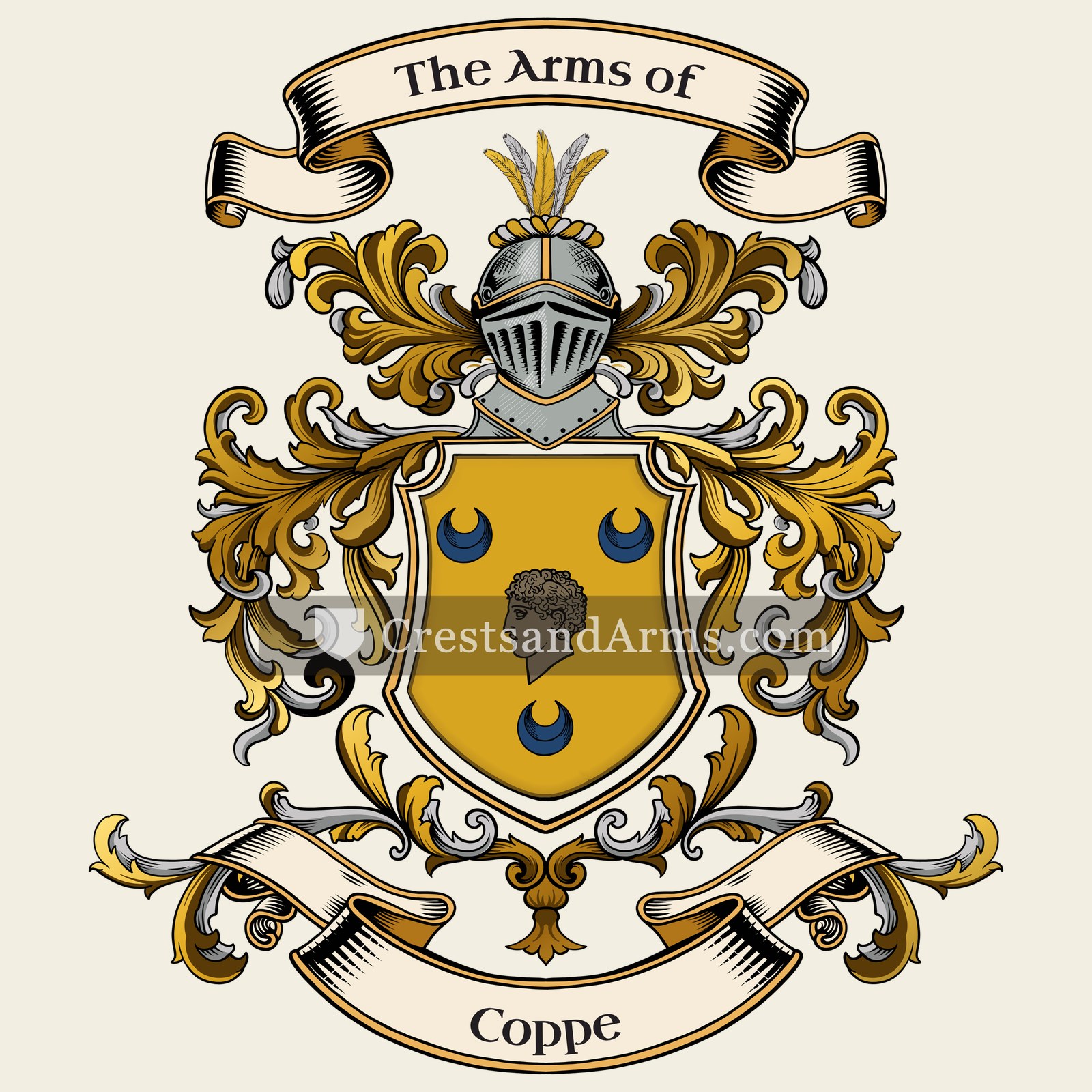
 savages head affrontyAn enemy overcome
 crescentHonour by the sovereign, and the second son
 savages head affrontyAn enemy overcome
 crescentHonour by the sovereign, and the second son