Map of England showing where the Corbitt arms are recorded
The Corbitt arms were recorded in Worcester, c. 1288.
Worcestershire was orchard and farming country with a scattering of old manors. Its gentry were middling rather than great, but a manor was a manor, and holding one was what brought arms.
This is where the arms were entered in the register. Families often moved to other parts of the country, so the same name can turn up in more than one region.
The body that granted and recorded arms in England in this period.
Edward I of England
Sovereign of the period
Edward I of England
1272–1307
Reigning in England when the Corbitt arms are first recorded.
How Arms Worked in England
English heraldry allowed arms to be shared by all legitimate descendants of the original owner. These symbols were treated as personal property that moved through the generations to all children. While the eldest son kept the original design, other family members could use the same shield without needing to change it or register their own unique versions.
Granting authority
The College of Arms in London has regulated the use of coats of arms throughout England and Wales since 1484.
How they got arms
Families typically obtained their coats of arms through a formal grant from the Crown or by proving their ancient right to them.
Where arms were recorded
All official coats of arms are recorded in the registers kept at the College of Arms, which date back to the fifteenth century.
The family's standing
Recorded among the armigerous families of Worcester.
Origin & History of the Corbitt Family in England
The surname Corbitt traces its roots back to medieval England, where it emerged as a descriptive name rooted in the Old French word corbet, meaning a raven. This nickname was likely bestowed upon an individual who possessed dark hair or a sharp, clever personality reminiscent of the bird. By the late thirteenth century, the family had established a notable presence in the city of Worcester. Records from 1288 confirm that members of the Corbitt family were active participants in the local community during this period. As the name spread across the English countryside, it evolved through various spellings in legal and tax documents, reflecting the way scribes recorded the name based on local dialects. These early generations were typically tied to the land and local trade, helping to weave the Corbitt name into the fabric of English social history long before the rise of modern record-keeping.
Meaning of the Corbitt family crest colors & symbols
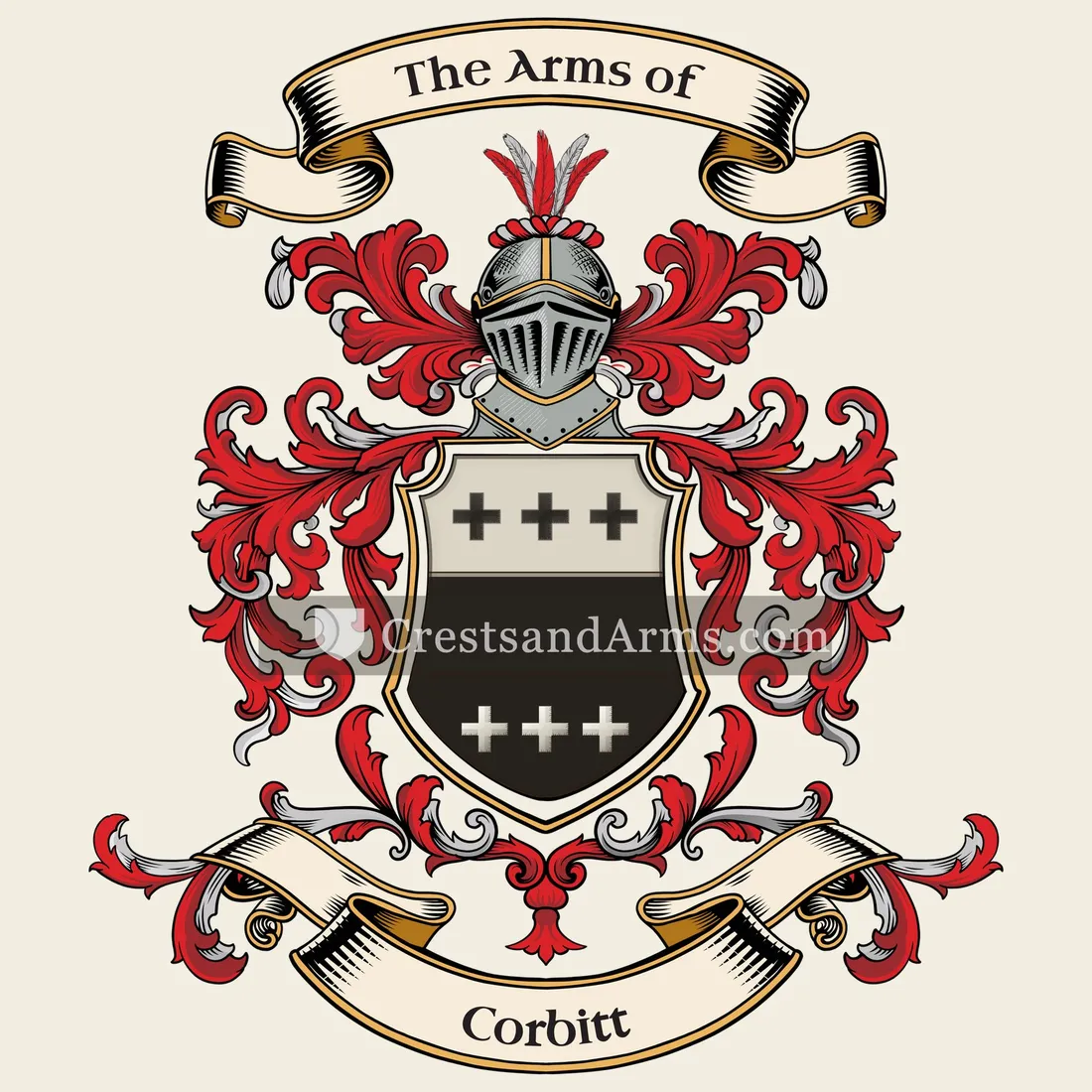
Symbols on this shield
fessThe military belt, and readiness to serve
cross symbolChristian faith and service
Colours
Silver (Argent)Means: Peace and sincerity
Black (Sable)Means: Constancy
Historical info
Source
Sir Bernard Burke, The General Armory of England, Scotland, Ireland and Wales, London: Harrison & Sons, 1884
Blazon (the actual original written record)
“Per fesse ar. and sa. a fesse betw. six crosses crosslet counterchanged”
Netherlandsc. 1815
Digital archive packCoat of arms PNG, gold border print PDF, vector SVG and the certificate of authenticity. Sent to your email in minutes.
Map of Netherlands showing where the Corbitt arms are recorded
The Corbitt arms were recorded in Netherlands, c. 1815.
Arms such as these were typically recorded in Friesland.
Friesland was low, wet country on the northern coast of the Netherlands, farmed by families who had held the same land for centuries. Free landholders were unusually common there, and a free landholder could carry arms.
This is where the arms were entered in the register. Families often moved to other parts of the country, so the same name can turn up in more than one region.
Region
Friesland
First recorded
1815
Granting Authority for the Corbitt Arms
Hoge Raad van Adel
Photograph made by me · CC BY-SA 3.0
The body that granted and recorded arms in Netherlands in this period.
William I of the Netherlands
Sovereign of the period
William I of the Netherlands
1815–1840
Reigning in England when the Corbitt arms are first recorded.
How Arms Worked in Netherlands
In the Netherlands, coats of arms were often used by noble families and those who held specific public offices. These arms were passed down through the generations to legitimate descendants. Younger branches of a family usually kept the original design without needing to add special marks. This system ensured that the family identity remained clear and consistent over many years.
Granting authority
The Hoge Raad van Adel is the official body that regulates and manages noble titles and coats of arms in the Netherlands.
How they got arms
Families typically obtained their coats of arms through official royal grants or by proving their long-standing historical use of the symbols.
Where arms were recorded
Coats of arms are officially recorded in the registers held by the Hoge Raad van Adel, which began its work in 1814.
The family's standing
Recorded among the armigerous families of Netherlands.
Origin & History of the Corbitt Family in Netherlands
The family name Corbitt has deep roots in the northern region of the Netherlands known as Friesland. By the early nineteenth century, members of the family were firmly established in this area, which was defined by its unique language and strong sense of regional independence. During this period, the Netherlands underwent significant political changes as it transitioned from Napoleonic rule to the formation of the United Kingdom of the Netherlands in 1815. Families like the Corbitts were often involved in the agricultural and maritime trades that sustained the Frisian economy. Because Friesland was historically isolated from the rest of the country by water and culture, the family likely maintained a close-knit community structure. The presence of the name in official records from 1815 suggests that the family was part of the growing administrative efforts to track citizens through standardized civil registration. This era marked a time when families began to solidify their identities within the modern Dutch state while preserving their local Frisian heritage.
Corbitt Meaning & Related Branches
Root word
corbeau
Old French word for a raven or crow.
This name
CorbittA nickname for a person with dark hair or a dark complexion.
also spelled
Corbatt
Documented Sources
Sir Bernard Burke, The General Armory of England, Scotland, Ireland and Wales, London: Harrison & Sons, 1884
Reaney, P.H. and Wilson, R.M., A Dictionary of English Surnames, 1997
Worcestershire Archive and Archaeology Service, Court Rolls of the Manor of Worcester, 1288
Digital archive packCoat of arms PNG, gold border print PDF, vector SVG and the certificate of authenticity. Sent to your email in minutes.


 bordureA difference between branches of one family
 ravenConstancy and divine providence
 bordureA difference between branches of one family
 ravenConstancy and divine providence
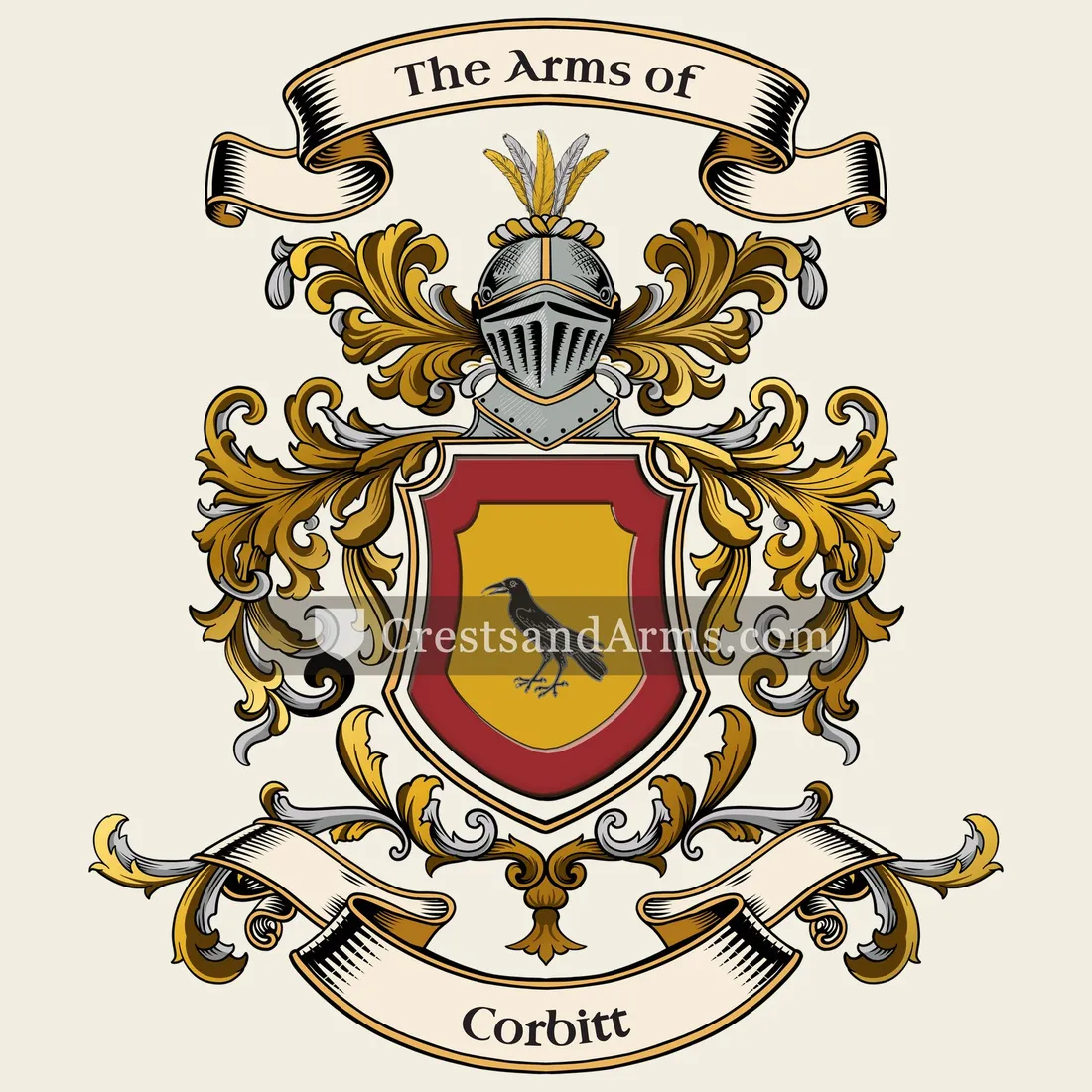


 fessThe military belt, and readiness to serve
 cross symbolChristian faith and service