Map of France showing where the Cordier arms are recorded
The Cordier arms were recorded in Lorraine, c. 1634.
Lorraine sat on the border between France and the German lands, and border country bred soldiers. Families here held small estates and served in arms, and a fighting man was exactly the sort who carried a shield of his own.
This is where the arms were entered in the register. Families often moved to other parts of the country, so the same name can turn up in more than one region.
The body that granted and recorded arms in France in this period.
Louis XIII of France
Sovereign of the period
Louis XIII of France
1617–1643
Reigning in France when the Cordier arms are first recorded.
How Arms Worked in France
In France, a coat of arms was a mark of honor that passed down through the male line to all legitimate descendants. Families often used the same shield without changes to show their shared heritage. If a branch wanted to stand out, they could add a small mark to their shield to show their specific place in the family tree.
Granting authority
The Juge d'armes de France acted as the official authority that regulated and verified coats of arms across the country.
How they got arms
Families typically inherited their arms from ancestors, though they could also receive them through royal grants or by proving their noble status.
Where arms were recorded
Coats of arms were officially recorded in the Armorial Général de France, which began its main collection in the year 1696.
The family's standing
Recorded among the armigerous families of Lorraine.
Origin & History of the Cordier Family in France
The surname Cordier originated in France as a descriptive occupational name for a rope maker. During the Middle Ages, people often adopted surnames based on the craft they practiced to support their families and identify themselves within their local villages. By the early 17th century, the name was firmly established in the Lorraine region, a territory known for its complex history and its position between French and Germanic cultures. Records confirm that members of the Cordier family were living in this area by 1634, a time when the region faced significant upheaval due to the Thirty Years War. As the family grew, they integrated into the local economy and social structure of the province, contributing to the agricultural and artisanal life that defined the Lorraine landscape for generations.
Coat of Arms & Family Crest Details
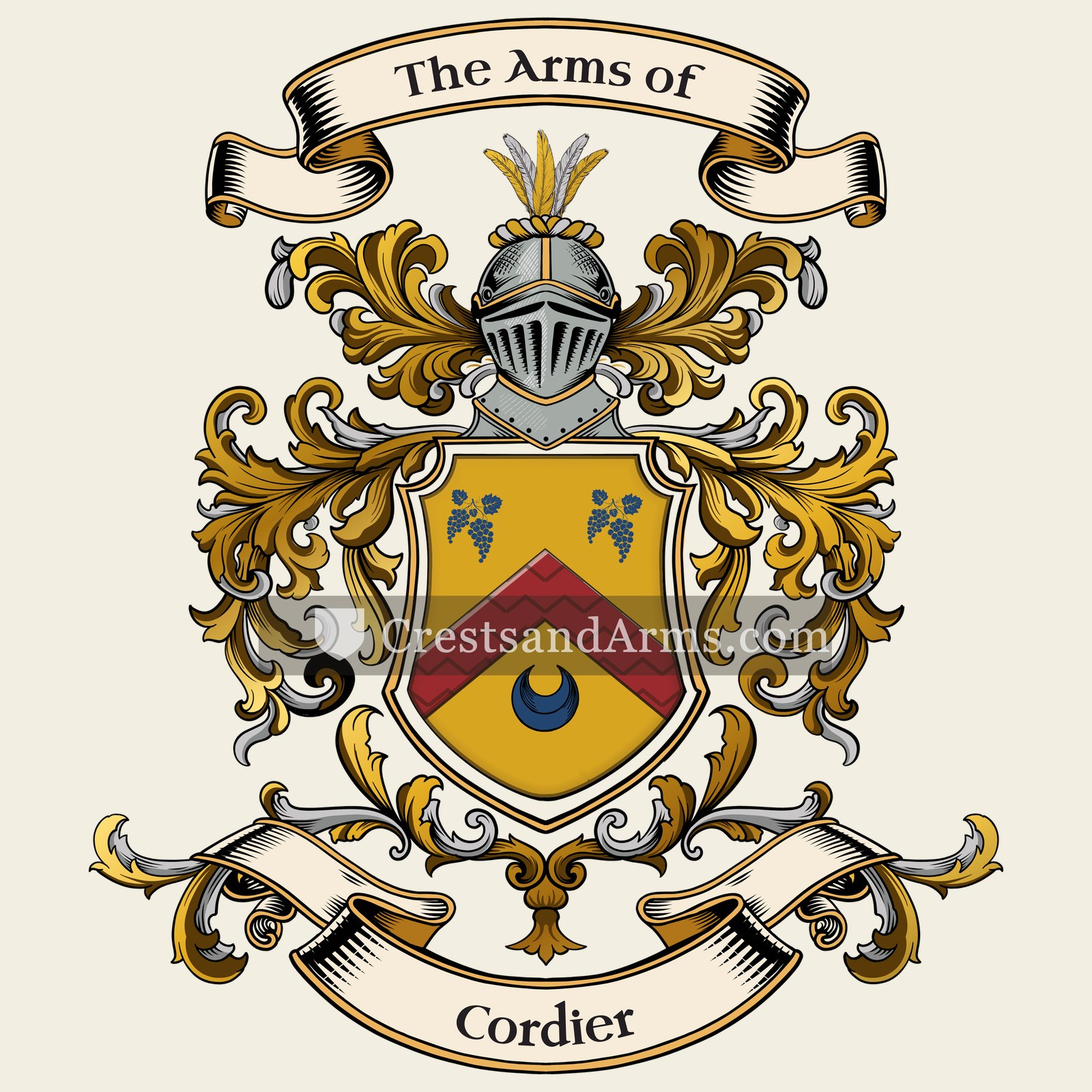
Symbols on this shield
chevronProtection, and faithful service completed
grapesPlenty, and the labour of the vine
crescentHonour by the sovereign, and the second son
Colours
Gold (Or)Means: Generosity
Red (Gules)Means: Military strength
Blue (Azure)Means: Loyalty and truth
Historical info
Source
J. B. Rietstap, Armorial Général, Gouda: G. B. van Goor Zonen, 1884–87
Blazon (the actual original written record)
“D'or au chev. de gu., acc. en chef de deux grappes de raisins d'azur, tigées et feuillées de sin., et en p. d'un croiss. d'azur.”
HainautHainaut, c. 1737
Digital archive packCoat of arms PNG, gold border print PDF, vector SVG and the certificate of authenticity. Sent to your email in minutes.
Map of Belgium showing where the Cordier arms are recorded
The Cordier arms were recorded in Hainaut, c. 1737.
Hainaut sat on the border between France and the Low Countries and was fought over for centuries. Families there held their land under arms and expected to defend it, so a shield was a working thing.
This is where the arms were entered in the register. Families often moved to other parts of the country, so the same name can turn up in more than one region.
The body that granted and recorded arms in Belgium in this period.
Charles VI, Holy Roman Emperor
Sovereign of the period
Charles VI, Holy Roman Emperor
1711–1740
Reigning in France when the Cordier arms are first recorded.
How Arms Worked in Belgium
In Belgium, a coat of arms is considered personal property that is passed down through the male line to legitimate descendants. Families often use the same shield design across generations to show their shared heritage. If a branch of the family wants to change the design, they must apply for an official update to their specific version of the arms.
Granting authority
The Conseil héraldique is the official body that regulates and approves all coats of arms in Belgium.
How they got arms
Families obtain their coats of arms through formal royal grants or by confirming their historical right to use existing designs.
Where arms were recorded
All approved coats of arms are officially recorded in the public registers of the Conseil héraldique since 1844.
The family's standing
Recorded among the armigerous families of Hainaut.
Origin & History of the Cordier Family in Belgium
The surname Cordier is rooted in the occupational history of medieval Europe, as it is derived from the French word for a rope maker. By the time the family was firmly established in the Hainaut region of Belgium in 1737, the name had long been associated with the skilled trades that supported local commerce and agriculture. During the eighteenth century, Hainaut was a bustling center of industry and coal mining, which created a high demand for durable ropes and cordage. Families bearing this name likely played a vital role in this economic landscape by providing essential tools for the transport of goods and the operation of heavy machinery. As the Cordier line grew within the province, they became integrated into the social fabric of the region, transitioning from specialized craftsmen into the broader community of laborers and landowners who shaped the development of the Belgian countryside.
Cordier Meaning & Related Branches
Root word
corda
Latin term referring to a rope or string.
This name
CordierAn occupational surname for a maker or seller of rope.
also spelled
Cordyer
Cordie
Cordyay
Related arms
Hattensimilar arms
Bellepercherecorded with Cordier, same area
Mothe (de la) de Hainnevillerecorded with Cordier, same area
Moyenvillerecorded with Cordier, same area
Documented Sources
J. B. Rietstap, Armorial Général, Gouda: G. B. van Goor Zonen, 1884–87
Dauzat, Albert, Dictionnaire étymologique des noms de famille et prénoms de France, 1951
Morlet, Marie-Thérèse, Dictionnaire étymologique des noms de famille, 1991
Archives départementales de Meurthe-et-Moselle, Registres paroissiaux et d'état civil de Lorraine, 1634
Digital archive packCoat of arms PNG, gold border print PDF, vector SVG and the certificate of authenticity. Sent to your email in minutes.


 chevronProtection, and faithful service completed
 chiefAuthority, wisdom and dominion
 cross symbolChristian faith and service
 starThe celestial goddess, and nobility
 lionCourage, strength and royalty
 chevronProtection, and faithful service completed
 chiefAuthority, wisdom and dominion
 cross symbolChristian faith and service
 starThe celestial goddess, and nobility
 lionCourage, strength and royalty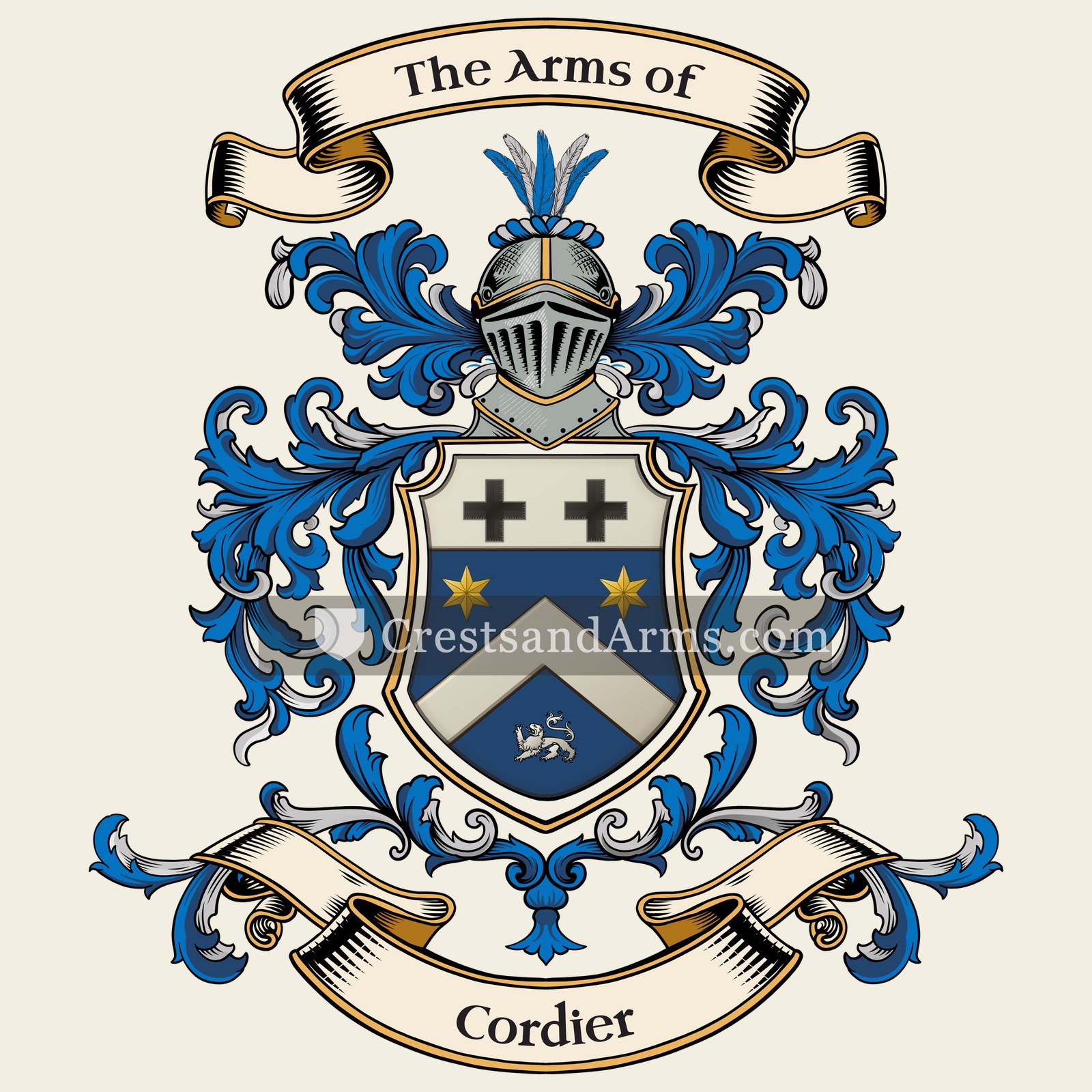


 grapesPlenty, and the labour of the vine
 crescentHonour by the sovereign, and the second son