Map of France showing where the Corella arms are recorded
The Corella arms were recorded in Navarre, c. 1663.
Navarre was mountain country straddling the Pyrenees, with a strong class of small independent landholders. A great many households counted as gentry there, and each needed a shield to be told apart.
This is where the arms were entered in the register. Families often moved to other parts of the country, so the same name can turn up in more than one region.
The body that granted and recorded arms in France in this period.
Louis XIV of France
Sovereign of the period
Louis XIV of France
1643–1715
Reigning in France when the Corella arms are first recorded.
How Arms Worked in France
In France, a coat of arms was a mark of honor that passed down through the male line to all legitimate descendants. Families often used the same shield without changes to show their shared heritage. If a branch wanted to stand out, they could add a small mark to their shield to show their specific place in the family tree.
Granting authority
The Juge d'armes de France acted as the official authority that regulated and verified coats of arms across the country.
How they got arms
Families typically inherited their arms from ancestors, though they could also receive them through royal grants or by proving their noble status.
Where arms were recorded
Coats of arms were officially recorded in the Armorial Général de France, which began its main collection in the year 1696.
The family's standing
Recorded among the armigerous families of Navarre.
Origin & History of the Corella Family in France
The family name Corella originates from the town of the same name located in the Navarre region of northern Spain. During the medieval period, it was common for families to adopt the name of their ancestral town as a way to identify their origins and social roots. By the year 1663, records confirm that members of the Corella family were well-established residents within this Navarrese territory. As the family grew, individuals began to migrate from this specific town to other parts of the Iberian Peninsula and eventually across the Atlantic to the Americas. This movement helped spread the name throughout the Spanish-speaking world while maintaining a connection to its historical beginnings in the fertile Ebro valley.
Corella Meaning & Related Branches
Root word
Cor
Latin term meaning heart or core.
This name
CorellaDerived from a place name in Spain or France referring to a heart-shaped hill or valley.
also spelled
Corel
Corell
Documented Sources
J. B. Rietstap, Armorial Général, Gouda: G. B. van Goor Zonen, 1884–87
Jimeno Jurío, José María. Toponimia navarra: Corella. 1997
Archivo General de Navarra. Sección de Protocolos Notariales. 1663
Caro Baroja, Julio. La casa en Navarra. 1982
Digital archive packCoat of arms PNG, gold border print PDF, vector SVG and the certificate of authenticity. Sent to your email in minutes.


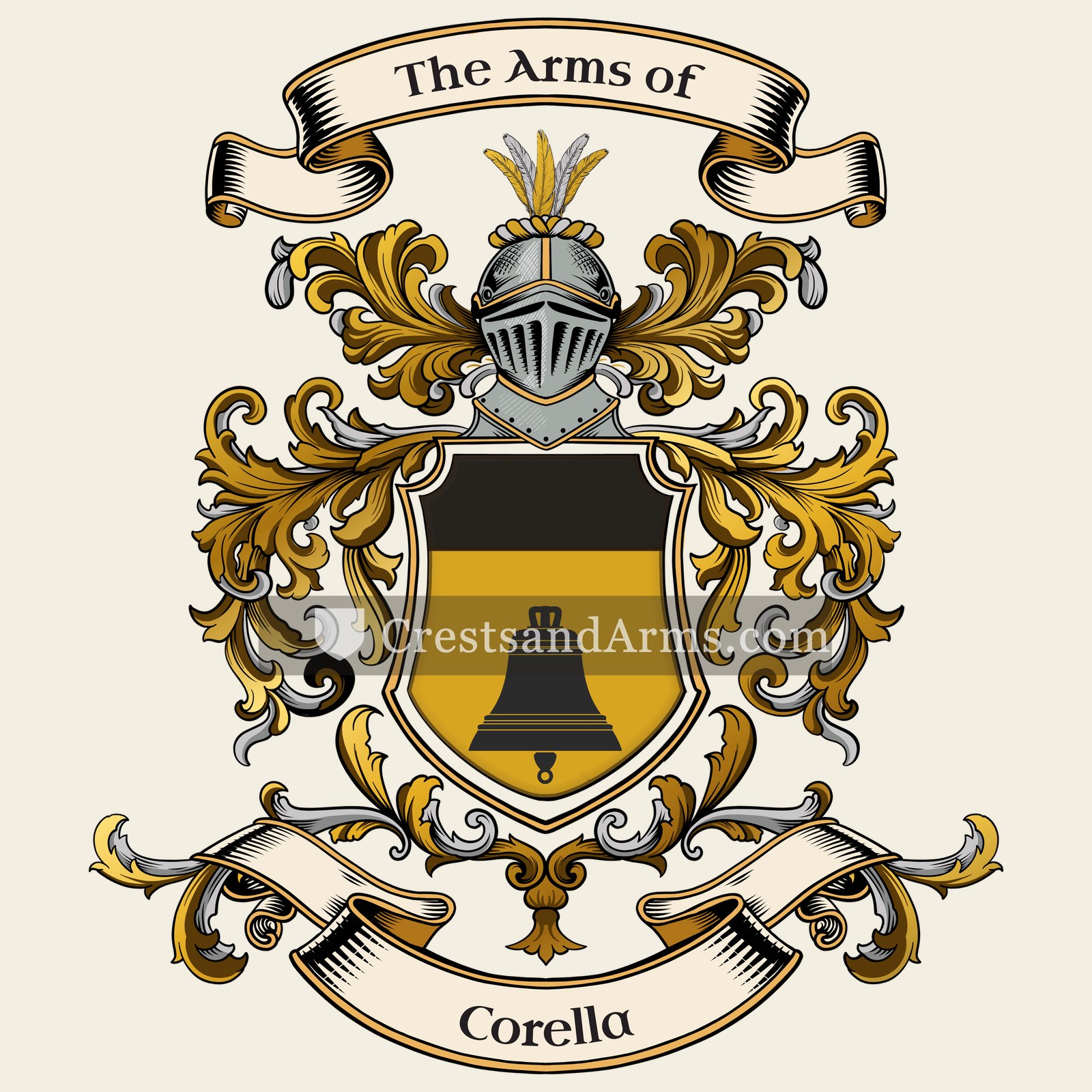
 chiefAuthority, wisdom and dominion
 bellA call to prayer, and a warning given
 chiefAuthority, wisdom and dominion
 bellA call to prayer, and a warning given