Map of Spain showing where the Cornell arms are recorded
The Cornell arms were recorded in Aragon, c. 1722.
Aragon was mountain and river country in north-eastern Spain, with a strong tradition of small independent landholders. A great many families counted as gentry there, and each one needed a shield to be told apart.
This is where the arms were entered in the register. Families often moved to other parts of the country, so the same name can turn up in more than one region.
The body that granted and recorded arms in Spain in this period.
Philip V of Spain
Sovereign of the period
Philip V of Spain
1714–1724
Reigning in Spain when the Cornell arms are first recorded.
How Arms Worked in Spain
In Spain, a coat of arms was considered a form of property that belonged to the entire family line. These arms were passed down from a father to all his children equally. Younger branches of the family usually kept the original design without needing to add any special marks to distinguish their specific line.
Granting authority
The Cronista Rey de Armas was the official body that regulated and granted coats of arms throughout Spain.
How they got arms
Families often obtained their arms through royal grants or by proving their noble status to the official heraldic authority.
Where arms were recorded
Coats of arms were officially recorded in the registers of the Cronista Rey de Armas starting in 1496.
The family's standing
Recorded among the armigerous families of Aragon.
Origin & History of the Cornell Family in Spain
The history of the Cornell family in Spain is deeply tied to the rugged landscape and social structure of the Aragon region during the early eighteenth century. By 1722, records confirm that members of the family were established residents in this area, which was a vital kingdom known for its unique legal traditions and strong local governance. During this period, families like the Cornells often played active roles in their local communities, participating in the agricultural and civic life that defined the Aragonese countryside. The name itself reflects the linguistic diversity of the region, where names were frequently shaped by the blending of local dialects and the influence of neighboring cultures. As the family settled into these mountain valleys and plains, they became part of the enduring social fabric of northern Spain, contributing to the development of the local economy and the preservation of regional customs that have lasted for generations.
Coat of Arms & Family Crest Details
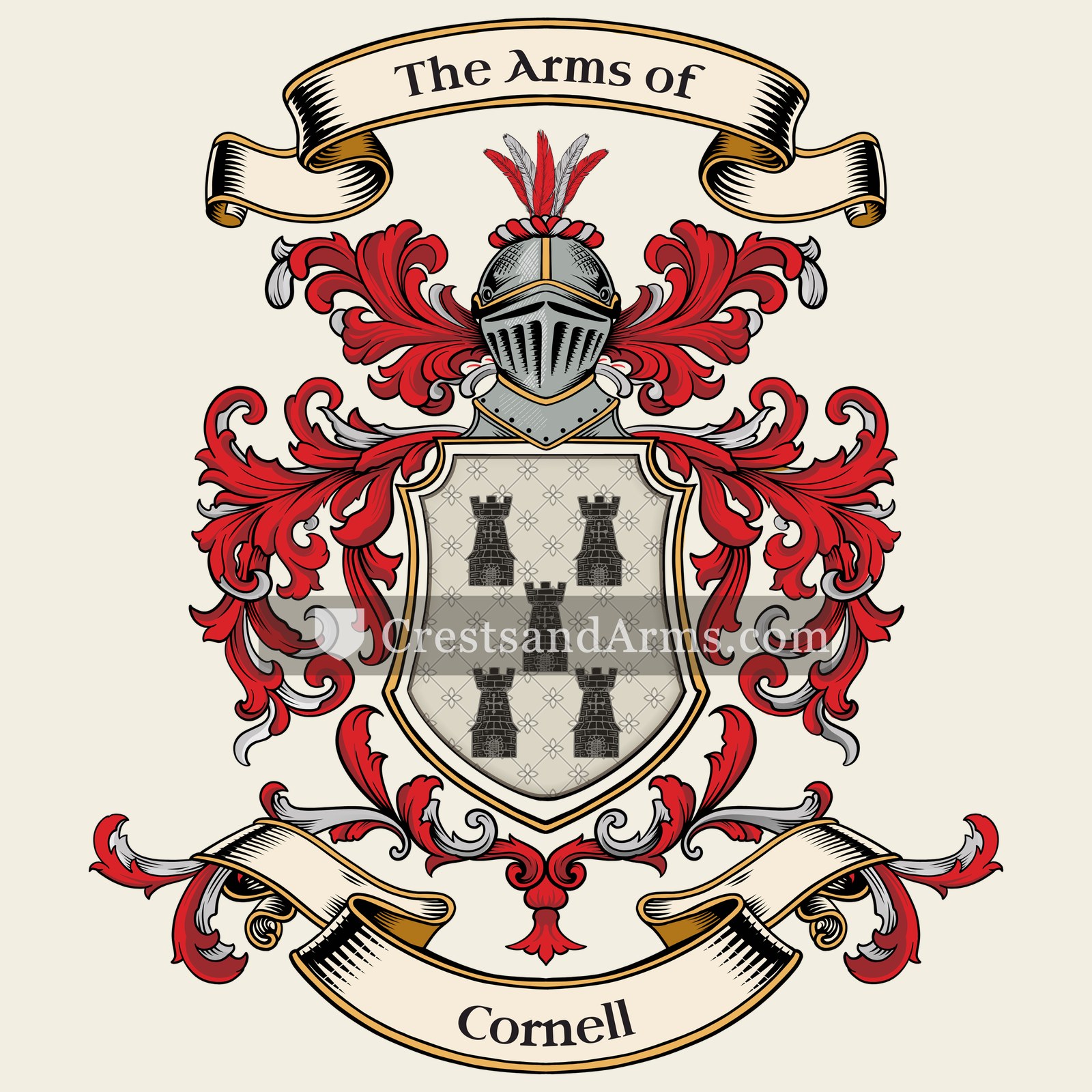
Symbols on this shield
towerGrandeur and solidity, and a stronghold defended
Colours
Silver (Argent)Means: Peace and sincerity
Black (Sable)Means: Constancy
Historical info
Source
Sir Bernard Burke, The General Armory of England, Scotland, Ireland and Wales, London: Harrison & Sons, 1884
Blazon (the actual original written record)
“Ar. five castles in cross sa”
Englandc. 1620
Digital archive packCoat of arms PNG, gold border print PDF, vector SVG and the certificate of authenticity. Sent to your email in minutes.
Map of England showing where the Cornell arms are recorded
The Cornell arms were recorded in England, c. 1620.
Arms such as these were typically recorded in York.
Yorkshire is the largest of the English counties, and it held more gentry families than any other. Land there was split among a great many households rather than a few, so a great many of them carried arms.
This is where the arms were entered in the register. Families often moved to other parts of the country, so the same name can turn up in more than one region.
The body that granted and recorded arms in England in this period.
James VI and I
Sovereign of the period
James VI and I
1603–1625
Reigning in Spain when the Cornell arms are first recorded.
How Arms Worked in England
English heraldry allowed arms to be shared by all legitimate descendants of the original owner. These symbols were treated as personal property that moved through the generations to all children. While the eldest son kept the original design, other family members could use the same shield without needing to change it or register their own unique versions.
Granting authority
The College of Arms in London has regulated the use of coats of arms throughout England and Wales since 1484.
How they got arms
Families typically obtained their coats of arms through a formal grant from the Crown or by proving their ancient right to them.
Where arms were recorded
All official coats of arms are recorded in the registers kept at the College of Arms, which date back to the fifteenth century.
The family's standing
Recorded among the armigerous families of England.
Origin & History of the Cornell Family in England
The name Cornell has deep roots in the northern regions of England, particularly within the historic city of York. During the early seventeenth century, the family was established in this area, living through a period of great social and religious change. The name itself is thought to be a variation of the name Cornelius, which was derived from the Latin word for horn. Over many generations, the spelling evolved as local clerks recorded the name phonetically in parish registers and legal documents. By 1620, families bearing this name were well-integrated into the local community, participating in the trades and civic life that defined York as a major northern hub. Their presence in the city during this time reflects the broader movement of families who helped shape the local economy and culture of Yorkshire before many eventually sought new opportunities across the Atlantic.
Cornell Meaning & Related Branches
Root word
Cornu
Latin term referring to a horn or a projection.
This name
CornellDerived from a topographic feature or a nickname related to a horn-shaped hill.
also spelled
Cornel
Cornall
Cornill
Related arms
Cornall, or Crownallvariant spelling
Documented Sources
J. B. Rietstap, Armorial Général, Gouda: G. B. van Goor Zonen, 1884–87
Archivo de la Corona de Aragón, Registro de la Real Audiencia de Aragón
García Ciprés, Gregorio, Linajes de la Nobleza de Aragón, 1915
Sinués y Ruiz, Augustín, El Reino de Aragón en el siglo XVIII, 1922
Digital archive packCoat of arms PNG, gold border print PDF, vector SVG and the certificate of authenticity. Sent to your email in minutes.


 ravenConstancy and divine providence
 ravenConstancy and divine providence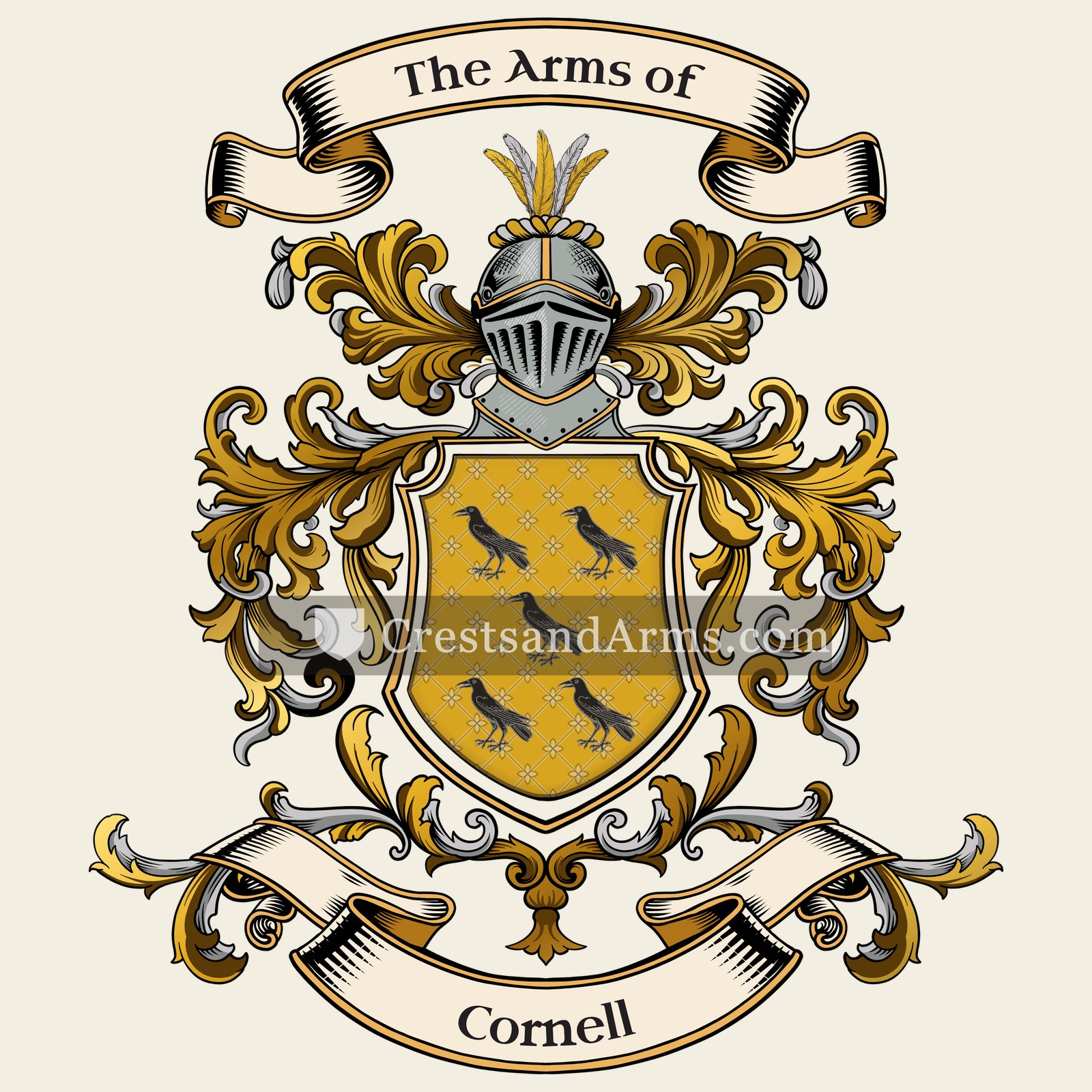


 towerGrandeur and solidity, and a stronghold defended