Map of Italy showing where the Corona arms are recorded
The Corona arms were recorded in Trévise, c. 1775.
This is where the arms were entered in the register. Families often moved to other parts of the country, so the same name can turn up in more than one region.
The body that granted and recorded arms in Italy in this period.
Alvise Giovanni Mocenigo
Sovereign of the period
Alvise Giovanni Mocenigo
1763–1778
Reigning in Italy when the Corona arms are first recorded.
How Arms Worked in Italy
In the Italian states, coats of arms were often used by noble families to show their status and history. These symbols were passed down through the generations to all legitimate male descendants. Younger branches of a family usually kept the original design but sometimes added small changes to distinguish their specific line from the main branch.
Granting authority
Various local rulers and city governments controlled the use of coats of arms across the different Italian states.
How they got arms
Families often assumed their own arms or received them as official grants from local lords, popes, or city councils.
Where arms were recorded
Arms were recorded in local city archives or private family books rather than in one single national register.
The family's standing
Recorded among the armigerous families of Italy.
Origin & History of the Corona Family in Italy
The family name Corona is deeply rooted in the linguistic and cultural landscape of Northern Italy. Derived from the Latin word for crown, the name likely originated as a descriptive nickname for a person who lived near a landmark with that shape or perhaps someone who held a specific role in a local community. By the late 18th century, the family established a clear presence in the city of Treviso, a historic town known for its canals and proximity to Venice. During this period, families in the Veneto region were often deeply integrated into the local agricultural or mercantile economies that defined the area. Records from 1775 confirm that the Corona family was already settled in this region, participating in the vibrant social and economic life of the town during the final years of the Republic of Venice. This era was a time of transition for many Italian families as they navigated the complex political shifts that eventually led to the unification of the country.
Coat of Arms & Family Crest Details
Symbols on this shield
chevronProtection, and faithful service completed
crownSovereignty, authority and just reward
Colours
Blue (Azure)Means: Loyalty and truth
Gold (Or)Means: Generosity
Historical info
Source
Sir Bernard Burke, The General Armory of England, Scotland, Ireland and Wales, London: Harrison & Sons, 1884
Blazon (the actual original written record)
“Az. a chev. betw. three ducal coronets or”
ChesterAdlington · Chester, c. 1620
Digital archive packCoat of arms PNG, gold border print PDF, vector SVG and the certificate of authenticity. Sent to your email in minutes.
Map of England showing where the Corona arms are recorded
The Corona arms were recorded in Chester, c. 1620.
Cheshire was governed apart from the rest of England for much of its history, with its own courts and its own gentry. That separateness bred a strong local landed class, and landed families carried arms.
This is where the arms were entered in the register. Families often moved to other parts of the country, so the same name can turn up in more than one region.
The body that granted and recorded arms in England in this period.
James VI and I
Sovereign of the period
James VI and I
1603–1625
Reigning in Italy when the Corona arms are first recorded.
How Arms Worked in England
English heraldry allowed arms to be shared by all legitimate descendants of the original owner. These symbols were treated as personal property that moved through the generations to all children. While the eldest son kept the original design, other family members could use the same shield without needing to change it or register their own unique versions.
Granting authority
The College of Arms in London has regulated the use of coats of arms throughout England and Wales since 1484.
How they got arms
Families typically obtained their coats of arms through a formal grant from the Crown or by proving their ancient right to them.
Where arms were recorded
All official coats of arms are recorded in the registers kept at the College of Arms, which date back to the fifteenth century.
The family's standing
Recorded among the armigerous families of Chester.
Origin & History of the Corona Family in England
The family name Corona carries a deep history that traces back to the bustling city of Chester in the early seventeenth century. By 1620, records confirm that members of the family were already established within this significant regional hub. Chester served as a vital port and a center for trade during this era, which likely influenced the family’s daily life and economic activities. The name itself is rooted in the Latin word for crown, suggesting that the earliest ancestors may have been associated with local administrative duties or ecclesiastical roles that required a connection to official authority. As residents of a walled city with ancient Roman foundations, these early family members lived in a place where history was visible in every street. Their presence in Chester highlights how families integrated into the social fabric of English provincial life during the reign of King James I.
Corona Meaning & Related Branches
Root word
Corona
Latin term for a crown, garland, or wreath.
This name
CoronaAn occupational name for a crown maker or a topographic name for someone living near a crown-shaped landmark.
also spelled
Coron
Coronah
Coronna
Corone
Related arms
Calrowrecorded with Corona, same area
Claytonrecorded with Corona, same area
Leghrecorded with Corona, same area
Documented Sources
J. B. Rietstap, Armorial Général, Gouda: G. B. van Goor Zonen, 1884–87
Archivio di Stato di Treviso, Stato delle anime della parrocchia di San Leonardo (1775)
Archivio Storico Comunale di Treviso, Registri dei battesimi e dei matrimoni
De Felice, Emidio, Dizionario dei cognomi italiani (1978)
Sartori, Antonio, Storia di Treviso (1964)
Digital archive packCoat of arms PNG, gold border print PDF, vector SVG and the certificate of authenticity. Sent to your email in minutes.


 crownSovereignty, authority and just reward
 crownSovereignty, authority and just reward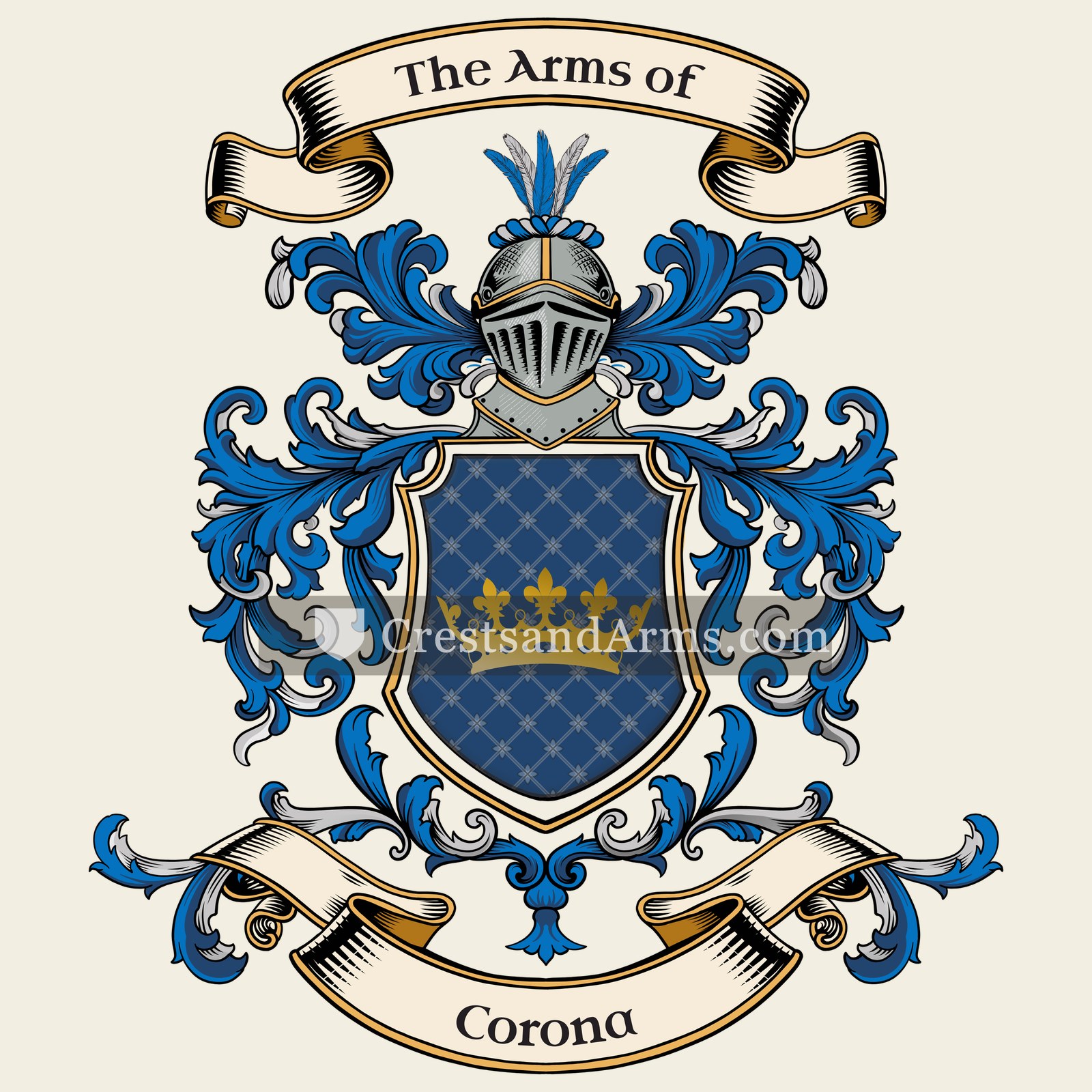


 chevronProtection, and faithful service completed