Map of Austria showing where the Coronato arms are recorded
The Coronato arms were recorded in Galicia, c. 1772.
Galicia was eastern country of large estates and small farming villages, held by families who had been there for a very long time. Land was what entitled a family to arms, and land there rarely changed hands.
This is where the arms were entered in the register. Families often moved to other parts of the country, so the same name can turn up in more than one region.
Region
Galicia
First recorded
1772
Granting Authority for the Coronato Arms
Imperial and Royal chancery
Sodacan · CC BY-SA 3.0
The body that granted and recorded arms in Austria in this period.
Joseph II, Holy Roman Emperor
Sovereign of the period
Joseph II, Holy Roman Emperor
1765–1790
Reigning in Austria when the Coronato arms are first recorded.
How Arms Worked in Austria
Austrian coats of arms were often linked directly to noble titles granted by the Emperor. These symbols belonged to the entire family line rather than just one individual. When a family grew, new branches kept the original design without needing to change it. This system allowed all members of a noble house to share the same identity across many generations.
Granting authority
The Imperial and Royal chancery managed all heraldic matters and controlled the official granting of arms throughout the Austrian lands.
How they got arms
Families typically received their arms through a formal imperial decree that often accompanied the elevation of a person to noble status.
Where arms were recorded
Official records of these grants were kept in the Imperial Register of Nobility which began its formal documentation process in 1453.
The family's standing
Recorded among the armigerous families of Galicia.
Origin & History of the Coronato Family in Austria
The surname Coronato is deeply rooted in the historical landscape of Galicia, Spain, where family members were documented as early as 1772. The name itself is derived from the Italian and Spanish word for crowned, which often suggests that the original bearers were individuals associated with local administration, church leadership, or prominent landholding families within their community. During the late 18th century, Galicia was a region defined by its strong agricultural traditions and its unique cultural identity, which allowed families like the Coronatos to establish deep roots in rural parishes. As members of the local society, they likely participated in the traditional life of the region, which included managing land and contributing to the social fabric of their villages. By the time they appear in the official records of the 1770s, the family was already well-integrated into the local population, reflecting the stability and continuity of life in northwestern Spain during that era.
Coronato Meaning & Related Branches
Root word
Corona
Latin term referring to a crown, garland, or circular object.
This name
CoronatoDerived from the Latin word for crown, likely denoting someone who made crowns or lived at a sign of a crown.
also spelled
Coronad
Coronaddo
Documented Sources
J. B. Rietstap, Armorial Général, Gouda: G. B. van Goor Zonen, 1884–87
Archivo del Reino de Galicia, Catastro de Ensenada, 1750-1775
Pérez García, J. M., Historia de Galicia: Una visión general, 1998
Sánchez-Albornoz, C., La España cristiana de los siglos VIII al XI, 1980
Digital archive packCoat of arms PNG, gold border print PDF, vector SVG and the certificate of authenticity. Sent to your email in minutes.


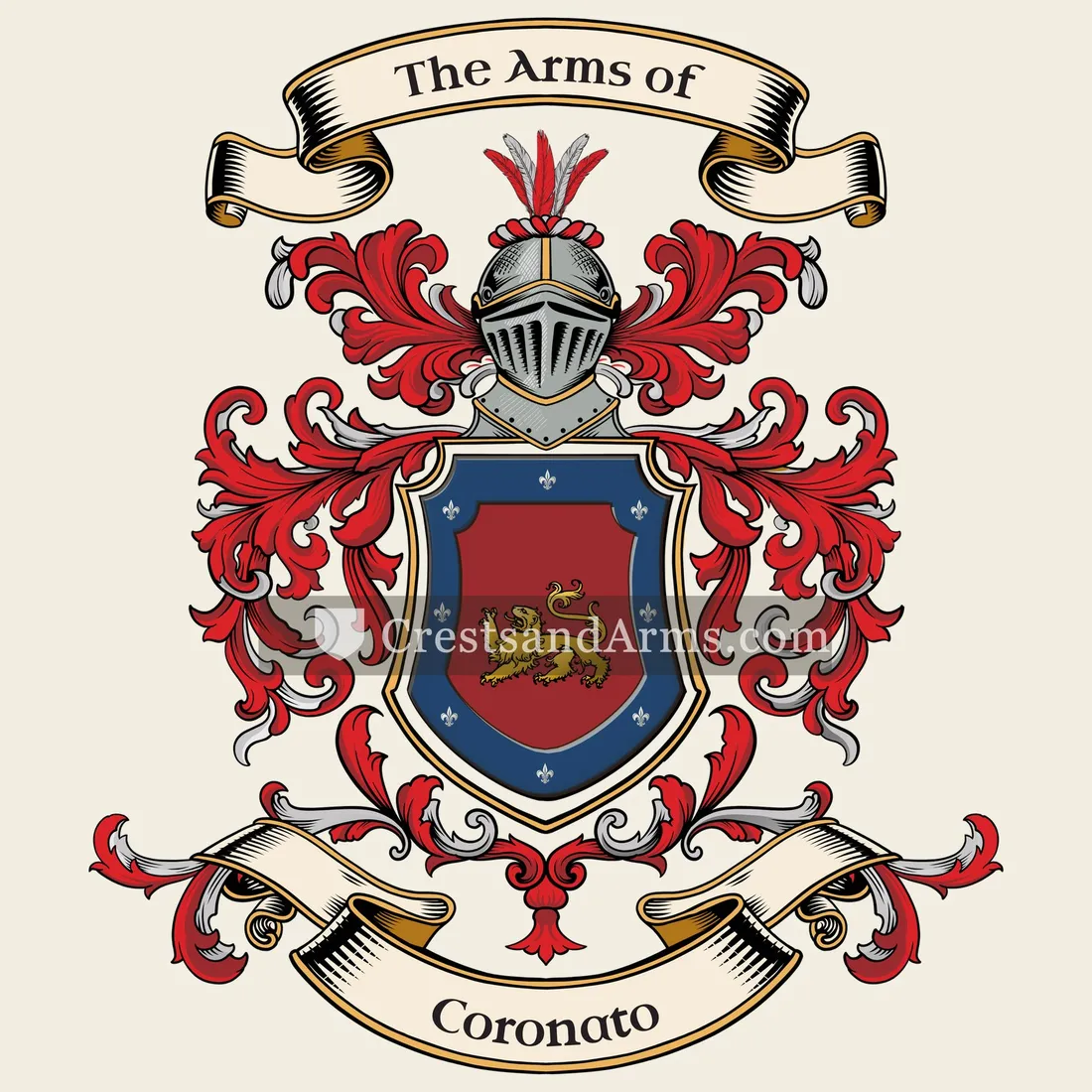
 chequyConstancy, and the counting-board
 lionCourage, strength and royalty
 fleur de lisPurity, light, and the sixth son
 chequyConstancy, and the counting-board
 lionCourage, strength and royalty
 fleur de lisPurity, light, and the sixth son