Map of Italy showing where the Corsini arms are recorded
The Corsini arms were recorded in Florence, c. 1781.
This is where the arms were entered in the register. Families often moved to other parts of the country, so the same name can turn up in more than one region.
The body that granted and recorded arms in Italy in this period.
Paolo Renier
Sovereign of the period
Paolo Renier
1779–1789
Reigning in Italy when the Corsini arms are first recorded.
How Arms Worked in Italy
In the Italian states, coats of arms were often used by noble families to show their status and history. These symbols were passed down through the generations to all legitimate male descendants. Younger branches of a family usually kept the original design but sometimes added small changes to distinguish their specific line from the main branch.
Granting authority
Various local rulers and city governments controlled the use of coats of arms across the different Italian states.
How they got arms
Families often assumed their own arms or received them as official grants from local lords, popes, or city councils.
Where arms were recorded
Arms were recorded in local city archives or private family books rather than in one single national register.
The family's standing
Recorded among the armigerous families of Italy.
Origin & History of the Corsini Family in Italy
The Corsini family emerged as a prominent force in Florence during the Middle Ages, establishing themselves as influential merchants and bankers. By the 12th century, the family had already secured a firm foothold in the city’s political and economic life, eventually rising to become one of the most powerful dynasties in Tuscany. Their success was largely built on international trade and financial services, which allowed them to expand their influence far beyond the borders of Florence. Over the centuries, members of the family held high-ranking positions in both the government and the church, including the election of Lorenzo Corsini as Pope Clement XII in 1730. By the time the family was well-documented in the late 18th century, they had long been recognized as a cornerstone of Florentine society, known for their significant contributions to the city’s art, architecture, and civic governance.
Corsini Meaning & Related Branches
Root word
Corso
A person originating from the island of Corsica.
This name
CorsiniA patronymic or descriptive surname denoting someone from Corsica or of Corsican descent.
also spelled
Corsiny
Related arms
Lippi-Albertisimilar arms
Documented Sources
J. B. Rietstap, Armorial Général, Gouda: G. B. van Goor Zonen, 1884–87
Brucker, Gene, Renaissance Florence, 1969
Kent, F.W., Lorenzo de' Medici and the Art of Magnificence, 2004
Archivio di Stato di Firenze, Carte Strozziane, serie V
Digital archive packCoat of arms PNG, gold border print PDF, vector SVG and the certificate of authenticity. Sent to your email in minutes.


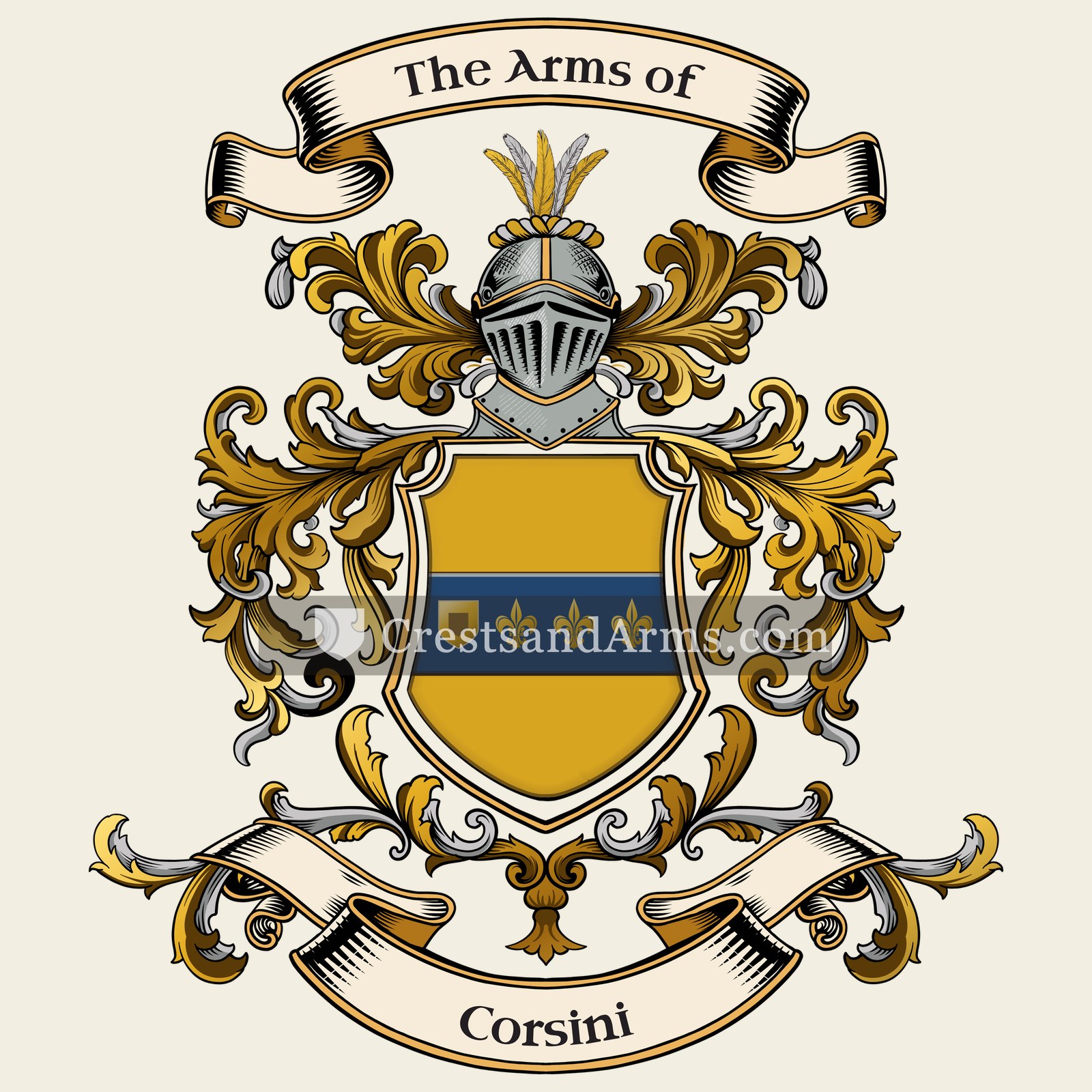
 fessThe military belt, and readiness to serve
 escutcheonA shield within a shield, and a claim inherited
 fleur de lisPurity, light, and the sixth son
 fessThe military belt, and readiness to serve
 escutcheonA shield within a shield, and a claim inherited
 fleur de lisPurity, light, and the sixth son