Map of Belgium showing where the Corten arms are recorded
The Corten arms were recorded in Brabant, c. 1633.
Brabant lay at the heart of the Low Countries, where the trade routes met. Its towns were wealthy and its landowners many, and both kinds of family kept arms, which is why the region is so heavily represented.
This is where the arms were entered in the register. Families often moved to other parts of the country, so the same name can turn up in more than one region.
The body that granted and recorded arms in Belgium in this period.
Philip IV of Spain
Sovereign of the period
Philip IV of Spain
1621–1665
Reigning in Belgium when the Corten arms are first recorded.
How Arms Worked in Belgium
In Belgium, a coat of arms is considered personal property that is passed down through the male line to legitimate descendants. Families often use the same shield design across generations to show their shared heritage. If a branch of the family wants to change the design, they must apply for an official update to their specific version of the arms.
Granting authority
The Conseil héraldique is the official body that regulates and approves all coats of arms in Belgium.
How they got arms
Families obtain their coats of arms through formal royal grants or by confirming their historical right to use existing designs.
Where arms were recorded
All approved coats of arms are officially recorded in the public registers of the Conseil héraldique since 1844.
The family's standing
Recorded among the armigerous families of Brabant.
Origin & History of the Corten Family in Belgium
The family name Corten finds its roots in the historic Duchy of Brabant, a region that spans parts of modern-day Belgium and the Netherlands. Records confirm that members of the Corten family were established in this area by 1633, living during a time when the region was a central hub for trade and cultural exchange in Europe. The name itself is likely a descriptive surname, often derived from the Middle Dutch word "kort," which means short. In the seventeenth century, such names were frequently given to individuals based on their physical stature or as a way to distinguish between different branches of a family living in the same village. As the family grew, they became integrated into the local social fabric of Brabant, participating in the agricultural and merchant life that defined the economy of the Low Countries during the early modern period.
Corten Meaning & Related Branches
Root word
Curtis
Derived from the Latin word curtis meaning a courtyard or farmstead.
This name
CortenA topographic name for someone who lived near or worked on a farmstead or manor.
also spelled
Cortene
Documented Sources
J. B. Rietstap, Armorial Général, Gouda: G. B. van Goor Zonen, 1884–87
Rijksarchief in België (State Archives in Belgium), Parochieregisters van Brabant (Parish Registers of Brabant)
Debrabandere, Frans, Woordenboek van de familienamen in België en Noord-Frankrijk (2003)
Leys, O., De familienamen in de Nederlanden (1975)
Digital archive packCoat of arms PNG, gold border print PDF, vector SVG and the certificate of authenticity. Sent to your email in minutes.


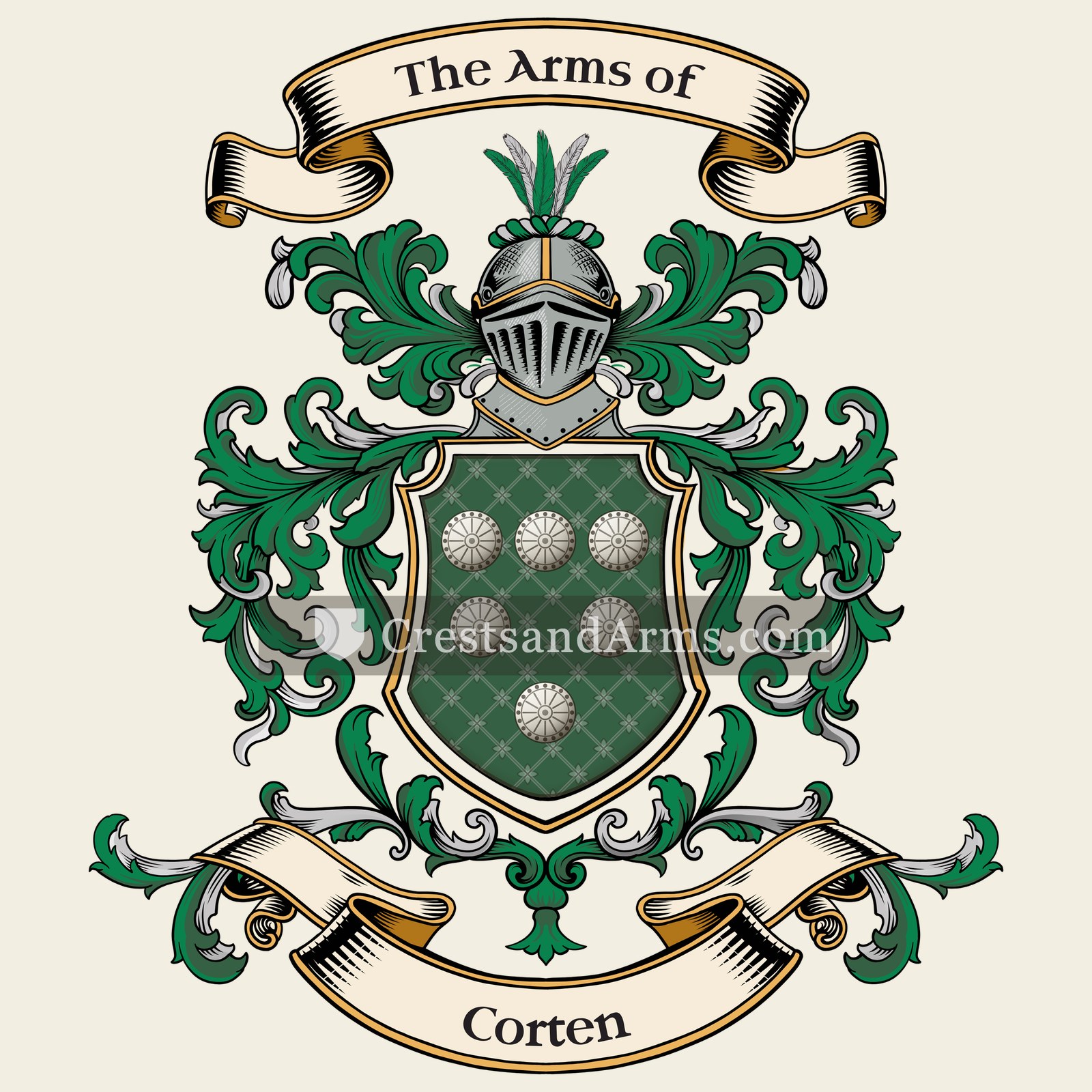
 roundelA coin, and one who has been to the crusades
 roundelA coin, and one who has been to the crusades