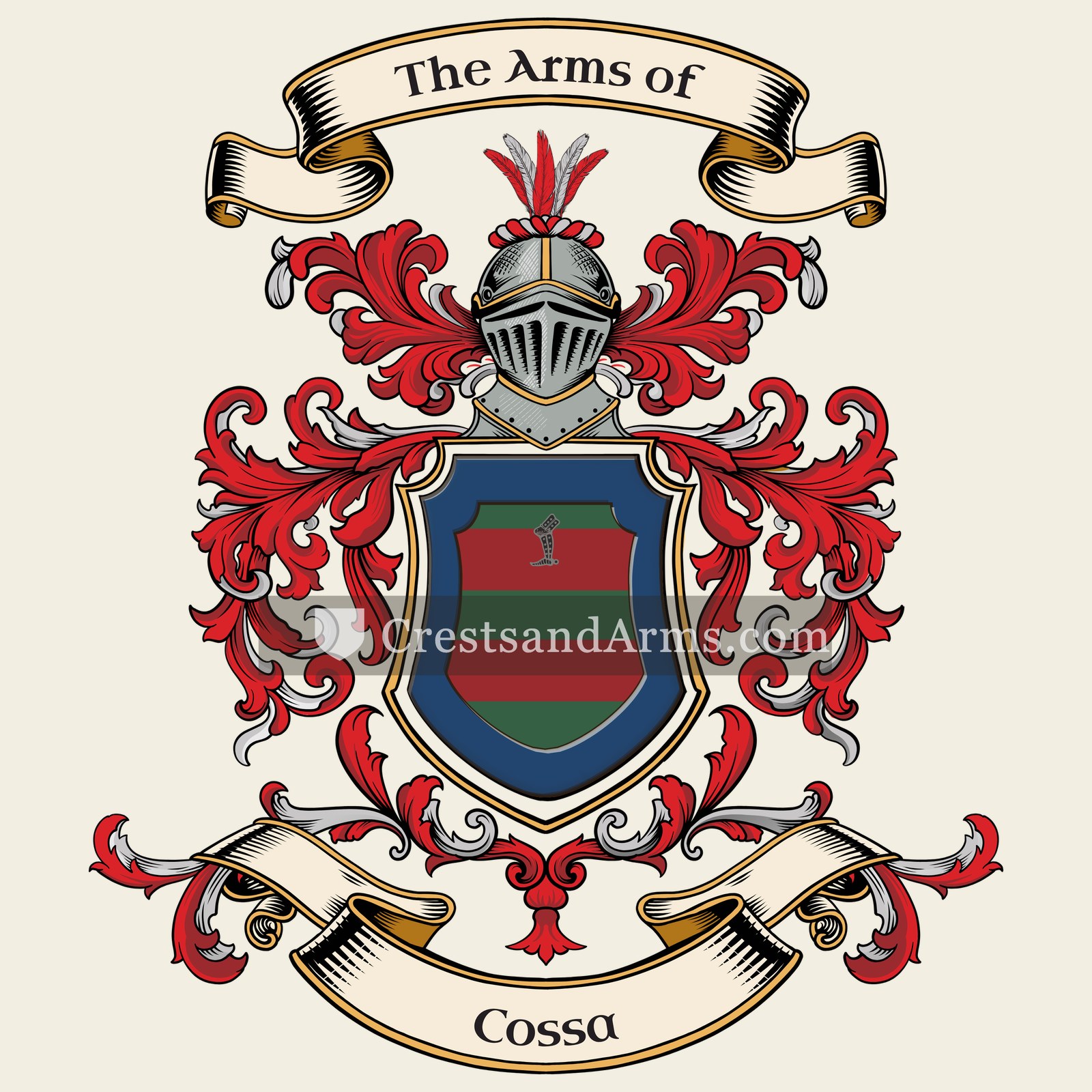
A record of documented arms, meaning and origin, researched for the Cossa family of Italy.
Reg. 6191 · Italian, A–C
Coat of Arms & Family Crest Details
Symbols on this shield
bordureA difference between branches of one family
legStrength and swiftness
Colours
Red (Gules)Means: Military strength
Silver (Argent)Means: Peace and sincerity
Blue (Azure)Means: Loyalty and truth
Historical info
Source
J. B. Rietstap, Armorial Général, Gouda: G. B. van Goor Zonen, 1884–87
Blazon (the actual original written record)
“Coupé: au 1 de gu. à une jambe humaine de carn., le pied en bas; au 2 d'arg. à trois barres de sin. L'écu entouré d'une bordure émanchée d'azur sur arg.”
ProvenceMilan · Provence, c. 1775
Digital archive packCoat of arms PNG, gold border print PDF, vector SVG and the certificate of authenticity. Sent to your email in minutes.
Map of Italy showing where the Cossa arms are recorded
The Cossa arms were recorded in Provence, c. 1775.
Provence was old country, with towns dating to the Romans and families who traced their land back nearly as far. Its gentry were many and long-settled, and long settlement is what fills a register.
This is where the arms were entered in the register. Families often moved to other parts of the country, so the same name can turn up in more than one region.
The body that granted and recorded arms in Italy in this period.
Alvise Giovanni Mocenigo
Sovereign of the period
Alvise Giovanni Mocenigo
1763–1778
Reigning in Italy when the Cossa arms are first recorded.
How Arms Worked in Italy
In the Italian states, coats of arms were often used by noble families to show their status and history. These symbols were passed down through the generations to all legitimate male descendants. Younger branches of a family usually kept the original design but sometimes added small changes to distinguish their specific line from the main branch.
Granting authority
Various local rulers and city governments controlled the use of coats of arms across the different Italian states.
How they got arms
Families often assumed their own arms or received them as official grants from local lords, popes, or city councils.
Where arms were recorded
Arms were recorded in local city archives or private family books rather than in one single national register.
The family's standing
Recorded among the armigerous families of Provence.
Origin & History of the Cossa Family in Italy
The family name Cossa has deep roots in the Mediterranean region, with historical records placing the family in Provence by the late 18th century. While the name is often associated with Italian origins, particularly in regions like Tuscany and Naples, members of the family established themselves as prominent figures in southern France by 1775. During this period, the family was integrated into the social and economic life of the Provence region, often appearing in local parish registers and administrative documents. These early ancestors were known for their involvement in regional trade and local governance, which helped them secure a stable standing within their communities. As they settled into French life, the family name became a recognized part of the local landscape, reflecting the movement of people and ideas across the borders of the Mediterranean world during the Enlightenment era.
Cossa Meaning & Related Branches
Root word
coxa
Latin term referring to the hip or thigh bone.
This name
CossaAn occupational or descriptive name for someone with a limp or a hip deformity.
also spelled
Kossa
Cossae
Cossah
Documented Sources
J. B. Rietstap, Armorial Général, Gouda: G. B. van Goor Zonen, 1884–87
Boyer, Joseph, Documents sur l'histoire de la Provence, 1952
Archives départementales des Bouches-du-Rhône, Registres paroissiaux et d'état civil de la ville de Marseille, 1770–1780
Masson, Frédéric, Les familles provençales et le commerce méditerranéen, 1905
Digital archive packCoat of arms PNG, gold border print PDF, vector SVG and the certificate of authenticity. Sent to your email in minutes.


 bordureA difference between branches of one family
 legStrength and swiftness
 bordureA difference between branches of one family
 legStrength and swiftness