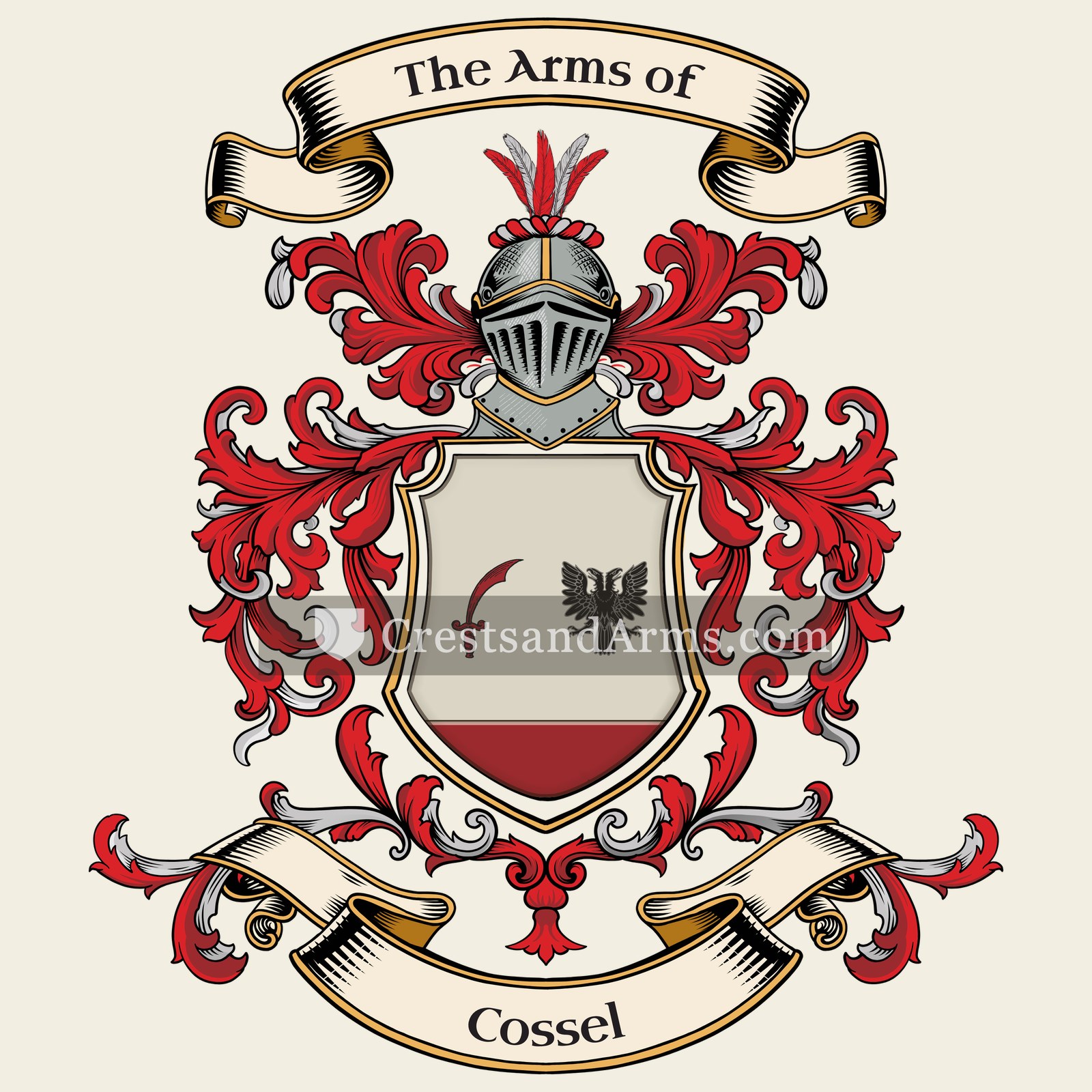
A record of documented arms, meaning and origin, researched for the Cossel family of Germany.
Reg. 2338 · German, A–C
Coat of Arms & Family Crest Details
Symbols on this shield
swordJustice, and military honour
eagleNobility, strength and a keen mind
Colours
Silver (Argent)Means: Peace and sincerity
Red (Gules)Means: Military strength
Black (Sable)Means: Constancy
Historical info
Source
J. B. Rietstap, Armorial Général, Gouda: G. B. van Goor Zonen, 1884–87
Blazon (the actual original written record)
“Parti: a. coupé de sa. sur arg.; à une épée de gu., br. en bande sur le tout, la p. enfilant une couronne d'or; b. d'arg. à une aigle de sa., bq. et m. d'or. A la champagne d'azur, br. sur le parti. Sur le tout tiercé en pal d'arg., de sa. et de gu. Ladite champagne ch. d'une peau de lion d'or, ceinte du même et attachée par une chaîne d'or à la base du surtout. Deux cq. cour. C.: 1o un lion iss. et cont. d'or, cour. du même; I. d'arg. et de gu.; 2o l'aigle; I. d'arg. et de sa.”
BrandenburgBrandenburg, c. 1667
Digital archive packCoat of arms PNG, gold border print PDF, vector SVG and the certificate of authenticity. Sent to your email in minutes.
Map of Germany showing where the Cossel arms are recorded
The Cossel arms were recorded in Brandenburg, c. 1667.
Brandenburg was sandy farming country around Berlin, held in large estates by families who served as officers. Land and military service each brought arms, and most families there had both.
This is where the arms were entered in the register. Families often moved to other parts of the country, so the same name can turn up in more than one region.
The body that granted and recorded arms in Germany in this period.
Leopold I, Holy Roman Emperor
Sovereign of the period
Leopold I, Holy Roman Emperor
1658–1705
Reigning in Germany when the Cossel arms are first recorded.
How Arms Worked in Germany
In the Holy Roman Empire, coats of arms were often granted to individuals by the Emperor or his representatives. These arms were then passed down through the generations to all legitimate descendants of the original holder. Younger branches of a family usually kept the same shield design without needing to change it, as the arms belonged to the entire lineage.
Granting authority
The Holy Roman Emperor held the sole power to grant new coats of arms throughout his vast imperial territories.
How they got arms
Families typically obtained their coats of arms through a formal imperial grant or by proving their noble status to the authorities.
Where arms were recorded
These grants were officially recorded in the Imperial Chancery registers, which began keeping formal records of such honors during the Middle Ages.
The family's standing
Recorded among the armigerous families of Brandenburg.
Origin & History of the Cossel Family in Germany
The family name Cossel finds its historical roots in the region of Brandenburg, where records confirm members of the family were established by the year 1667. During this period, Brandenburg was recovering from the devastation of the Thirty Years' War, and families like the Cossels often played a role in the social and administrative rebuilding of the local communities. The name itself is likely locational or derived from early Germanic naming customs common to the northern German territories. As the family settled into the region, they became part of the local fabric of Brandenburg, likely participating in the agricultural or trade-based economy that defined the area during the late seventeenth century. Their presence in the historical record during this time suggests they were part of a stable demographic that helped maintain the continuity of the region through a time of significant political and social transition.
Cossel Meaning & Related Branches
Root word
Konstant
Derived from the Latin word constantem meaning steadfast or firm.
This name
CosselA patronymic or locative surname indicating a descendant of someone named Constantine or from a place named Cossel.
also spelled
Kossel
Cozzel
Cossell
Related arms
Kosselvariant spelling
Documented Sources
J. B. Rietstap, Armorial Général, Gouda: G. B. van Goor Zonen, 1884–87
Enders, Lieselott. Die Altmark: Geschichte einer kurmärkischen Landschaft im Spätmittelalter. 2008
Ribbe, Wolfgang. Geschichte Berlins. 1987
Geheimes Staatsarchiv Preußischer Kulturbesitz, I. HA Rep. 7 (General-Verzeichnis der kurmärkischen Stände)
Brandenburgisches Landeshauptarchiv, Rep. 2 (Kurmärkische Stände und Ritterschaft)
Digital archive packCoat of arms PNG, gold border print PDF, vector SVG and the certificate of authenticity. Sent to your email in minutes.


 swordJustice, and military honour
 eagleNobility, strength and a keen mind
 swordJustice, and military honour
 eagleNobility, strength and a keen mind