A record of documented arms, meaning and origin, researched for the Costa family lines. Documented in 3 countries.
Reg. 1769 · French, A–C
Coat of Arms & Family Crest Details
Symbols on this shield
cross symbolChristian faith and service
mountThe ground held, and steadfastness upon it
crownSovereignty, authority and just reward
mulletThe third son, and a divine quality from above
Colours
Blue (Azure)Means: Loyalty and truth
Silver (Argent)Means: Peace and sincerity
Gold (Or)Means: Generosity
Historical info
Source
J. B. Rietstap, Armorial Général, Gouda: G. B. van Goor Zonen, 1884–87
Blazon (the actual original written record)
“D'azur à une croix d'arg., bordée d'or, posée sur le sommet d'une montagne de onze coupeaux d'arg., verdoyée de sin.; ladite croix surm. d'une couronne royale d'or, doublée de gu. et acc. à dextre et à sen. d'une étoile aussi d'or.”
RoussillonRoussillon, c. 1663
Digital archive packCoat of arms PNG, gold border print PDF, vector SVG and the certificate of authenticity. Sent to your email in minutes.
Map of France showing where the Costa arms are recorded
The Costa arms were recorded in Roussillon, c. 1663.
Roussillon was Pyrenean country that belonged to Spain before it belonged to France. Its families held small estates under both crowns, and serving either one brought a shield.
This is where the arms were entered in the register. Families often moved to other parts of the country, so the same name can turn up in more than one region.
The body that granted and recorded arms in France in this period.
Louis XIV of France
Sovereign of the period
Louis XIV of France
1643–1715
Reigning in France when the Costa arms are first recorded.
How Arms Worked in France
In France, a coat of arms was a mark of honor that passed down through the male line to all legitimate descendants. Families often used the same shield without changes to show their shared heritage. If a branch wanted to stand out, they could add a small mark to their shield to show their specific place in the family tree.
Granting authority
The Juge d'armes de France acted as the official authority that regulated and verified coats of arms across the country.
How they got arms
Families typically inherited their arms from ancestors, though they could also receive them through royal grants or by proving their noble status.
Where arms were recorded
Coats of arms were officially recorded in the Armorial Général de France, which began its main collection in the year 1696.
The family's standing
Recorded among the armigerous families of Roussillon.
Origin & History of the Costa Family in France
The surname Costa has deep roots in the Roussillon region, a territory that transitioned from Spanish to French control during the seventeenth century. By 1663, families bearing this name were already well-established in the local landscape, living through a period of significant political change as the region was formally integrated into the Kingdom of France following the Treaty of the Pyrenees. The name itself is derived from the Latin word costa, which refers to a rib, a side, or the slope of a hill. In the context of early Roussillon, it likely served as a topographic identifier for families who lived on or near the rugged hillsides of the eastern Pyrenees. As these families navigated life under a new administration, they remained tied to the land and the agricultural traditions of the Mediterranean coast. Their presence in official records from the mid-seventeenth century highlights their role as part of the foundational population that helped shape the unique cultural identity of this borderland province.
Coat of Arms & Family Crest Details
Symbols on this shield
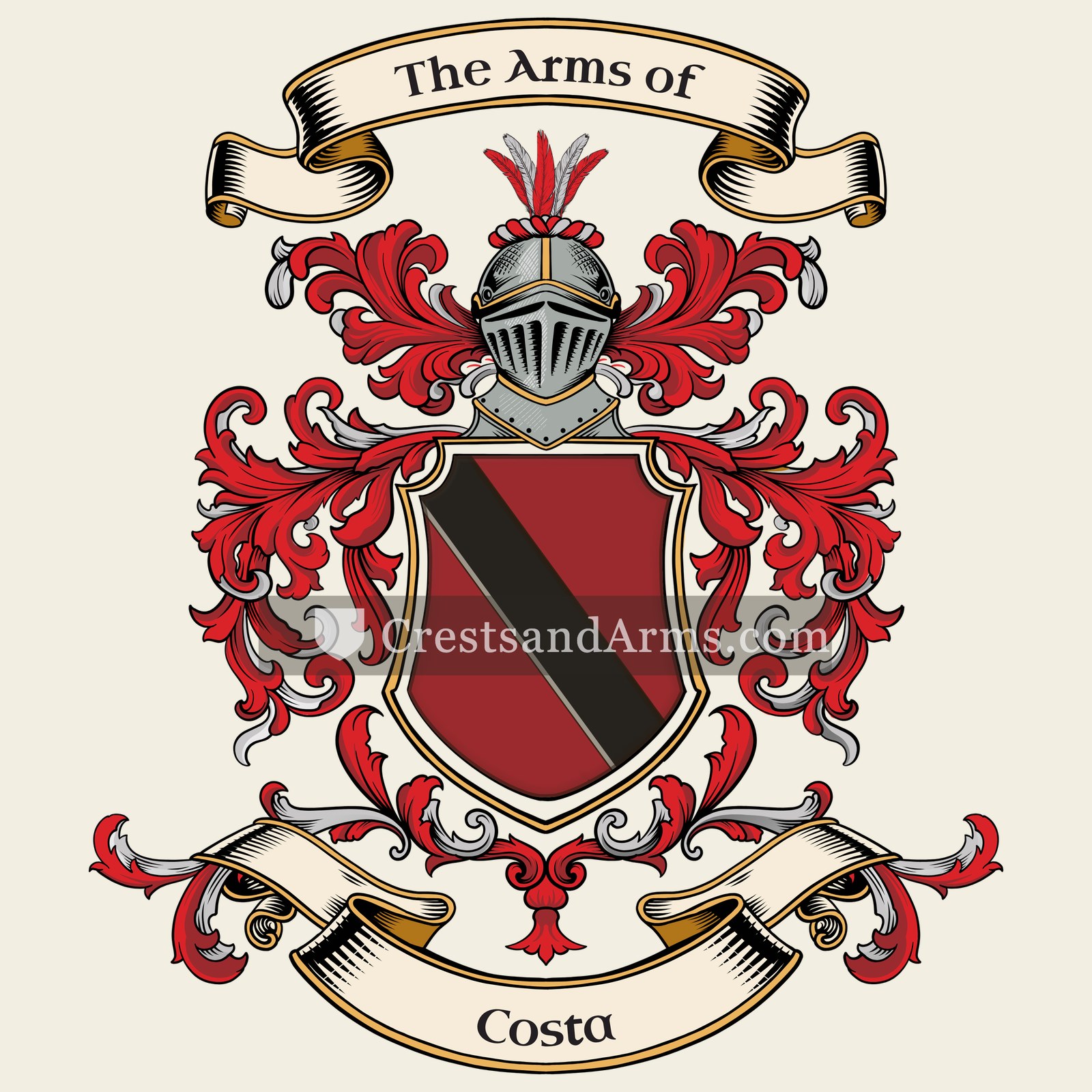
bendDefence, and the scarf of a commander
Colours
Red (Gules)Means: Military strength
Silver (Argent)Means: Peace and sincerity
Black (Sable)Means: Constancy
Historical info
Source
J. B. Rietstap, Armorial Général, Gouda: G. B. van Goor Zonen, 1884–87
Blazon (the actual original written record)
“Parti de gu. et d'arg.; à la bande de sa., br. sur le tout.”
ItalyRome, c. 1775
Digital archive packCoat of arms PNG, gold border print PDF, vector SVG and the certificate of authenticity. Sent to your email in minutes.
Map of Italy showing where the Costa arms are recorded
The Costa arms were recorded in Rome, c. 1775.
This is where the arms were entered in the register. Families often moved to other parts of the country, so the same name can turn up in more than one region.
The body that granted and recorded arms in Italy in this period.
Alvise Giovanni Mocenigo
Sovereign of the period
Alvise Giovanni Mocenigo
1763–1778
Reigning in France when the Costa arms are first recorded.
How Arms Worked in Italy
In the Italian states, coats of arms were often used by noble families to show their status and history. These symbols were passed down through the generations to all legitimate male descendants. Younger branches of a family usually kept the original design but sometimes added small changes to distinguish their specific line from the main branch.
Granting authority
Various local rulers and city governments controlled the use of coats of arms across the different Italian states.
How they got arms
Families often assumed their own arms or received them as official grants from local lords, popes, or city councils.
Where arms were recorded
Arms were recorded in local city archives or private family books rather than in one single national register.
The family's standing
Recorded among the armigerous families of Italy.
Origin & History of the Costa Family in Italy
The surname Costa is deeply rooted in the Italian language, originating from the Latin word *costa*, which means rib, side, or slope. In the context of early Italian history, the name was often used as a topographic descriptor to identify families who lived on the side of a hill or near a steep mountain path. By the time the family was firmly established in Rome during the late 18th century, the name had evolved from a simple geographic label into a recognized ancestral identity. Families bearing this name were often integrated into the urban fabric of Rome, where they participated in the local trades and social structures of the papal city. As the family navigated life in 1775, they were part of a long tradition of Italian lineages that defined themselves through their connection to the landscape and their enduring presence within the historic neighborhoods of the capital.
Coat of Arms & Family Crest Details
Colours
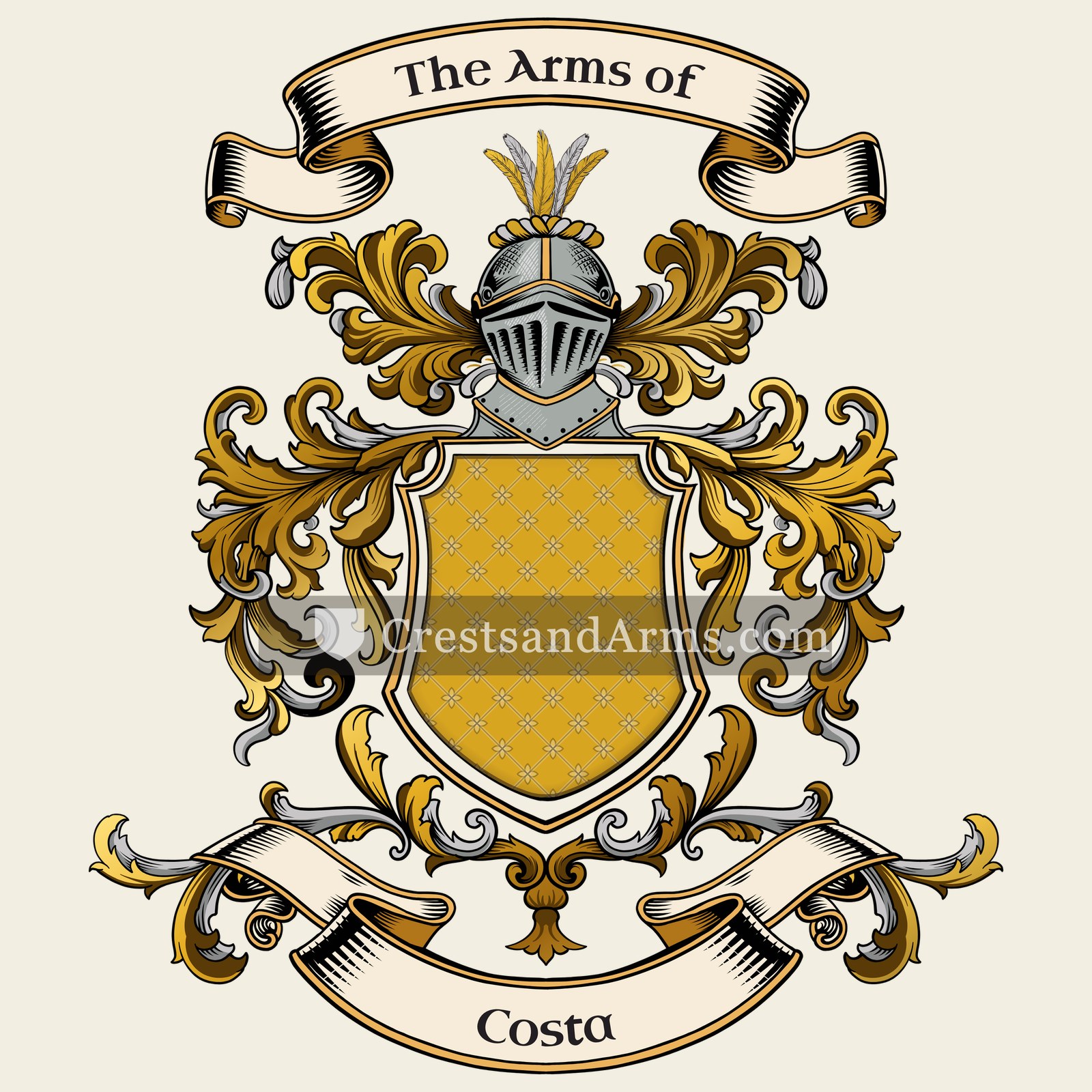
Gold (Or)Means: Generosity
Historical info
Source
J. B. Rietstap, Armorial Général, Gouda: G. B. van Goor Zonen, 1884–87
Blazon (the actual original written record)
“D'or à trois côtes d'homme de gu., posées en fasces, l'une sur l'autre. C.: un renne pass. au nat.”
Britainc. 1700
Digital archive packCoat of arms PNG, gold border print PDF, vector SVG and the certificate of authenticity. Sent to your email in minutes.
Map of Britain showing where the Costa arms are recorded
The Costa arms were recorded in Britain, c. 1700.
Arms such as these were typically recorded in Kent.
Kent sits between London and the short crossing to Europe, and the trade passing through made it wealthy. Merchant families bought land with that money, and it was landowners who took coats of arms.
This is where the arms were entered in the register. Families often moved to other parts of the country, so the same name can turn up in more than one region.
The body that granted and recorded arms in Britain in this period.
William III of England
Sovereign of the period
William III of England
1694–1702
Reigning in France when the Costa arms are first recorded.
How Arms Worked in Britain
English heraldry allowed arms to be shared by all legitimate descendants of the original owner. These symbols were treated as personal property that moved through the generations to all children. While the eldest son kept the original design, other family members could use the same shield without needing to change it or register their own unique versions.
Granting authority
The College of Arms in London has regulated the use of coats of arms throughout England and Wales since 1484.
How they got arms
Families typically obtained their coats of arms through a formal grant from the Crown or by proving their ancient right to them.
Where arms were recorded
All official coats of arms are recorded in the registers kept at the College of Arms, which date back to the fifteenth century.
The family's standing
Recorded among the armigerous families of Britain.
Origin & History of the Costa Family in Britain
The surname Costa arrived in Britain as part of a long tradition of migration from Southern Europe, particularly from the Mediterranean regions of Italy, Spain, and Portugal. While the name is deeply rooted in these Latin-speaking cultures, records confirm that family members were established in the county of Kent by the year 1700. During this period, Kent served as a vital gateway for continental travelers and merchants arriving via the English Channel. Families bearing this name often integrated into local trade networks or agricultural communities, bringing with them cultural influences from their homelands. Over the following century, these early settlers helped transition the name from a foreign identifier into a recognized part of the local English landscape. By settling in the southeast, the Costa family became part of the diverse social fabric that defined the coastal regions of Britain during the early modern era.
Costa Meaning & Related Branches
Root word
Costa
Derived from the Latin word costa meaning rib, side, or flank.
This name
CostaA topographic name for someone who lived on a slope or riverbank.
also spelled
Kosta
Costae
Costah
Related arms
Borelsimilar arms
Mendezsimilar arms
Temodiosimilar arms
Cattaneorecorded with Costa, same area
Documented Sources
J. B. Rietstap, Armorial Général, Gouda: G. B. van Goor Zonen, 1884–87
Capeille, Jean, Dictionnaire de biographies roussillonnaises, 1914
Archives Départementales des Pyrénées-Orientales, Série E: Familles et seigneuries, 1663
Puiggari, Pierre, Catalogue biographique des avocats du département des Pyrénées-Orientales, 1864
Digital archive packCoat of arms PNG, gold border print PDF, vector SVG and the certificate of authenticity. Sent to your email in minutes.


 cross symbolChristian faith and service
 mountThe ground held, and steadfastness upon it
 crownSovereignty, authority and just reward
 mulletThe third son, and a divine quality from above
 cross symbolChristian faith and service
 mountThe ground held, and steadfastness upon it
 crownSovereignty, authority and just reward
 mulletThe third son, and a divine quality from above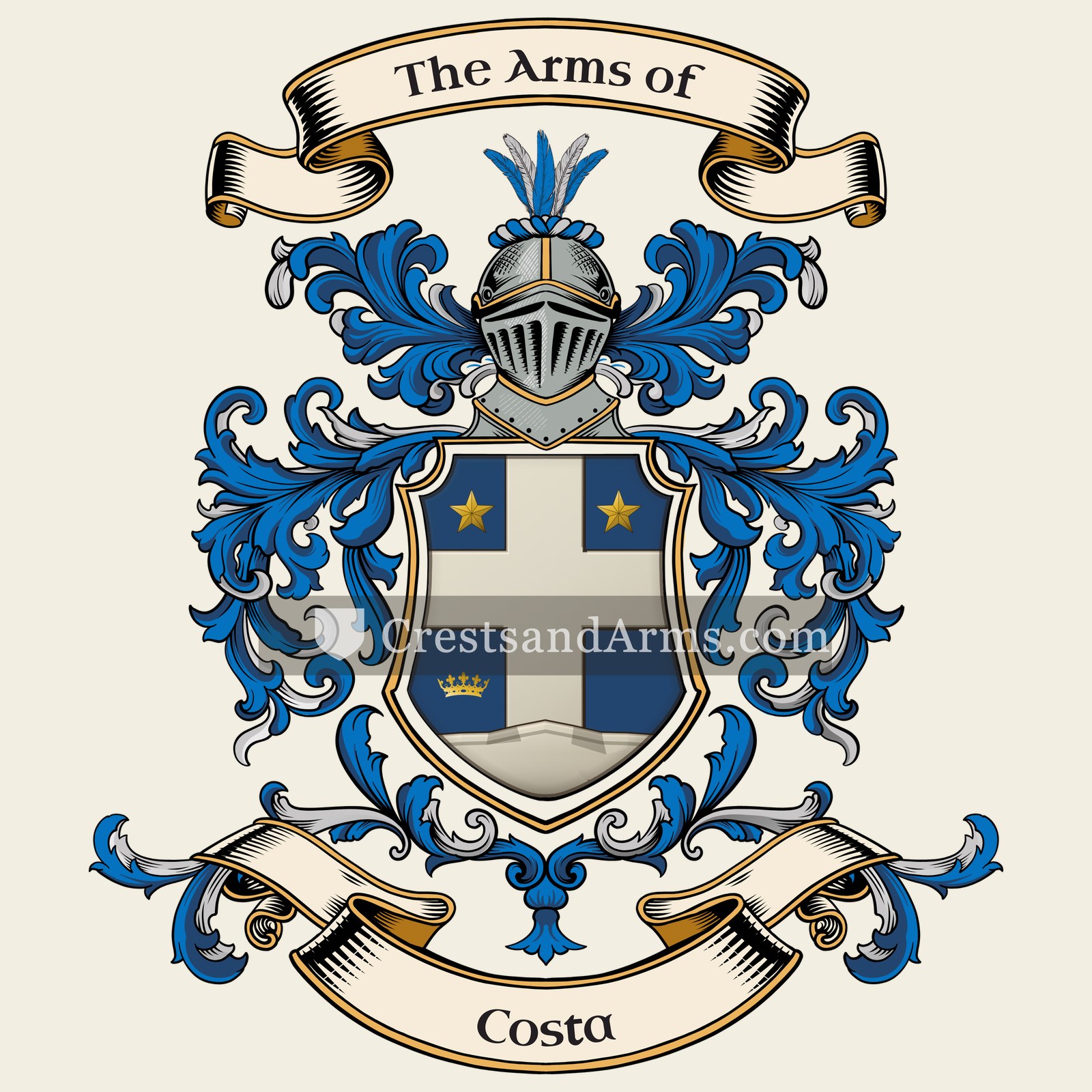


 bendDefence, and the scarf of a commander