Map of Spain showing where the Costales arms are recorded
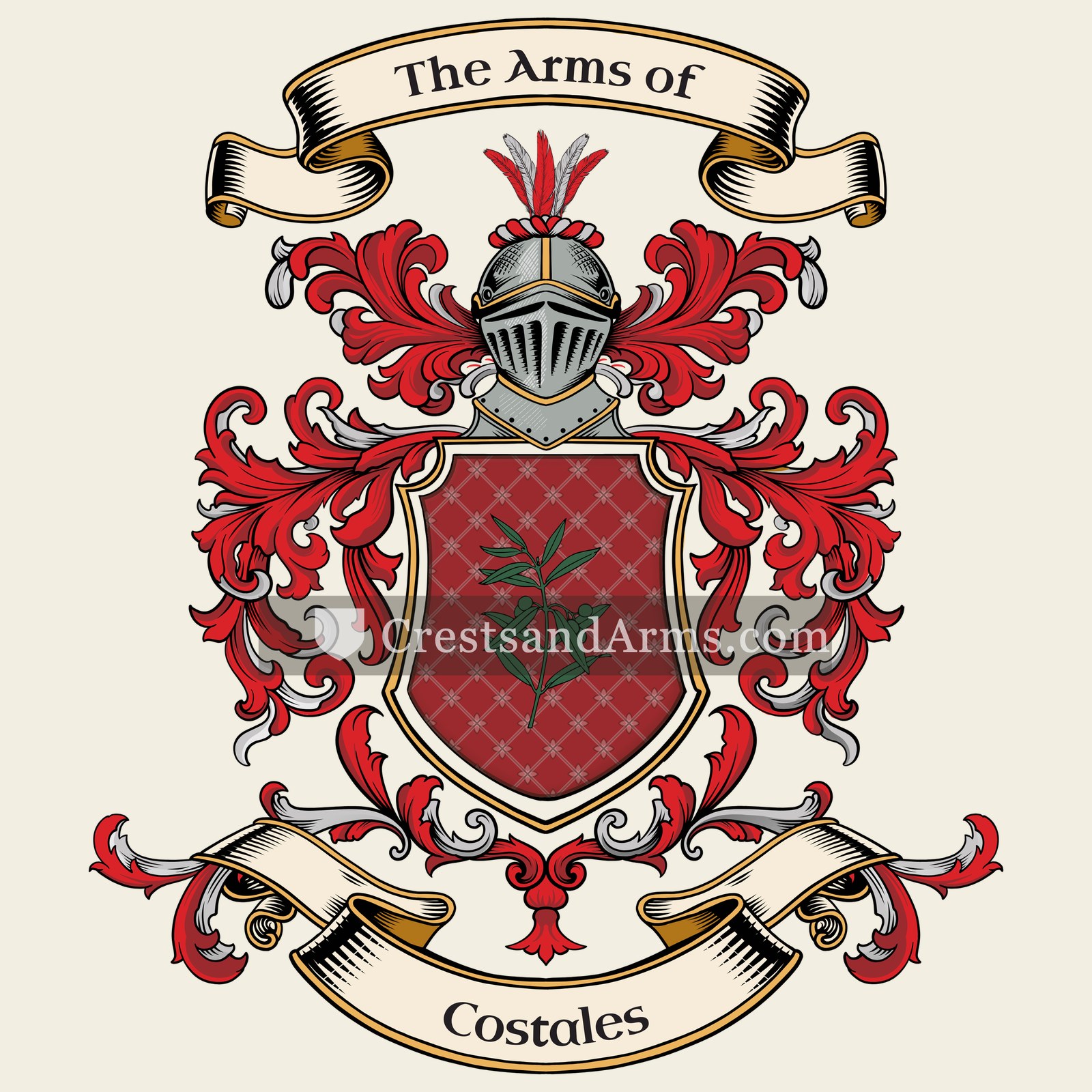
The Costales arms were recorded in Asturies, c. 1722.
This is where the arms were entered in the register. Families often moved to other parts of the country, so the same name can turn up in more than one region.
The body that granted and recorded arms in Spain in this period.
Philip V of Spain
Sovereign of the period
Philip V of Spain
1714–1724
Reigning in Spain when the Costales arms are first recorded.
How Arms Worked in Spain
In Spain, a coat of arms was considered a form of property that belonged to the entire family line. These arms were passed down from a father to all his children equally. Younger branches of the family usually kept the original design without needing to add any special marks to distinguish their specific line.
Granting authority
The Cronista Rey de Armas was the official body that regulated and granted coats of arms throughout Spain.
How they got arms
Families often obtained their arms through royal grants or by proving their noble status to the official heraldic authority.
Where arms were recorded
Coats of arms were officially recorded in the registers of the Cronista Rey de Armas starting in 1496.
The family's standing
Recorded among the armigerous families of Spain.
Origin & History of the Costales Family in Spain
The family name Costales finds its deepest historical roots in the rugged, mountainous region of Asturias in northern Spain. By the early eighteenth century, records confirm that members of the family were well-established in this area, particularly within the council of Piloña. The name itself is topographical, likely derived from the Spanish word "costal," which refers to a sack or a side, suggesting that the original bearers may have lived near a specific hillside or worked in trades involving the transport of goods. During the 1700s, the people of Asturias lived in small, tight-knit rural communities where families were often defined by their connection to the land and their local parish. As the family grew, they became part of the resilient cultural fabric of northern Spain, maintaining their presence in the Asturian valleys for generations before eventually spreading to other parts of the world.
Costales Meaning & Related Branches
Root word
Costa
Derived from the Latin word costa meaning rib, side, or slope.
This name
CostalesA topographic surname referring to someone who lived on a hillside or the slope of a mountain.
also spelled
Kostales
Costalez
Costaless
Documented Sources
J. B. Rietstap, Armorial Général, Gouda: G. B. van Goor Zonen, 1884–87
Archivo Histórico Diocesano de Oviedo, Libros Sacramentales de la Parroquia de San Juan de Berbío, 1722
Canella Secades, Fermín, El libro de Oviedo: guía descriptiva y histórica, 1887
Madoz, Pascual, Diccionario geográfico-estadístico-histórico de España y sus posesiones de Ultramar, 1845
Digital archive packCoat of arms PNG, gold border print PDF, vector SVG and the certificate of authenticity. Sent to your email in minutes.


 branchPeace, and new growth
 branchPeace, and new growth