Map of France showing where the Costea arms are recorded
The Costea arms were recorded in Lyonnais, c. 1663.
Lyonnais centred on Lyon, one of the great banking and silk towns of France. Money made in the city bought estates in the countryside around it, and those estates brought arms with them.
This is where the arms were entered in the register. Families often moved to other parts of the country, so the same name can turn up in more than one region.
The body that granted and recorded arms in France in this period.
Louis XIV of France
Sovereign of the period
Louis XIV of France
1643–1715
Reigning in France when the Costea arms are first recorded.
How Arms Worked in France
In France, a coat of arms was a mark of honor that passed down through the male line to all legitimate descendants. Families often used the same shield without changes to show their shared heritage. If a branch wanted to stand out, they could add a small mark to their shield to show their specific place in the family tree.
Granting authority
The Juge d'armes de France acted as the official authority that regulated and verified coats of arms across the country.
How they got arms
Families typically inherited their arms from ancestors, though they could also receive them through royal grants or by proving their noble status.
Where arms were recorded
Coats of arms were officially recorded in the Armorial Général de France, which began its main collection in the year 1696.
The family's standing
Recorded among the armigerous families of Lyonnais.
Origin & History of the Costea Family in France
The family name Costea first appears in the historical record of the Lyonnais region during the mid-seventeenth century, specifically documented in 1663. During this period, the Lyonnais area served as a vital crossroads for trade and migration, connecting the busy markets of Lyon to the surrounding rural provinces. Families bearing this name likely integrated into the local social fabric through agricultural labor or artisanal trades, which were the primary drivers of the regional economy at the time. Because the name reflects linguistic roots often associated with the Latin word for rib or side, it may have originally functioned as a descriptive nickname for a person living on the edge of a settlement or near a specific geographical boundary. By establishing themselves in this province, the early members of the Costea family participated in the steady growth of the French heartland, navigating the social shifts and economic demands that defined life under the reign of King Louis XIV.
Meaning of the Costea family crest colors & symbols
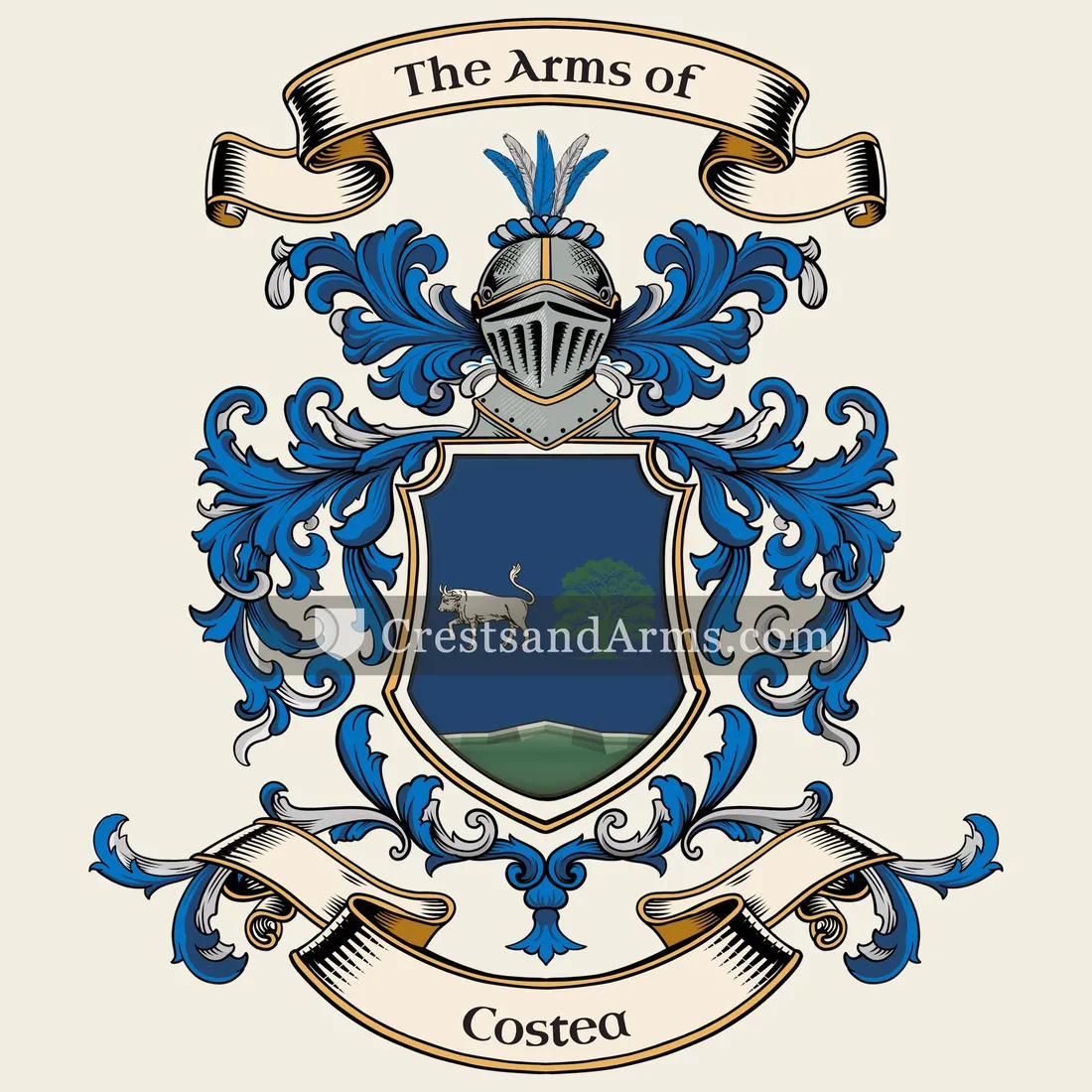
Symbols on this shield
mountThe ground held, and steadfastness upon it
bullValour and generosity
treeLife, endurance and deep roots
Colours
Blue (Azure)Means: Loyalty and truth
Green (Vert)Means: Hope
Silver (Argent)Means: Peace and sincerity
Historical info
Source
J. B. Rietstap, Armorial Général, Gouda: G. B. van Goor Zonen, 1884–87
Blazon (the actual original written record)
“D'azur à une vache d'arg., pass. au pied d'un arbre de sin., le tout soutenu d'une terrasse du même. Brl. de sin. et d'arg. C.: un arbre de sin. L. d'arg. et de sin.”
Netherlandsc. 1815
Digital archive packCoat of arms PNG, gold border print PDF, vector SVG and the certificate of authenticity. Sent to your email in minutes.
Map of Netherlands showing where the Costea arms are recorded
The Costea arms were recorded in Netherlands, c. 1815.
Arms such as these were typically recorded in Friesland.
Friesland was low, wet country on the northern coast of the Netherlands, farmed by families who had held the same land for centuries. Free landholders were unusually common there, and a free landholder could carry arms.
This is where the arms were entered in the register. Families often moved to other parts of the country, so the same name can turn up in more than one region.
Region
Friesland
First recorded
1815
Granting Authority for the Costea Arms
Hoge Raad van Adel
Photograph made by me · CC BY-SA 3.0
The body that granted and recorded arms in Netherlands in this period.
William I of the Netherlands
Sovereign of the period
William I of the Netherlands
1815–1840
Reigning in France when the Costea arms are first recorded.
How Arms Worked in Netherlands
In the Netherlands, coats of arms were often used by noble families and those who held specific public offices. These arms were passed down through the generations to legitimate descendants. Younger branches of a family usually kept the original design without needing to add special marks. This system ensured that the family identity remained clear and consistent over many years.
Granting authority
The Hoge Raad van Adel is the official body that regulates and manages noble titles and coats of arms in the Netherlands.
How they got arms
Families typically obtained their coats of arms through official royal grants or by proving their long-standing historical use of the symbols.
Where arms were recorded
Coats of arms are officially recorded in the registers held by the Hoge Raad van Adel, which began its work in 1814.
The family's standing
Recorded among the armigerous families of Netherlands.
Origin & History of the Costea Family in Netherlands
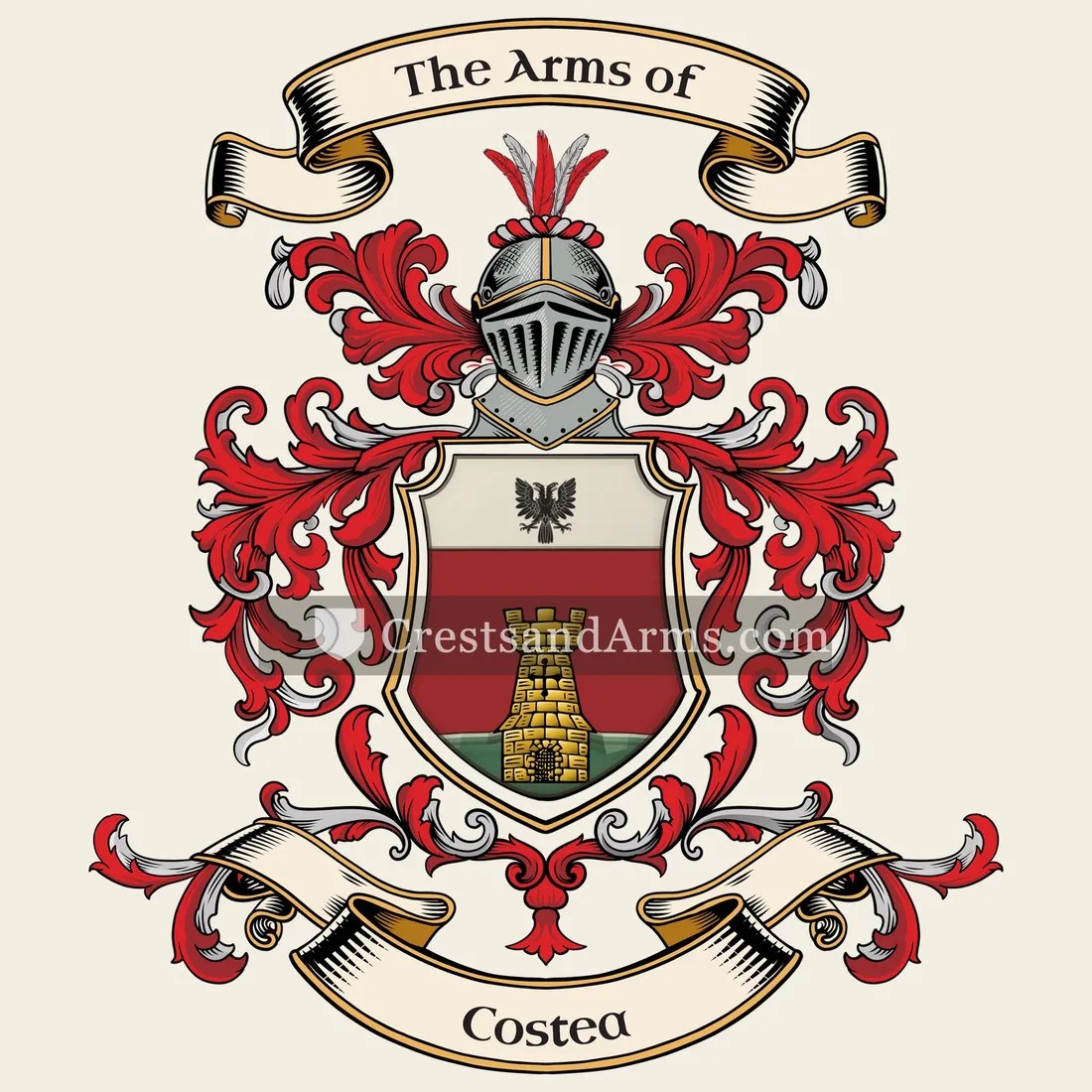
The history of the Costea name in the Netherlands begins with the arrival of family members in the northern province of Friesland around 1815. During this period, the Napoleonic Wars had recently concluded, and the Netherlands was undergoing significant administrative changes, including the formal registration of surnames for tax and military purposes. While the name Costea has roots in Eastern and Southeastern Europe, its appearance in Frisian records suggests that these early ancestors were likely part of the movement of people across the continent during the transition from the French occupation to the establishment of the United Kingdom of the Netherlands. These early settlers integrated into the local Frisian community, adapting to the unique linguistic and social environment of the region. By settling in Friesland, the family became part of the local demographic landscape during a time when the Dutch government was standardizing civil registration, which helped solidify the name within the official records of the province.
Meaning of the Costea family crest colors & symbols
Symbols on this shield
mountThe ground held, and steadfastness upon it
chiefAuthority, wisdom and dominion
towerGrandeur and solidity, and a stronghold defended
eagleNobility, strength and a keen mind
Colours
Red (Gules)Means: Military strength
Silver (Argent)Means: Peace and sincerity
Green (Vert)Means: Hope
Gold (Or)Means: Generosity
Black (Sable)Means: Constancy
Historical info
Source
J. B. Rietstap, Armorial Général, Gouda: G. B. van Goor Zonen, 1884–87
Blazon (the actual original written record)
“De gu. à une tour d'or, ouv. de sin. et posée sur une terrasse isolée du même; au chev. d'arg., ch. d'une aigie iss. de sa., languée de gu. (ou: De gu. à une tour d'or, ouv. d'azur, s'élevant d'une mer d'arg.; au chef du même, ch. d'une aigie iss. de sa., languée de gu., cour. d'or. Cq. cour. C.: une aigie iss. de sa., languée de gu., cour. d'or. L. de gu. et d'or. S.: deux griffons d'or, arm. et lamp. de gu.”
BelgiumBruges, c. 1737
Digital archive packCoat of arms PNG, gold border print PDF, vector SVG and the certificate of authenticity. Sent to your email in minutes.
Map of Belgium showing where the Costea arms are recorded
The Costea arms were recorded in Bruges, c. 1737.
This is where the arms were entered in the register. Families often moved to other parts of the country, so the same name can turn up in more than one region.
The body that granted and recorded arms in Belgium in this period.
Charles VI, Holy Roman Emperor
Sovereign of the period
Charles VI, Holy Roman Emperor
1711–1740
Reigning in France when the Costea arms are first recorded.
How Arms Worked in Belgium
In Belgium, a coat of arms is considered personal property that is passed down through the male line to legitimate descendants. Families often use the same shield design across generations to show their shared heritage. If a branch of the family wants to change the design, they must apply for an official update to their specific version of the arms.
Granting authority
The Conseil héraldique is the official body that regulates and approves all coats of arms in Belgium.
How they got arms
Families obtain their coats of arms through formal royal grants or by confirming their historical right to use existing designs.
Where arms were recorded
All approved coats of arms are officially recorded in the public registers of the Conseil héraldique since 1844.
The family's standing
Recorded among the armigerous families of Belgium.
Origin & History of the Costea Family in Belgium
The history of the Costea family in Belgium begins with their documented presence in the historic city of Bruges by 1737. During this period, Bruges was a vital center for trade and craftsmanship, attracting families who sought to build new lives within its prosperous merchant networks. While the name itself carries roots that stretch across European borders, its appearance in the local records of Bruges suggests that these early family members were integrated into the urban fabric of the Low Countries. They likely navigated the complex social and economic landscape of the eighteenth century by participating in the local guilds or the bustling maritime commerce that defined the region. By settling in such a prominent hub, the early Costea family members became part of the long tradition of migration that shaped the diverse population of Belgian cities. Their presence in these official records serves as a testament to their early transition into the local community and their role in the ongoing development of the city.
Costea Meaning & Related Branches
Root word
Constantinus
Derived from the Latin word for constant or steadfast.
This name
CosteaA Romanian diminutive form of Constantine, signifying someone who is firm and unchanging.
also spelled
Koste
Cost
Costee
Kostay
Documented Sources
J. B. Rietstap, Armorial Général, Gouda: G. B. van Goor Zonen, 1884–87
Archives Départementales du Rhône, Registres paroissiaux de la province du Lyonnais, 1663
Béghain, Patrice, Dictionnaire historique de Lyon, 2009
Fédou, René, Les hommes et la terre à Lyon et dans son arrière-pays, 1978
Digital archive packCoat of arms PNG, gold border print PDF, vector SVG and the certificate of authenticity. Sent to your email in minutes.


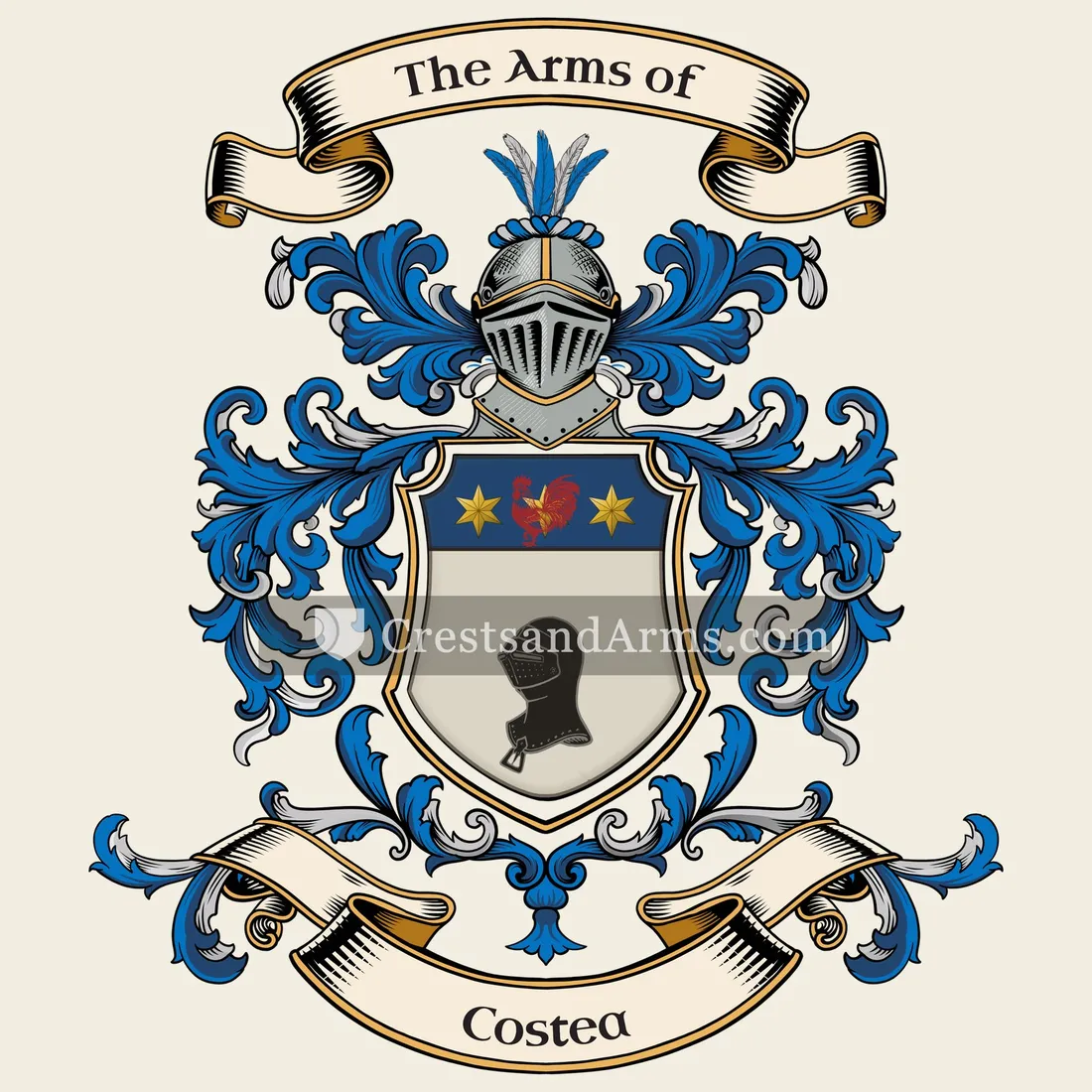
 chiefAuthority, wisdom and dominion
 helmetWisdom and security in defence
 starThe celestial goddess, and nobility
 cockCourage, vigilance and readiness for battle
 chiefAuthority, wisdom and dominion
 helmetWisdom and security in defence
 starThe celestial goddess, and nobility
 cockCourage, vigilance and readiness for battle


 mountThe ground held, and steadfastness upon it
 bullValour and generosity
 treeLife, endurance and deep roots


 towerGrandeur and solidity, and a stronghold defended
 eagleNobility, strength and a keen mind