Map of Britain showing where the Costello arms are recorded
The Costello arms were recorded in Britain, c. 1700.
Arms such as these were typically recorded in Kent.
Kent sits between London and the short crossing to Europe, and the trade passing through made it wealthy. Merchant families bought land with that money, and it was landowners who took coats of arms.
This is where the arms were entered in the register. Families often moved to other parts of the country, so the same name can turn up in more than one region.
The body that granted and recorded arms in Britain in this period.
William III of England
Sovereign of the period
William III of England
1694–1702
Reigning in Britain when the Costello arms are first recorded.
How Arms Worked in Britain
English heraldry allowed arms to be shared by all legitimate descendants of the original owner. These symbols were treated as personal property that moved through the generations to all children. While the eldest son kept the original design, other family members could use the same shield without needing to change it or register their own unique versions.
Granting authority
The College of Arms in London has regulated the use of coats of arms throughout England and Wales since 1484.
How they got arms
Families typically obtained their coats of arms through a formal grant from the Crown or by proving their ancient right to them.
Where arms were recorded
All official coats of arms are recorded in the registers kept at the College of Arms, which date back to the fifteenth century.
The family's standing
Recorded among the armigerous families of Britain.
Origin & History of the Costello Family in Britain
The Costello family name has roots that stretch back to the medieval period, though its presence in Britain became more established during the eighteenth century. By the year 1700, records show that members of the family were settled in the county of Kent. During this era, families often moved across the Irish Sea to England for better economic opportunities or to escape political instability. Once in Kent, the Costellos integrated into the local agricultural and trade communities that defined the region at the time. They lived through a period of significant social change as the British economy shifted toward early industrialization. Over the following decades, the family name became a part of the local fabric, reflecting the broader patterns of migration and settlement that shaped the population of southern England.
Coat of Arms & Family Crest Details
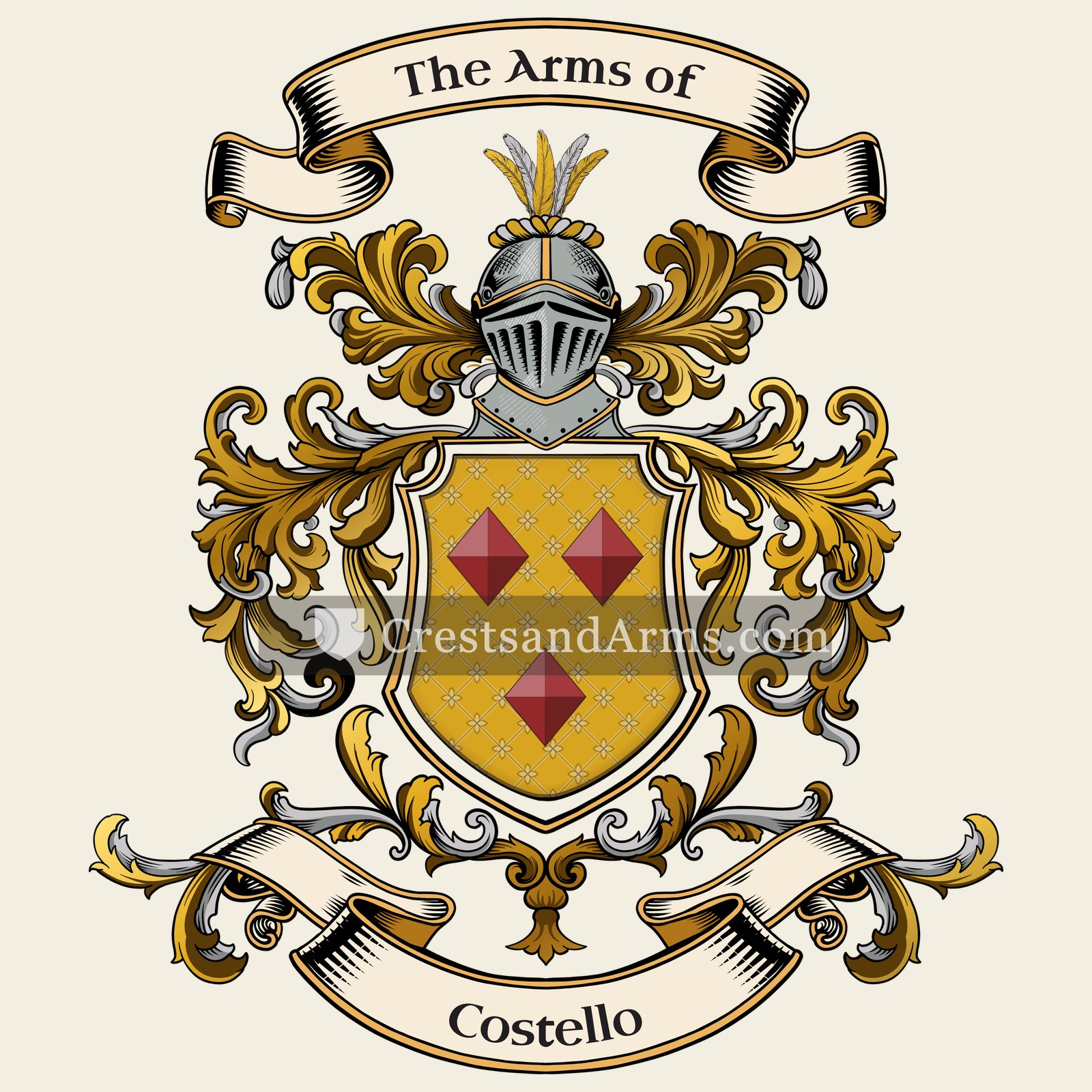
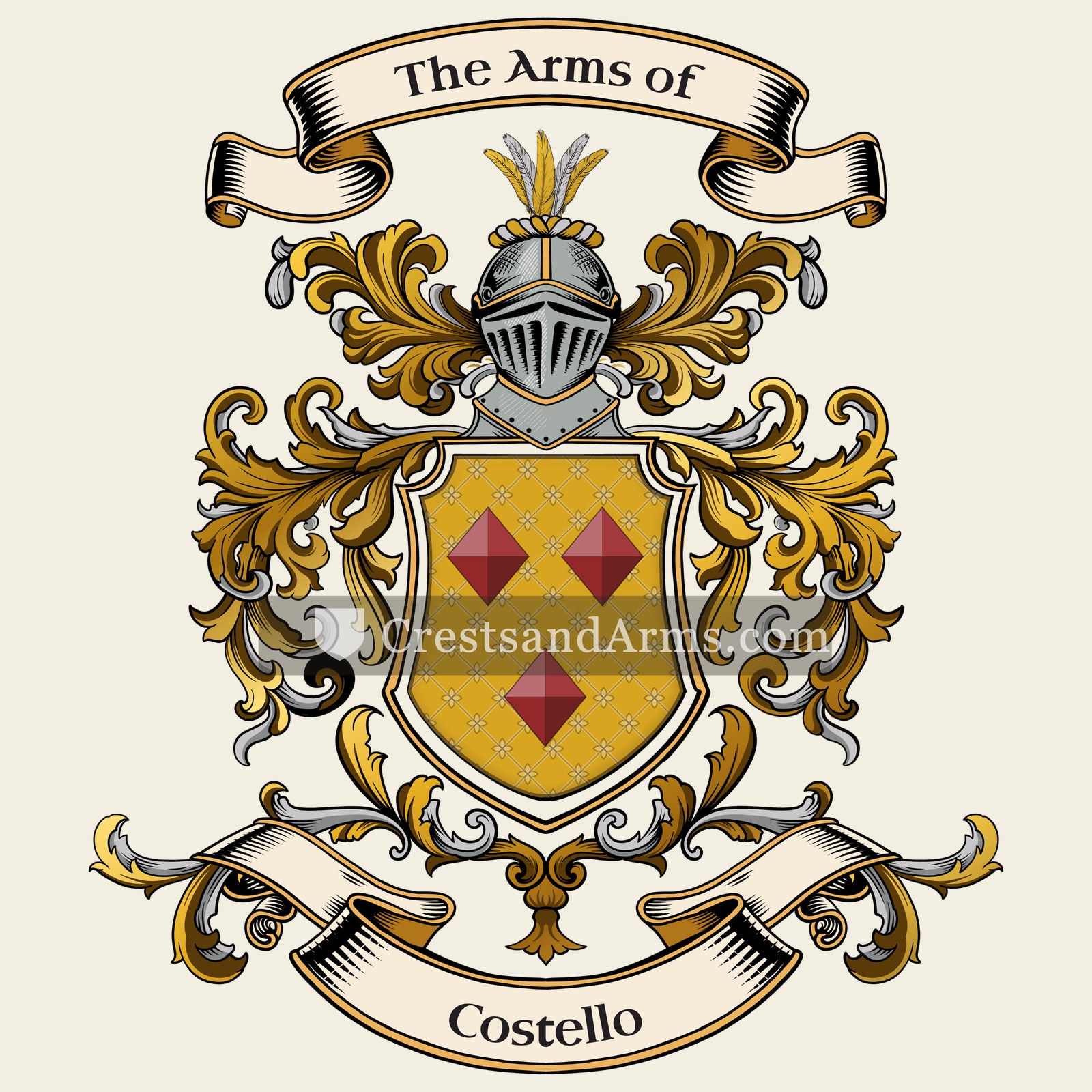
Symbols on this shield
lozengeHonour and nobility, and the arms of a woman
Colours
Gold (Or)Means: Generosity
Red (Gules)Means: Military strength
Historical info
Source
Sir Bernard Burke, The General Armory of England, Scotland, Ireland and Wales, London: Harrison & Sons, 1884
Blazon (the actual original written record)
“Or, three lozenges gu”
MayoCastlemore · Mayo, c. 1586
Digital archive packCoat of arms PNG, gold border print PDF, vector SVG and the certificate of authenticity. Sent to your email in minutes.
Map of Ireland showing where the Costello arms are recorded
The Costello arms were recorded in Mayo, c. 1586.
Mayo was poor western Irish country of bog and mountain, held by a small number of old families. Land changed hands rarely there, and families who held on appear in the records.
This is where the arms were entered in the register. Families often moved to other parts of the country, so the same name can turn up in more than one region.
The body that granted and recorded arms in Ireland in this period.
Elizabeth I of England
Sovereign of the period
Elizabeth I of England
1558–1603
Reigning in Britain when the Costello arms are first recorded.
How Arms Worked in Ireland
The Ulster King of Arms granted coats of arms to individuals who proved their social standing and good character. These symbols were typically inherited by all legitimate descendants of the original holder. If a family branch wanted a unique look, they could apply for a specific change to their design through the office to ensure their identity remained distinct.
Granting authority
The Ulster King of Arms acted as the official body that regulated and issued all coats of arms throughout Ireland.
How they got arms
Families obtained their arms through formal grants issued by the office after proving their eligibility and paying the required fees.
Where arms were recorded
All official grants were recorded in the registers held by the Ulster King of Arms starting from the year 1552.
The family's standing
Recorded among the armigerous families of Mayo.
Origin & History of the Costello Family in Ireland
The surname Costello finds its deepest roots in the province of Connacht, specifically within County Mayo. The name is an anglicized version of the Gaelic name Mac Oisdealbhaigh, which translates to the son of Oisdealbhach. The original Oisdealbhach was a Norse-Gaelic figure, meaning the family line blended Viking heritage with native Irish traditions. By the late sixteenth century, the family had established a significant presence in the barony of Costello in County Mayo. Records from 1586 confirm that the family held substantial influence in this region during a time of great political transition in Ireland. Over the following centuries, the family became deeply integrated into the local culture of the west of Ireland, maintaining their connection to the land and their unique ancestral identity through generations of change.
Costello Meaning & Related Branches
Root word
Costin
A diminutive form of the name Constantine meaning constant or steadfast.
This name
CostelloA patronymic surname derived from the Old French personal name Costel meaning little rib.
also spelled
Kostello
Costelloe
Kostelo
Costelow
Costiloe
Related arms
Eustacerecorded with Costello, same area
Documented Sources
J. B. Rietstap, Armorial Général, Gouda: G. B. van Goor Zonen, 1884–87
Cottle, Basil, The Penguin Dictionary of Surnames, 1967
Reaney, P.H. and Wilson, R.M., A Dictionary of English Surnames, 1991
The National Archives, Parish registers of Kent, series RG 4
Digital archive packCoat of arms PNG, gold border print PDF, vector SVG and the certificate of authenticity. Sent to your email in minutes.


 lozengeHonour and nobility, and the arms of a woman
 lozengeHonour and nobility, and the arms of a woman