Map of Netherlands showing where the Coster arms are recorded
The Coster arms were recorded in Amsterdam, c. 1815.
This is where the arms were entered in the register. Families often moved to other parts of the country, so the same name can turn up in more than one region.
Region
Amsterdam
Town
Amsterdam
First recorded
1815
Granting Authority for the Coster Arms
Hoge Raad van Adel
Photograph made by me · CC BY-SA 3.0
The body that granted and recorded arms in Netherlands in this period.
William I of the Netherlands
Sovereign of the period
William I of the Netherlands
1815–1840
Reigning in Netherlands when the Coster arms are first recorded.
How Arms Worked in Netherlands
In the Netherlands, coats of arms were often used by noble families and those who held specific public offices. These arms were passed down through the generations to legitimate descendants. Younger branches of a family usually kept the original design without needing to add special marks. This system ensured that the family identity remained clear and consistent over many years.
Granting authority
The Hoge Raad van Adel is the official body that regulates and manages noble titles and coats of arms in the Netherlands.
How they got arms
Families typically obtained their coats of arms through official royal grants or by proving their long-standing historical use of the symbols.
Where arms were recorded
Coats of arms are officially recorded in the registers held by the Hoge Raad van Adel, which began its work in 1814.
The family's standing
Recorded among the armigerous families of Netherlands.
Origin & History of the Coster Family in Netherlands
The surname Coster has deep roots in the Netherlands, where it functioned as an occupational name for a sacristan or a church official. During the Middle Ages, people often adopted names based on their daily work, and those who managed the maintenance and religious items of a local parish were known as a koster. By the time the family was firmly established in Amsterdam in 1815, the name had evolved from a job title into a permanent hereditary surname. During this era, Amsterdam was a bustling center of trade and social change following the end of the Napoleonic Wars. Families like the Costers were part of the growing urban population that helped shape the city as it transitioned into the modern Dutch state. The name reflects a long history of community service and religious involvement that stretches back centuries before the family became a recognized part of the Amsterdam records in the early nineteenth century.
Coat of Arms & Family Crest Details
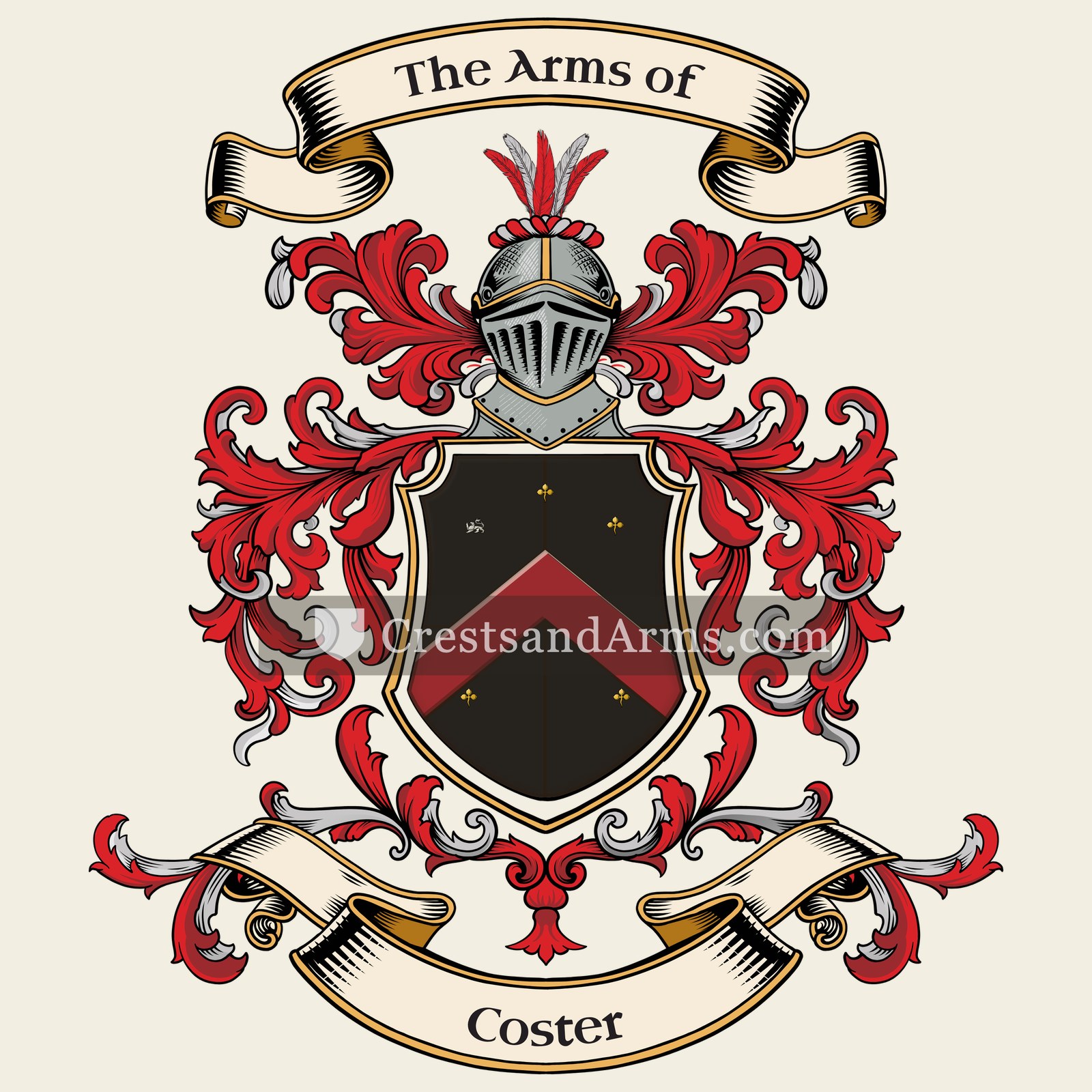
Symbols on this shield
chevronProtection, and faithful service completed
lionCourage, strength and royalty
trefoilPerpetuity, and the Trinity
Colours
Black (Sable)Means: Constancy
Red (Gules)Means: Military strength
Silver (Argent)Means: Peace and sincerity
Gold (Or)Means: Generosity
Historical info
Source
J. B. Rietstap, Armorial Général, Gouda: G. B. van Goor Zonen, 1884–87
Blazon (the actual original written record)
“Ec.: aux 1 et 4 de sa. au lion d'arg., supp. de sa patte dextre un trèfle d'or; aux 2 et 3 d'arg. au chev. de gu. Sur le tout d'azur à trois trèfles couchés d'or, les queues à sen., rangés en pal. Trois cq. cour. C.: 1° et 3° un demi-vol aux armes du 1, celui à dextre cont.; 2° le lion, iss. L. d'arg. et d'azur. T.: deux chevaliers, tenant chacun une bannière bordée d'or, ch. des armes du surtout.”
BavariaBavaria, c. 1827
Digital archive packCoat of arms PNG, gold border print PDF, vector SVG and the certificate of authenticity. Sent to your email in minutes.
Map of Germany showing where the Coster arms are recorded
The Coster arms were recorded in Bavaria, c. 1827.
Bavaria was a country of old landed families and walled market towns. Estates passed down the same line for centuries, and both the landowners and the leading townsmen kept arms, which is why so many Bavarian names sit in the registers.
This is where the arms were entered in the register. Families often moved to other parts of the country, so the same name can turn up in more than one region.
The body that granted and recorded arms in Germany in this period.
Frederick William III of Prussia
Sovereign of the period
Frederick William III of Prussia
1797–1840
Reigning in Netherlands when the Coster arms are first recorded.
How Arms Worked in Germany
Prussian heraldry was strictly tied to social rank and noble status rather than being a free choice for every citizen. These symbols were treated as permanent family property that moved through the generations to all legitimate heirs. If a family branch wanted to change their design to stand out, they had to apply for official permission to alter their specific version of the shield.
Granting authority
The Prussian Heroldsamt acted as the central state office that managed and strictly controlled all noble titles and coats of arms.
How they got arms
Families usually obtained their arms through formal royal grants or by proving their long-standing noble status to the state authorities.
Where arms were recorded
All official coats of arms were kept in the rolls of the Prussian Heroldsamt, which functioned from 1706 until 1918.
The family's standing
Recorded among the armigerous families of Bavaria.
Origin & History of the Coster Family in Germany
The surname Coster is rooted in the occupational history of medieval Europe, where it functioned as a descriptive term for people who worked as sacristans or church officials. In the German-speaking regions, the name evolved from the Latin word *custos*, which translates to guardian or keeper. By the early 19th century, records confirm that families bearing this name were well-established in the southern state of Bavaria. These early ancestors likely lived in tight-knit agricultural or artisan communities where their family name served as a link to their traditional duties within the local parish. As the region underwent significant social and political changes during the 1820s, these families maintained their presence in the Bavarian landscape, contributing to the local economy and the cultural fabric of their villages. This period marked a time of transition for many German families, and the Coster name remained a steady identifier for those who had deep roots in the Bavarian countryside.
Coster Meaning & Related Branches
Root word
Custos
Latin term meaning a guardian, warden, or keeper.
This name
CosterAn occupational surname for a sexton, sacristan, or someone who guarded a building.
also spelled
Koster
Related arms
Coestervariant spelling
Köstervariant spelling
Documented Sources
J. B. Rietstap, Armorial Général, Gouda: G. B. van Goor Zonen, 1884–87
Beem, H., De Joodse afkomst van Nederlandse familienamen, 1974
Meertens, P.J., De betekenis van Nederlandse familienamen, 1959


 dovePeace, love and the Holy Spirit
 dovePeace, love and the Holy Spirit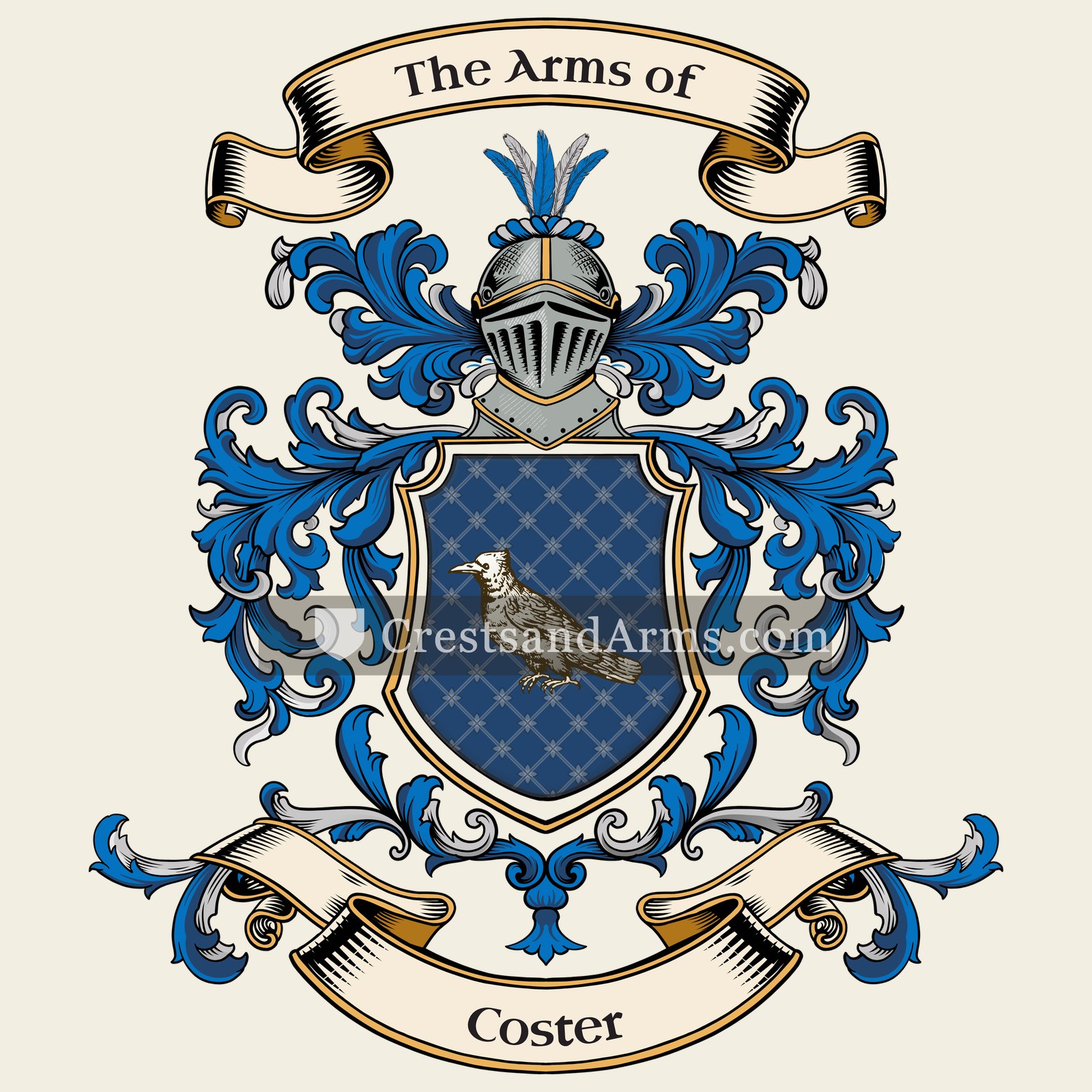


 chevronProtection, and faithful service completed
 lionCourage, strength and royalty
 trefoilPerpetuity, and the Trinity