Map of Switzerland showing where the Cotten arms are recorded
The Cotten arms were recorded in Fribourg, c. 1745.
This is where the arms were entered in the register. Families often moved to other parts of the country, so the same name can turn up in more than one region.
The body that granted and recorded arms in Switzerland in this period.
How Arms Worked in Switzerland
In Switzerland, coats of arms were not restricted to the nobility and were often adopted by common citizens and families. These symbols were passed down through generations to show family identity. When branches of a family grew, they often changed small details of the design to distinguish their own line from the original group.
Granting authority
Cantonal and civic authorities managed the use of coats of arms within their specific regions and local jurisdictions.
How they got arms
Families typically assumed their own coats of arms based on local custom rather than receiving them from a central monarch.
Where arms were recorded
Arms were recorded in various cantonal and civic registers starting from the fourteenth century throughout the Swiss region.
The family's standing
Recorded among the armigerous families of Switzerland.
Origin & History of the Cotten Family in Switzerland
The history of the Cotten family in Switzerland is deeply rooted in the cultural landscape of the Fribourg region. By the year 1745, members of the family were already established residents within this area, which was known for its mix of French and German linguistic traditions. During the eighteenth century, families like the Cottens often played vital roles in the local agricultural economy or served as skilled tradespeople in the growing urban centers. Life in Fribourg at this time was heavily influenced by the local government and the church, which kept detailed records of births, marriages, and deaths to track the population. The presence of the family in this specific region suggests they were part of a stable community that valued local ties and regional identity. Over time, the name became woven into the fabric of the local society, reflecting the broader patterns of migration and settlement that defined the Swiss cantons during the Enlightenment era.
Meaning of the Cotten family crest colors & symbols
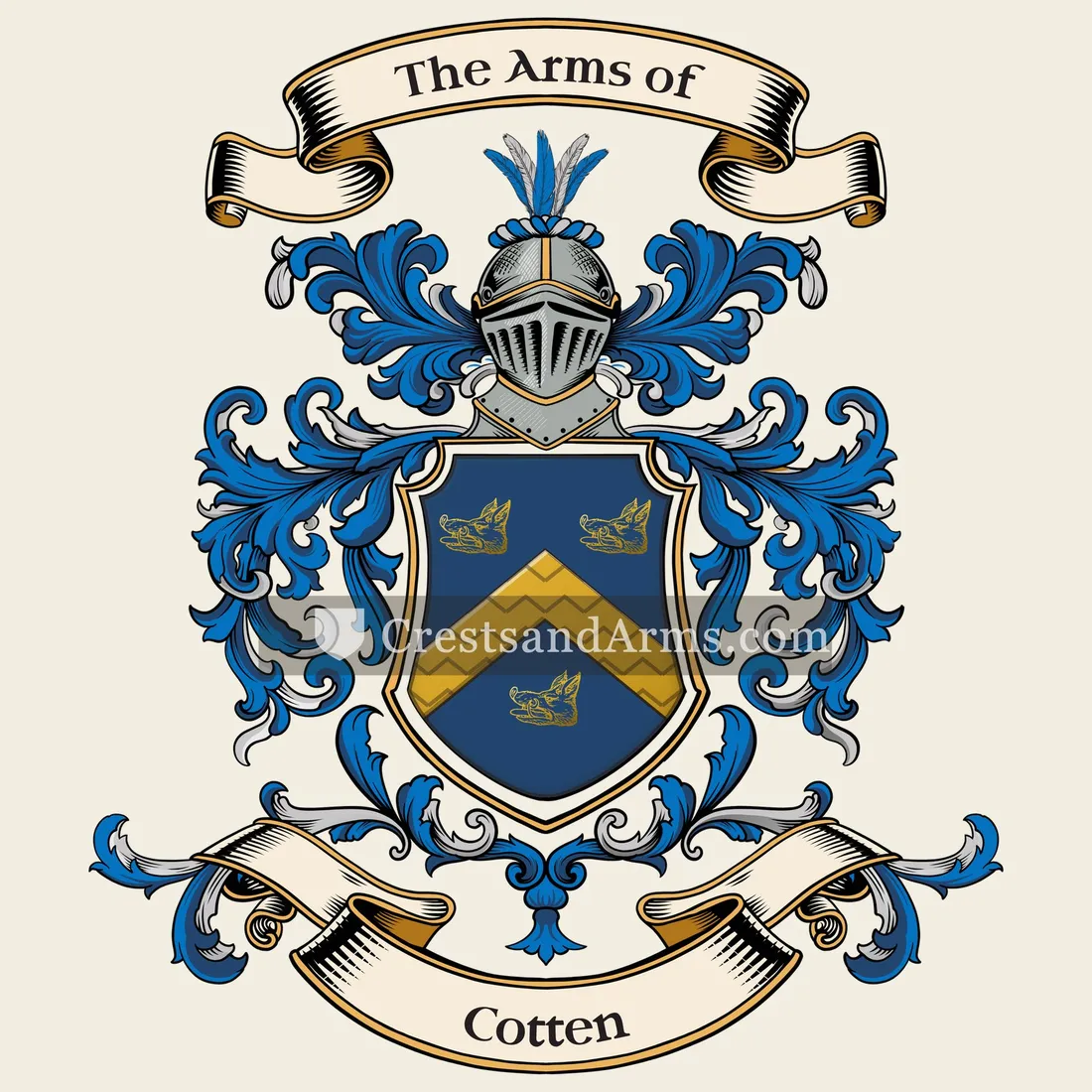
Symbols on this shield
chevronProtection, and faithful service completed
boars headA fierce fighter who battles to the end
Colours
Blue (Azure)Means: Loyalty and truth
Gold (Or)Means: Generosity
Historical info
Source
Sir Bernard Burke, The General Armory of England, Scotland, Ireland and Wales, London: Harrison & Sons, 1884
Blazon (the actual original written record)
“Az. two chev. betw. three boars' heads erased or”
Englandc. 1620
Digital archive packCoat of arms PNG, gold border print PDF, vector SVG and the certificate of authenticity. Sent to your email in minutes.
Map of England showing where the Cotten arms are recorded
The Cotten arms were recorded in England, c. 1620.
Arms such as these were typically recorded in York.
Yorkshire is the largest of the English counties, and it held more gentry families than any other. Land there was split among a great many households rather than a few, so a great many of them carried arms.
This is where the arms were entered in the register. Families often moved to other parts of the country, so the same name can turn up in more than one region.
The body that granted and recorded arms in England in this period.
James VI and I
Sovereign of the period
James VI and I
1603–1625
Reigning in Switzerland when the Cotten arms are first recorded.
How Arms Worked in England
English heraldry allowed arms to be shared by all legitimate descendants of the original owner. These symbols were treated as personal property that moved through the generations to all children. While the eldest son kept the original design, other family members could use the same shield without needing to change it or register their own unique versions.
Granting authority
The College of Arms in London has regulated the use of coats of arms throughout England and Wales since 1484.
How they got arms
Families typically obtained their coats of arms through a formal grant from the Crown or by proving their ancient right to them.
Where arms were recorded
All official coats of arms are recorded in the registers kept at the College of Arms, which date back to the fifteenth century.
The family's standing
Recorded among the armigerous families of England.
Origin & History of the Cotten Family in England
The surname Cotten is rooted in the landscape of medieval England, where it functioned as a topographical name for families living near a field of cotton or a patch of cultivated land. By the early 17th century, the name was well-established in northern England, particularly within the city of York. Records confirm that members of the Cotten family were active residents in York by 1620, a time when the city served as a vital hub for trade and regional administration. During this period, families with this name were often integrated into the local merchant class or the skilled trades that supported the city’s economy. As the family grew, they became part of the social fabric of Yorkshire, contributing to the development of the region through their professional work and community involvement. This history reflects the broader movement of English families who settled in established urban centers to build stable lives during the early modern era.
Cotten Meaning & Related Branches
Root word
Cottus
A Latin term referring to a type of small fish or head.
This name
CottenAn occupational name for a maker of cotte, a type of medieval tunic.
also spelled
Kottens
Cotten
Kotens
Documented Sources
J. B. Rietstap, Armorial Général, Gouda: G. B. van Goor Zonen, 1884–87
State Archives of Fribourg (Archives de l'État de Fribourg), Registres paroissiaux de la ville de Fribourg
Kuenlin, Franz, Dictionnaire géographique, statistique et historique du canton de Fribourg, 1832
Staehli, Alfred, Kulturdenkmäler in Freiburg, 1977
Digital archive packCoat of arms PNG, gold border print PDF, vector SVG and the certificate of authenticity. Sent to your email in minutes.


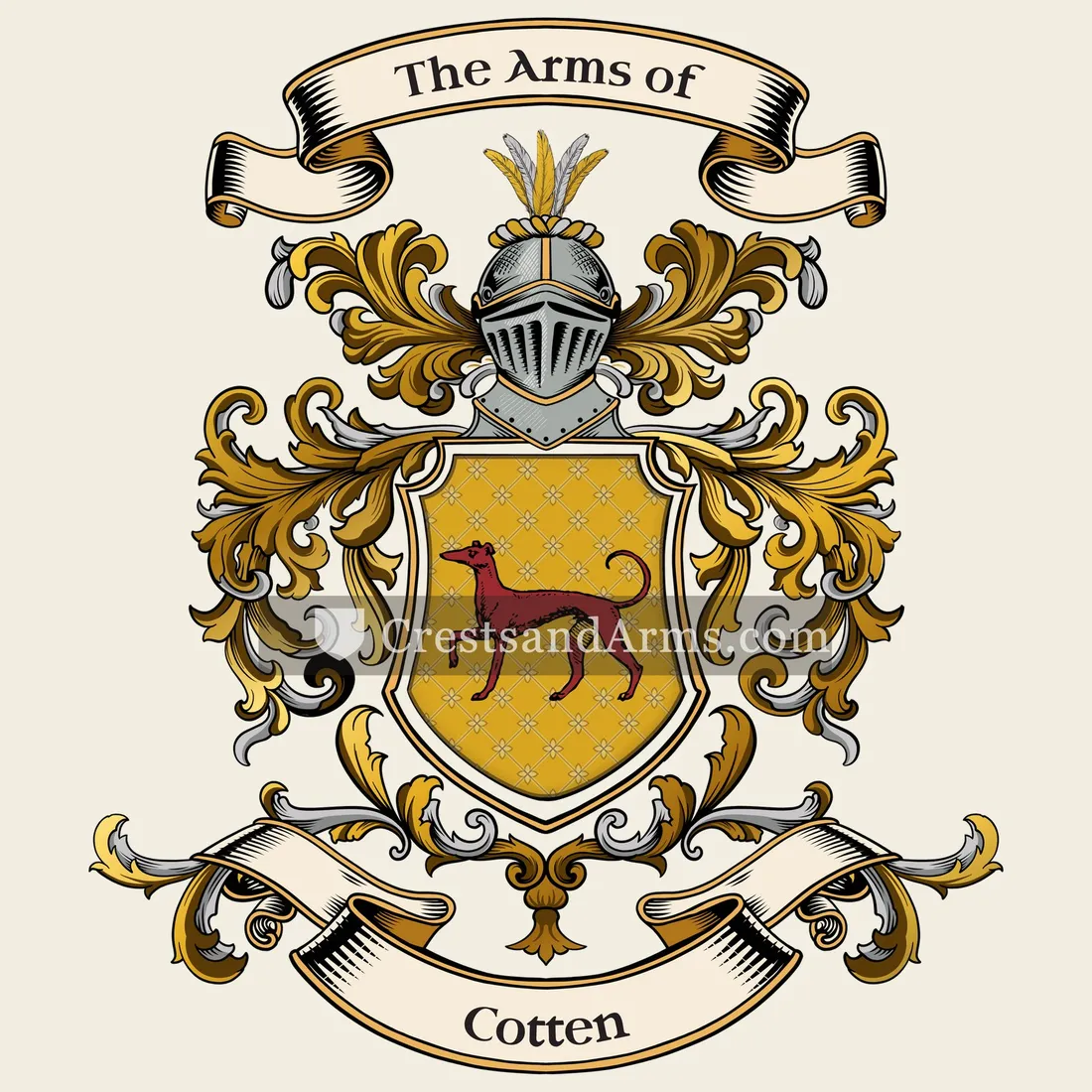
 greyhoundCourage, vigilance and loyalty
 greyhoundCourage, vigilance and loyalty

 chevronProtection, and faithful service completed
 boars headA fierce fighter who battles to the end