Map of France showing where the Court arms are recorded
The Court arms were recorded in Normandie, c. 1663.
Normandie held a dense crowd of knightly families on some of the best farmland in France. Its men had fought and settled abroad for generations, and a family that sent sons to war needed a shield they could be recognised by.
This is where the arms were entered in the register. Families often moved to other parts of the country, so the same name can turn up in more than one region.
The body that granted and recorded arms in France in this period.
Louis XIV of France
Sovereign of the period
Louis XIV of France
1643–1715
Reigning in France when the Court arms are first recorded.
How Arms Worked in France
In France, a coat of arms was a mark of honor that passed down through the male line to all legitimate descendants. Families often used the same shield without changes to show their shared heritage. If a branch wanted to stand out, they could add a small mark to their shield to show their specific place in the family tree.
Granting authority
The Juge d'armes de France acted as the official authority that regulated and verified coats of arms across the country.
How they got arms
Families typically inherited their arms from ancestors, though they could also receive them through royal grants or by proving their noble status.
Where arms were recorded
Coats of arms were officially recorded in the Armorial Général de France, which began its main collection in the year 1696.
The family's standing
Recorded among the armigerous families of Normandie.
Origin & History of the Court Family in France
The surname Court carries a rich history rooted in the landscape and social structure of medieval France. The name is topographical, meaning it was originally given to families who lived near a courtyard, a manor house, or the grounds of a royal residence. By the time the family was firmly established in the Normandy region in 1663, the name had already been in use for centuries across various French provinces. During this era, families in Normandy were often deeply connected to the local agricultural economy and the administrative life of their parishes. As the name spread, it became associated with people who served in local government roles or managed land for larger estates. This connection to the term for a court or enclosed space suggests that the earliest ancestors were likely people of some local standing who lived at the heart of their village communities.
Coat of Arms & Family Crest Details
Symbols on this shield
chiefAuthority, wisdom and dominion
hammerHonest labour, and the smith's craft
Colours
Blue (Azure)Means: Loyalty and truth
Silver (Argent)Means: Peace and sincerity
Black (Sable)Means: Constancy
Historical info
Source
J. B. Rietstap, Armorial Général, Gouda: G. B. van Goor Zonen, 1884–87
Blazon (the actual original written record)
“D'azur; au chef d'arg., ch. de deux maillets de sa.”
Netherlandsc. 1815
Digital archive packCoat of arms PNG, gold border print PDF, vector SVG and the certificate of authenticity. Sent to your email in minutes.
Map of Netherlands showing where the Court arms are recorded
The Court arms were recorded in Netherlands, c. 1815.
Arms such as these were typically recorded in Friesland.
Friesland was low, wet country on the northern coast of the Netherlands, farmed by families who had held the same land for centuries. Free landholders were unusually common there, and a free landholder could carry arms.
This is where the arms were entered in the register. Families often moved to other parts of the country, so the same name can turn up in more than one region.
Region
Friesland
First recorded
1815
Granting Authority for the Court Arms
Hoge Raad van Adel
Photograph made by me · CC BY-SA 3.0
The body that granted and recorded arms in Netherlands in this period.
William I of the Netherlands
Sovereign of the period
William I of the Netherlands
1815–1840
Reigning in France when the Court arms are first recorded.
How Arms Worked in Netherlands
In the Netherlands, coats of arms were often used by noble families and those who held specific public offices. These arms were passed down through the generations to legitimate descendants. Younger branches of a family usually kept the original design without needing to add special marks. This system ensured that the family identity remained clear and consistent over many years.
Granting authority
The Hoge Raad van Adel is the official body that regulates and manages noble titles and coats of arms in the Netherlands.
How they got arms
Families typically obtained their coats of arms through official royal grants or by proving their long-standing historical use of the symbols.
Where arms were recorded
Coats of arms are officially recorded in the registers held by the Hoge Raad van Adel, which began its work in 1814.
The family's standing
Recorded among the armigerous families of Netherlands.
Origin & History of the Court Family in Netherlands
The family name Court has deep roots in the northern regions of the Netherlands, particularly within the province of Friesland. By the early nineteenth century, official records confirm that members of the family were well-established residents of this coastal area. The name itself likely originated as a descriptive term, often used to identify individuals who lived near a royal estate or a local administrative center. In the Dutch context, the spelling reflects a connection to the French word for a courtyard or a place of legal gathering, which suggests that early ancestors may have held positions of local authority or lived near a significant town square. As the family settled into the Frisian landscape, they became part of the distinct cultural and linguistic traditions of the region, eventually integrating into the local community as farmers, tradespeople, and civic participants during a time of great political change in the Netherlands.
Coat of Arms & Family Crest Details
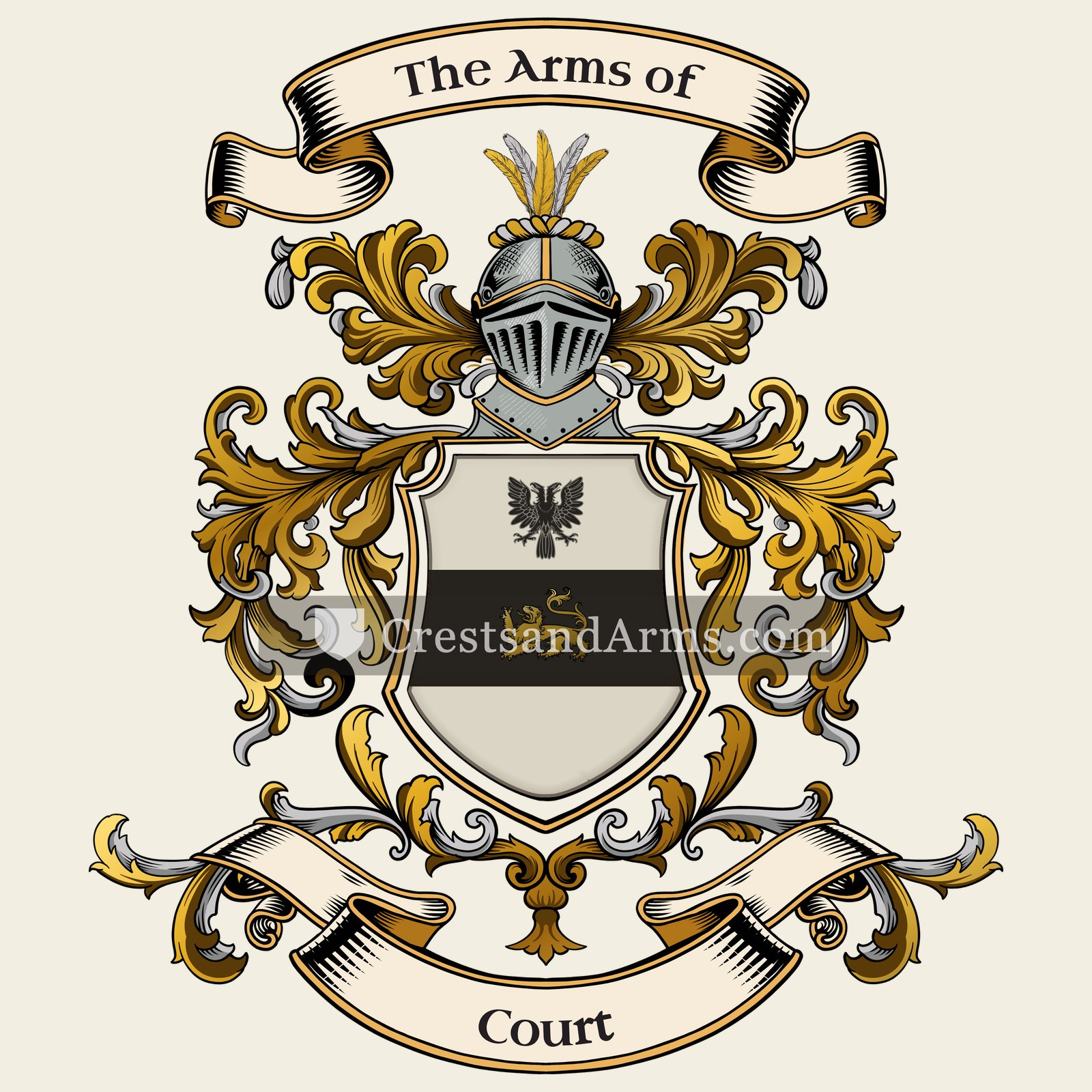
Symbols on this shield
bendDefence, and the scarf of a commander
eagleNobility, strength and a keen mind
lionCourage, strength and royalty
Colours
Silver (Argent)Means: Peace and sincerity
Black (Sable)Means: Constancy
Gold (Or)Means: Generosity
Historical info
Source
J. B. Rietstap, Armorial Général, Gouda: G. B. van Goor Zonen, 1884–87
Blazon (the actual original written record)
“Tiercé en fasce: au 1 d'arg. à l'aigle de sa.; au 2 de sa. au lion léopardé d'or; au 3 bandé de sa. et d'arg. Cq. cour. C.: un lion iss. d'or, cour. du même, tenant une fleur-de-lis d'arg. L. d'arg. et de sa.”
SwitzerlandLeyde, c. 1745
Digital archive packCoat of arms PNG, gold border print PDF, vector SVG and the certificate of authenticity. Sent to your email in minutes.
Map of Switzerland showing where the Court arms are recorded
The Court arms were recorded in Leyde, c. 1745.
Arms such as these were typically recorded in Bern.
Bern was the largest of the Swiss cantons and ran itself, with its own council and its own courts. Its governing families held office for generations, and office of that kind carried a shield with it.
This is where the arms were entered in the register. Families often moved to other parts of the country, so the same name can turn up in more than one region.
The body that granted and recorded arms in Switzerland in this period.
How Arms Worked in Switzerland
In Switzerland, coats of arms were not restricted to the nobility and were often adopted by common citizens and families. These symbols were passed down through generations to show family identity. When branches of a family grew, they often changed small details of the design to distinguish their own line from the original group.
Granting authority
Cantonal and civic authorities managed the use of coats of arms within their specific regions and local jurisdictions.
How they got arms
Families typically assumed their own coats of arms based on local custom rather than receiving them from a central monarch.
Where arms were recorded
Arms were recorded in various cantonal and civic registers starting from the fourteenth century throughout the Swiss region.
The family's standing
Recorded among the armigerous families of Switzerland.
Origin & History of the Court Family in Switzerland
The family name Court has deep roots in the Swiss region of Bern, where records confirm members of the family were established by 1745. The name is often linked to the French word for short, which suggests that it may have originally served as a descriptive nickname for a person of smaller stature. In the context of medieval and early modern Switzerland, such names frequently transitioned from informal labels to formal surnames as local governments began to track residents more closely for tax and military purposes. By the mid-18th century, the Court family was integrated into the social fabric of the Bernese canton, likely participating in the agricultural or trade-based economy that defined the region at the time. Their presence in official records from this period indicates that they were recognized citizens who contributed to the stability and growth of their local communities.
Court Meaning & Related Branches
Root word
Cohors
A Latin term referring to an enclosure, yard, or military cohort.
This name
CourtA topographic name for someone who lived near a courtyard or a farmyard.
also spelled
Dacourt
Kur
Short
Documented Sources
J. B. Rietstap, Armorial Général, Gouda: G. B. van Goor Zonen, 1884–87
Dauzat, Albert. Dictionnaire étymologique des noms et prénoms de France. 1951
Morlet, Marie-Thérèse. Dictionnaire étymologique des noms de famille. 1991
Archives départementales de la Seine-Maritime. Registres paroissiaux et d'état civil. 1663
Digital archive packCoat of arms PNG, gold border print PDF, vector SVG and the certificate of authenticity. Sent to your email in minutes.


 roseThe seventh son, and beauty with grace
 roseThe seventh son, and beauty with grace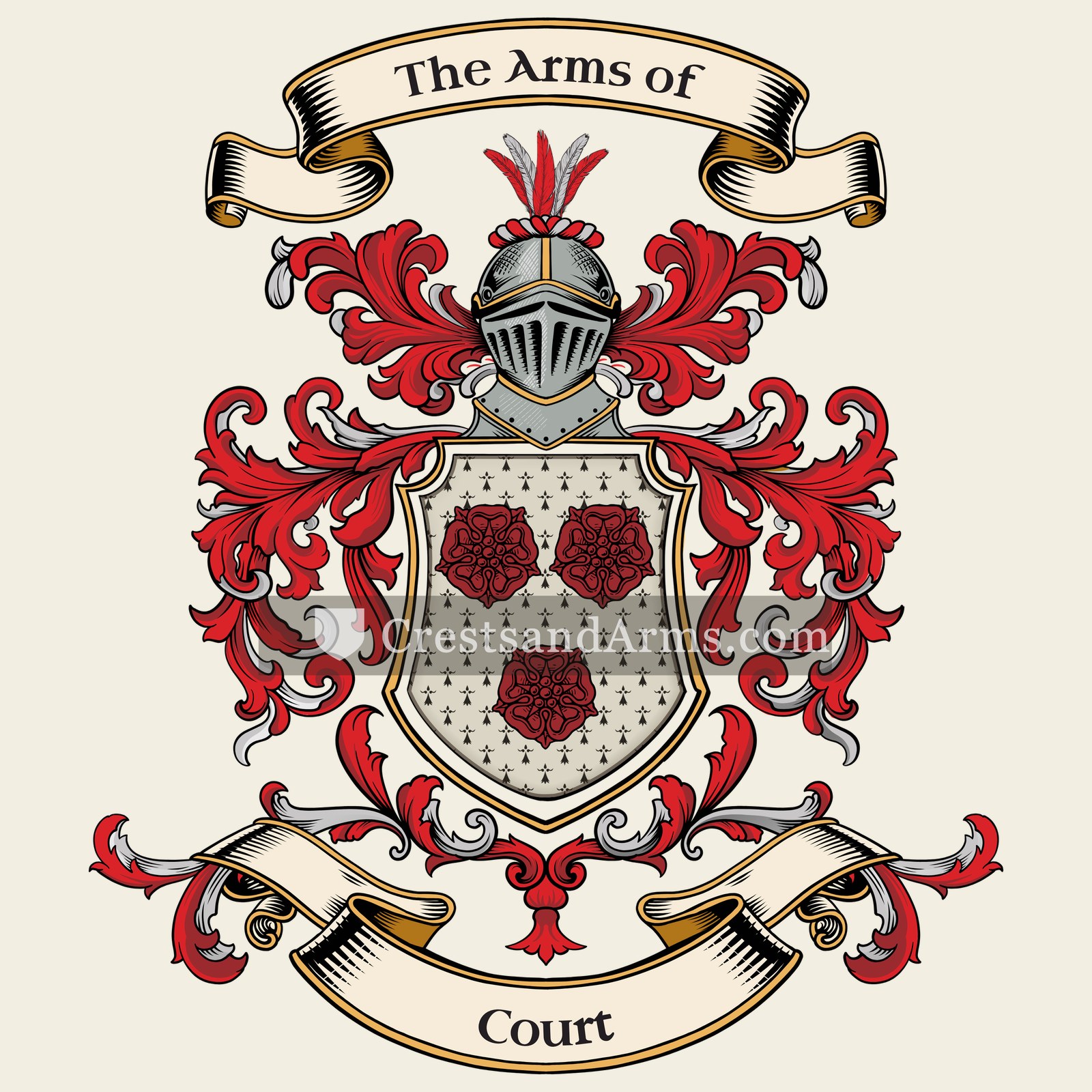


 chiefAuthority, wisdom and dominion
 hammerHonest labour, and the smith's craft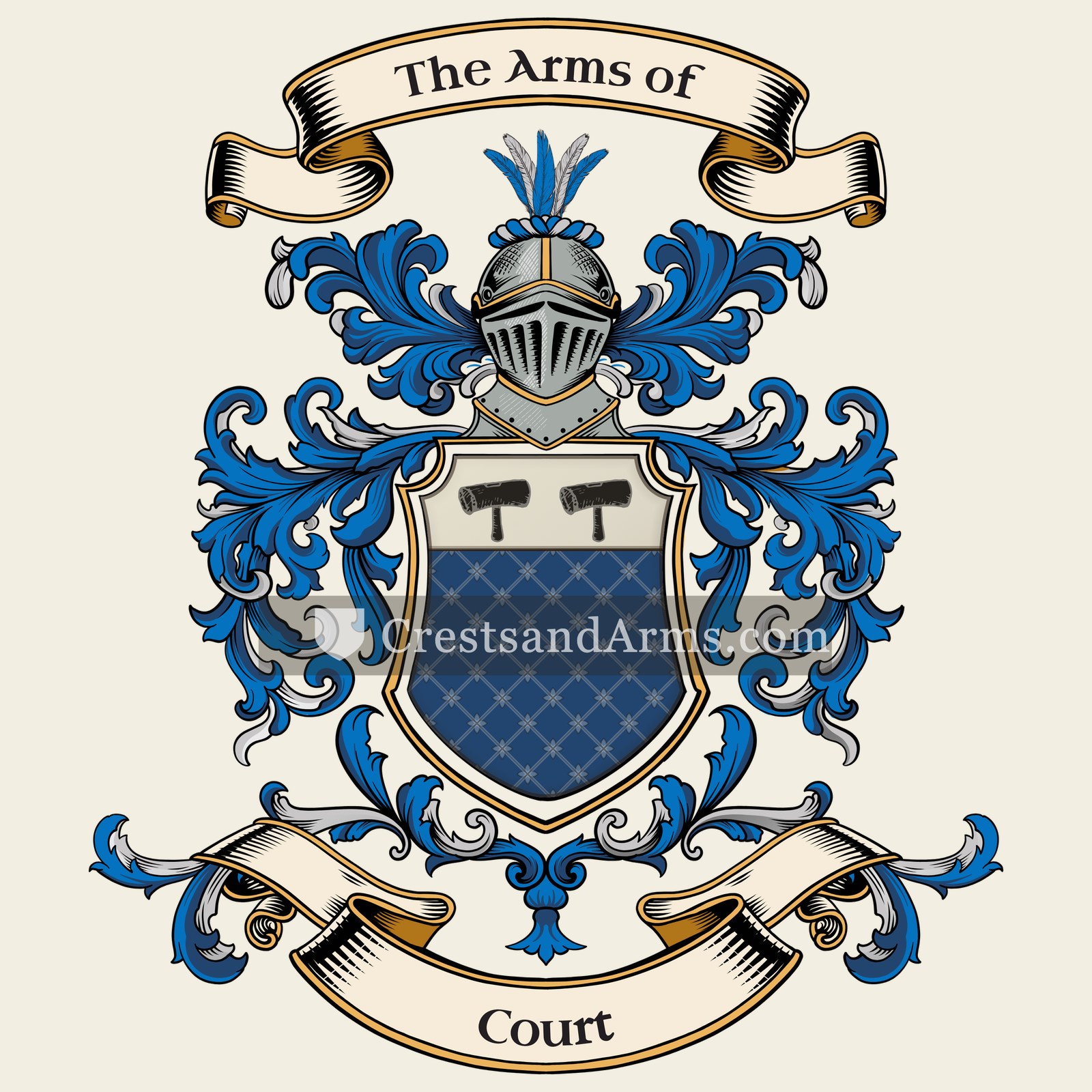


 bendDefence, and the scarf of a commander
 eagleNobility, strength and a keen mind
 lionCourage, strength and royalty