Map of Belgium showing where the Cousin arms are recorded
The Cousin arms were recorded in Mons Hainaut, c. 1686.
This is where the arms were entered in the register. Families often moved to other parts of the country, so the same name can turn up in more than one region.
The body that granted and recorded arms in Belgium in this period.
Charles II of Spain
Sovereign of the period
Charles II of Spain
1665–1700
Reigning in Belgium when the Cousin arms are first recorded.
How Arms Worked in Belgium
In Belgium, a coat of arms is considered personal property that is passed down through the male line to legitimate descendants. Families often use the same shield design across generations to show their shared heritage. If a branch of the family wants to change the design, they must apply for an official update to their specific version of the arms.
Granting authority
The Conseil héraldique is the official body that regulates and approves all coats of arms in Belgium.
How they got arms
Families obtain their coats of arms through formal royal grants or by confirming their historical right to use existing designs.
Where arms were recorded
All approved coats of arms are officially recorded in the public registers of the Conseil héraldique since 1844.
The family's standing
Recorded among the armigerous families of Belgium.
Origin & History of the Cousin Family in Belgium
The family name Cousin has deep roots in the historical landscape of the Low Countries, particularly within the region that is now Belgium. By the late seventeenth century, the family had established a notable presence in the city of Mons, which served as a significant administrative and cultural hub in the County of Hainaut. During this era, Mons was a center of trade and craftsmanship, and families like the Cousins were often integrated into the local urban fabric through roles in commerce or civic administration. The name itself likely originated as a descriptive nickname, reflecting the close-knit nature of medieval communities where kinship terms were frequently used to identify individuals. As residents of Mons in 1686, members of the Cousin family lived through a period of intense political transition as the region navigated the complex power struggles between European monarchies. Their presence in the city records from this time highlights their role as part of the established population that helped shape the social and economic character of the region during the early modern period.
Coat of Arms & Family Crest Details
Colours
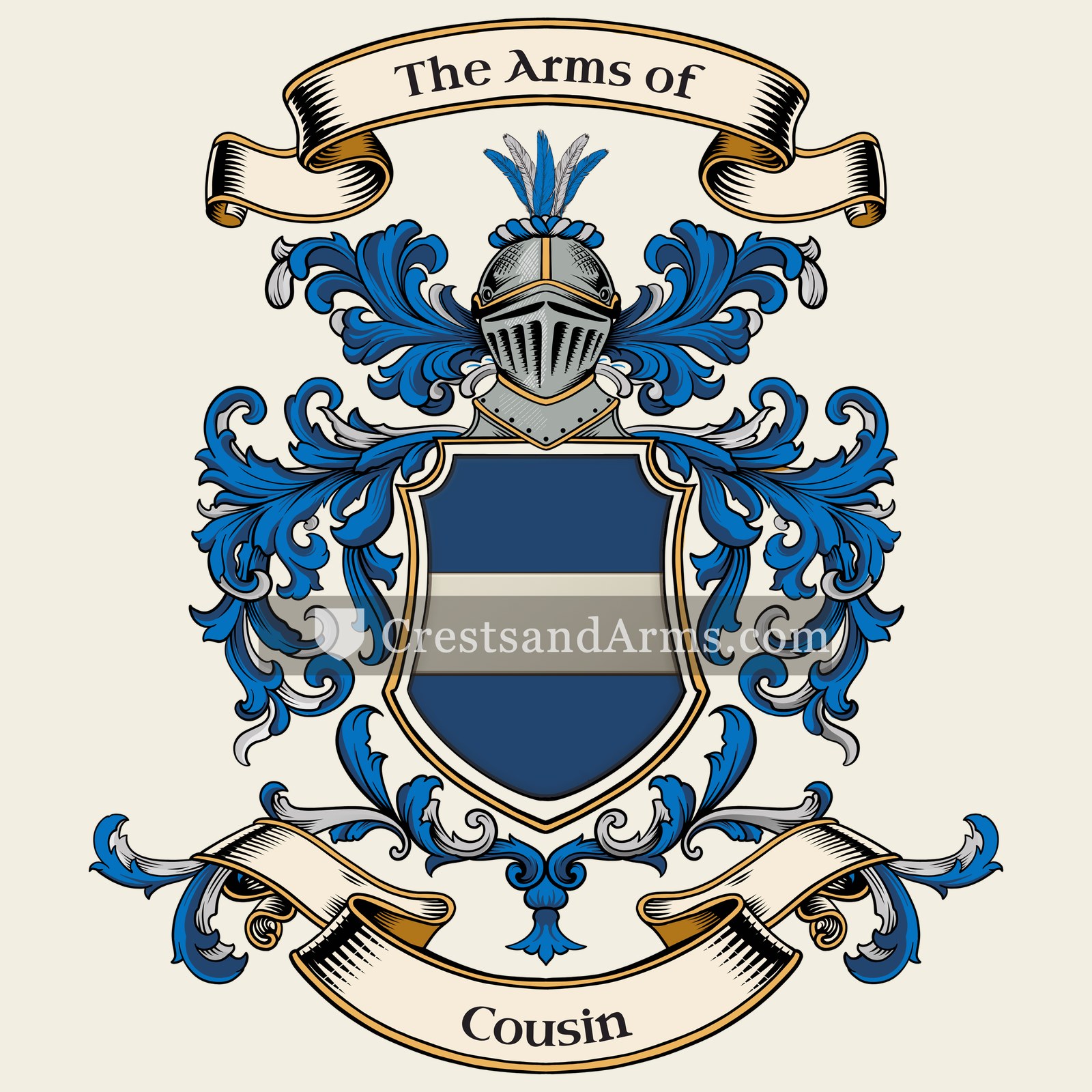
Blue (Azure)Means: Loyalty and truth
Silver (Argent)Means: Peace and sincerity
Historical info
Source
J. B. Rietstap, Armorial Général, Gouda: G. B. van Goor Zonen, 1884–87
Blazon (the actual original written record)
“D'azur à une Foi d'arg.”
BerryBourbonnais · Berry, c. 1663
Digital archive packCoat of arms PNG, gold border print PDF, vector SVG and the certificate of authenticity. Sent to your email in minutes.
Map of France showing where the Cousin arms are recorded
The Cousin arms were recorded in Berry, c. 1663.
Berry was central French farming country, quiet and long-settled. Its estates were modest and stayed in the same hands for centuries, and steady landholding of that kind is exactly what puts a name into the heraldic records.
This is where the arms were entered in the register. Families often moved to other parts of the country, so the same name can turn up in more than one region.
The body that granted and recorded arms in France in this period.
Louis XIV of France
Sovereign of the period
Louis XIV of France
1643–1715
Reigning in Belgium when the Cousin arms are first recorded.
How Arms Worked in France
In France, a coat of arms was a mark of honor that passed down through the male line to all legitimate descendants. Families often used the same shield without changes to show their shared heritage. If a branch wanted to stand out, they could add a small mark to their shield to show their specific place in the family tree.
Granting authority
The Juge d'armes de France acted as the official authority that regulated and verified coats of arms across the country.
How they got arms
Families typically inherited their arms from ancestors, though they could also receive them through royal grants or by proving their noble status.
Where arms were recorded
Coats of arms were officially recorded in the Armorial Général de France, which began its main collection in the year 1696.
The family's standing
Recorded among the armigerous families of Berry.
Origin & History of the Cousin Family in France
The surname Cousin emerged in France as a descriptive name rooted in the social structures of the Middle Ages. It originated from the Old French word *cousin*, which was used to identify a relative or a kinsman within a community. By the time historical records confirm the presence of the family in the province of Berry in 1663, the name had long been established as a common way to distinguish families living in rural parishes. In the central regions of France, families bearing this name were often integrated into the local agricultural economy, working the land and participating in the tight-knit village life of the seventeenth century. Because the name was derived from a common term for family ties, it appeared independently in various regions across the country. The specific branch in Berry represents a long tradition of families who maintained deep roots in their provincial home, contributing to the local history of the region through generations of steady community involvement.
Cousin Meaning & Related Branches
Root word
consobrinus
Latin term meaning a mother's sister's child or cousin.
This name
CousinA surname originally used as a nickname or descriptive term for a relative or kinsman.
also spelled
Cousyn
Kuzan
Cozin
Related arms
Coussinvariant spelling
Couzinvariant spelling
Documented Sources
J. B. Rietstap, Armorial Général, Gouda: G. B. van Goor Zonen, 1884–87
Archives de l'État à Mons, Registres paroissiaux de la ville de Mons
Devillers, Léopold, Inventaire analytique des archives de la ville de Mons, 1882
Piérard, Christiane, Histoire de Mons, 1973
Digital archive packCoat of arms PNG, gold border print PDF, vector SVG and the certificate of authenticity. Sent to your email in minutes.


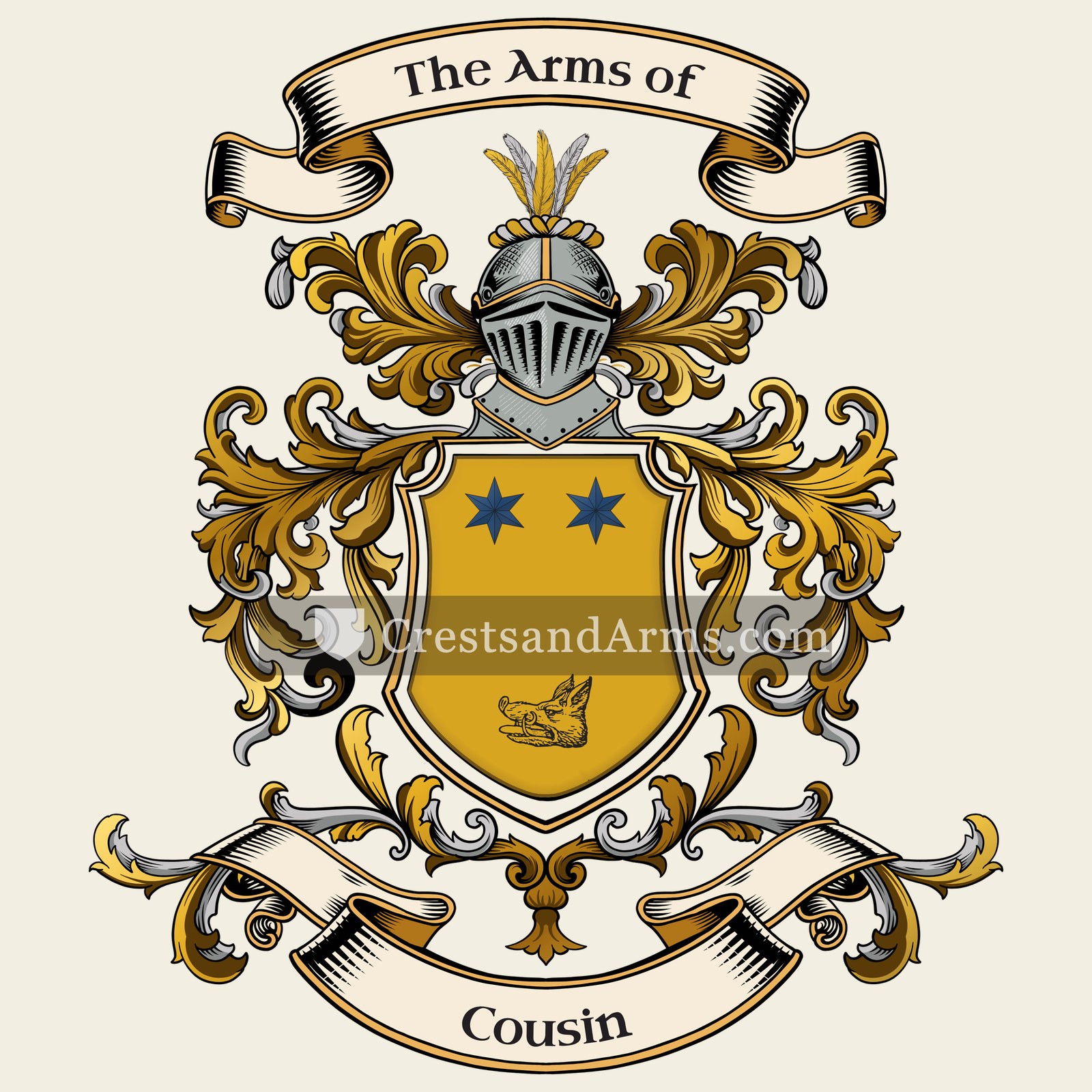
 starThe celestial goddess, and nobility
 boars headA fierce fighter who battles to the end
 starThe celestial goddess, and nobility
 boars headA fierce fighter who battles to the end