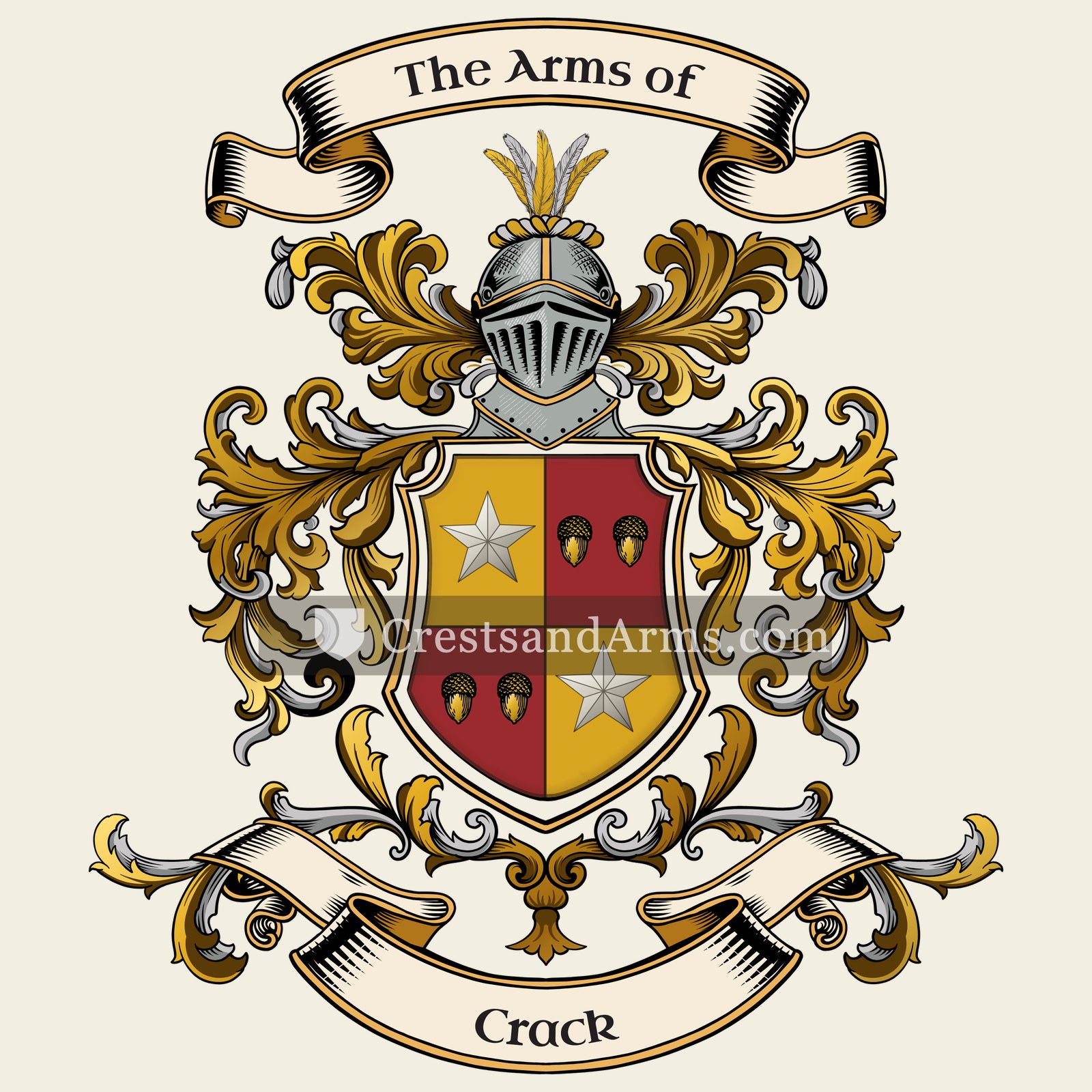
A record of documented arms, meaning and origin, researched for the Crack family of Netherlands.
Reg. 6996 · Dutch, A–C
Coat of Arms & Family Crest Details
Symbols on this shield
mulletThe third son, and a divine quality from above
acornAntiquity and strength from small beginnings
Colours
Gold (Or)Means: Generosity
Red (Gules)Means: Military strength
Silver (Argent)Means: Peace and sincerity
Historical info
Source
J. B. Rietstap, Armorial Général, Gouda: G. B. van Goor Zonen, 1884–87
Blazon (the actual original written record)
“Ec.: aux 1 et 4 d'or à une étoile d'arg.; aux 2 et 3 de gu. à deux glands d'or, mouv. d'un chicot du même, en fasce. C.: un gland d'or, la queue en bas.”
FrieslandFriesland, c. 1815
Digital archive packCoat of arms PNG, gold border print PDF, vector SVG and the certificate of authenticity. Sent to your email in minutes.
Map of Netherlands showing where the Crack arms are recorded
The Crack arms were recorded in Friesland, c. 1815.
Friesland was low, wet country on the northern coast of the Netherlands, farmed by families who had held the same land for centuries. Free landholders were unusually common there, and a free landholder could carry arms.
This is where the arms were entered in the register. Families often moved to other parts of the country, so the same name can turn up in more than one region.
Region
Friesland
First recorded
1815
Granting Authority for the Crack Arms
Hoge Raad van Adel
Photograph made by me · CC BY-SA 3.0
The body that granted and recorded arms in Netherlands in this period.
William I of the Netherlands
Sovereign of the period
William I of the Netherlands
1815–1840
Reigning in Netherlands when the Crack arms are first recorded.
How Arms Worked in Netherlands
In the Netherlands, coats of arms were often used by noble families and those who held specific public offices. These arms were passed down through the generations to legitimate descendants. Younger branches of a family usually kept the original design without needing to add special marks. This system ensured that the family identity remained clear and consistent over many years.
Granting authority
The Hoge Raad van Adel is the official body that regulates and manages noble titles and coats of arms in the Netherlands.
How they got arms
Families typically obtained their coats of arms through official royal grants or by proving their long-standing historical use of the symbols.
Where arms were recorded
Coats of arms are officially recorded in the registers held by the Hoge Raad van Adel, which began its work in 1814.
The family's standing
Recorded among the armigerous families of Friesland.
Origin & History of the Crack Family in Netherlands
The surname Crack has deep roots in the coastal region of Friesland, where family members were documented as early as 1815. In the Frisian language and surrounding dialects, names often evolved from descriptive nicknames or references to a person’s trade and local environment. The name likely originated as a topographic identifier, referring to individuals who lived near a specific crack in the landscape, such as a narrow waterway or a fissure in the marshy terrain common to the Dutch coastline. During the early nineteenth century, the region underwent significant administrative changes under the Kingdom of the Netherlands, which led to the formal registration of surnames in official civil records. As families transitioned from traditional patronymic naming systems to fixed hereditary surnames, the Crack name became firmly established within the local community, reflecting the distinct linguistic heritage of the Frisian people.
Crack Meaning & Related Branches
Root word
Krak
A Middle Dutch term referring to a loud noise or crack.
This name
CrackA nickname for a noisy person or someone associated with a loud sound.
also spelled
Krak
Crac
Documented Sources
J. B. Rietstap, Armorial Général, Gouda: G. B. van Goor Zonen, 1884–87
Tresoar (Frisian Historical and Literary Center), Burgerlijke Stand van Friesland (Civil Registry of Friesland), 1811–1950
Huizinga, Frans, Etymologisch woordenboek van de Nederlandse familienamen, 1959
Meertens Instituut, Nederlandse Familienamenbank (Dutch Surname Database), 2010
Digital archive packCoat of arms PNG, gold border print PDF, vector SVG and the certificate of authenticity. Sent to your email in minutes.


 mulletThe third son, and a divine quality from above
 acornAntiquity and strength from small beginnings
 mulletThe third son, and a divine quality from above
 acornAntiquity and strength from small beginnings