A record of documented arms, meaning and origin, researched for the Cranach family lines. Documented in 2 countries.
Reg. 6973 · German, A–C
Coat of Arms & Family Crest Details
Symbols on this shield
serpentWisdom, healing and prudence
Colours
Gold (Or)Means: Generosity
Black (Sable)Means: Constancy
Historical info
Source
J. B. Rietstap, Armorial Général, Gouda: G. B. van Goor Zonen, 1884–87
Blazon (the actual original written record)
“D'or à une couleuvre ondoyante en fasce de sa., ayant des ailes de chauve-souris du même, ladite couleuvre cour. de gu. et tenant entre ses dents une bague d'or, châtonnée d'un rubis. C.: la couleuvre, sur une couronne d'épines au nat. [A cette fam. appartenait le peintre, Lucas Cranach.]”
Germanyc. 1765
Digital archive packCoat of arms PNG, gold border print PDF, vector SVG and the certificate of authenticity. Sent to your email in minutes.
Map of Germany showing where the Cranach arms are recorded
The Cranach arms were recorded in Germany, c. 1765.
Arms such as these were typically recorded in Bavaria.
Bavaria was a country of old landed families and walled market towns. Estates passed down the same line for centuries, and both the landowners and the leading townsmen kept arms, which is why so many Bavarian names sit in the registers.
This is where the arms were entered in the register. Families often moved to other parts of the country, so the same name can turn up in more than one region.
The body that granted and recorded arms in Germany in this period.
Francis I, Holy Roman Emperor
Sovereign of the period
Francis I, Holy Roman Emperor
1745–1765
Reigning in Germany when the Cranach arms are first recorded.
How Arms Worked in Germany
In the Holy Roman Empire, coats of arms were often granted to individuals by the Emperor or his representatives. These arms were then passed down through the generations to all legitimate descendants of the original holder. Younger branches of a family usually kept the same shield design without needing to change it, as the arms belonged to the entire lineage.
Granting authority
The Holy Roman Emperor held the sole power to grant new coats of arms throughout his vast imperial territories.
How they got arms
Families typically obtained their coats of arms through a formal imperial grant or by proving their noble status to the authorities.
Where arms were recorded
These grants were officially recorded in the Imperial Chancery registers, which began keeping formal records of such honors during the Middle Ages.
The family's standing
Recorded among the armigerous families of Germany.
Origin & History of the Cranach Family in Germany
The family name Cranach is deeply rooted in the cultural and artistic history of Germany. While the name is most famously associated with the Renaissance painter Lucas Cranach the Elder, who took his surname from his birthplace of Kronach in Bavaria, the name evolved over centuries as families moved across the German landscape. By the mid-eighteenth century, historical records confirm that members of the Cranach family were firmly established in the Bavarian region. During this era, families often lived in small, tight-knit communities where their surname served as a link to their geographic origins. As the family grew and spread throughout the German states, they participated in the typical life of the time, often working in trades or local administration. This history reflects the broader movement of German families who maintained their ancestral identity while adapting to the changing social and economic conditions of the eighteenth century.
Coat of Arms & Family Crest Details
Symbols on this shield
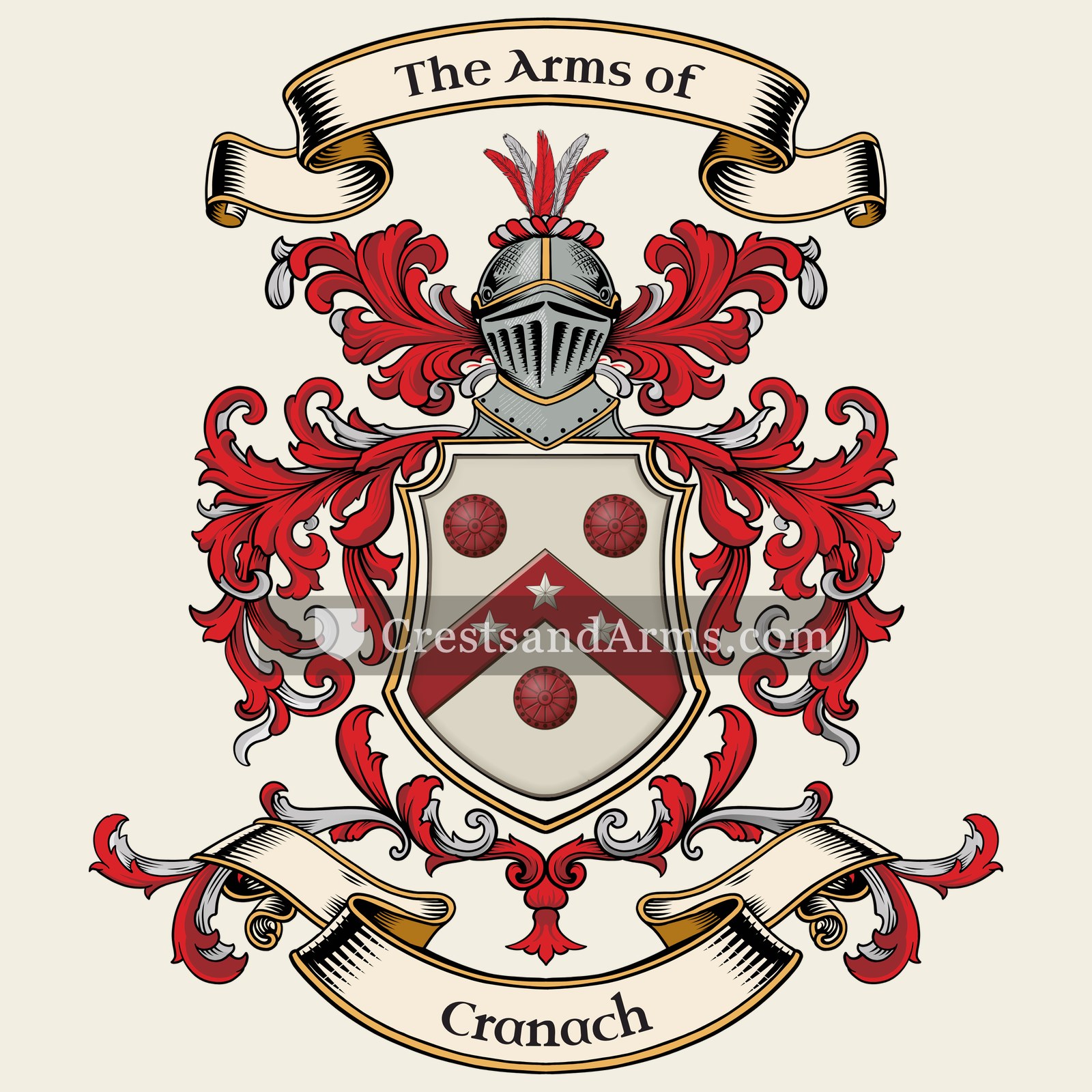
chevronProtection, and faithful service completed
roundelA coin, and one who has been to the crusades
mulletThe third son, and a divine quality from above
Colours
Silver (Argent)Means: Peace and sincerity
Red (Gules)Means: Military strength
Historical info
Source
Sir Bernard Burke, The General Armory of England, Scotland, Ireland and Wales, London: Harrison & Sons, 1884
Blazon (the actual original written record)
“Ar. on a chev. gu. betw. three torteaux as many mullets of the field”
ChesterCranach · Chester, c. 1620
Digital archive packCoat of arms PNG, gold border print PDF, vector SVG and the certificate of authenticity. Sent to your email in minutes.
Map of England showing where the Cranach arms are recorded
The Cranach arms were recorded in Chester, c. 1620.
Cheshire was governed apart from the rest of England for much of its history, with its own courts and its own gentry. That separateness bred a strong local landed class, and landed families carried arms.
This is where the arms were entered in the register. Families often moved to other parts of the country, so the same name can turn up in more than one region.
The body that granted and recorded arms in England in this period.
James VI and I
Sovereign of the period
James VI and I
1603–1625
Reigning in Germany when the Cranach arms are first recorded.
How Arms Worked in England
English heraldry allowed arms to be shared by all legitimate descendants of the original owner. These symbols were treated as personal property that moved through the generations to all children. While the eldest son kept the original design, other family members could use the same shield without needing to change it or register their own unique versions.
Granting authority
The College of Arms in London has regulated the use of coats of arms throughout England and Wales since 1484.
How they got arms
Families typically obtained their coats of arms through a formal grant from the Crown or by proving their ancient right to them.
Where arms were recorded
All official coats of arms are recorded in the registers kept at the College of Arms, which date back to the fifteenth century.
The family's standing
Recorded among the armigerous families of Chester.
Origin & History of the Cranach Family in England
The family name Cranach carries a distinct history that links its early presence in England to the bustling city of Chester during the seventeenth century. While the name is often associated with famous painters in Central Europe, the branch of the family established in Cheshire by 1620 suggests a migration pattern common for skilled tradespeople and merchants seeking new opportunities in growing English port towns. By settling in Chester, these early family members integrated into a regional hub known for its trade connections and historical significance as a gateway to Wales and Ireland. This period marked a time of transition for the family as they adapted to the local social and economic landscape of northwest England. Their presence in the city records provides a clear starting point for tracing their integration into the local community and their eventual expansion across the British Isles.
Cranach Meaning & Related Branches
Root word
Kranich
A large, long-legged wading bird of the Gruidae family.
This name
CranachA topographic or habitational name referring to someone who lived near a crane habitat.
also spelled
Cranack
Kranach
Kranak
Cranak
Documented Sources
J. B. Rietstap, Armorial Général, Gouda: G. B. van Goor Zonen, 1884–87
Friedländer, Max J. and Rosenberg, Jakob, Die Gemälde von Lucas Cranach, 1932
Kuhn, Johannes, Die Geschichte der Stadt Kronach, 1978


 serpentWisdom, healing and prudence
 serpentWisdom, healing and prudence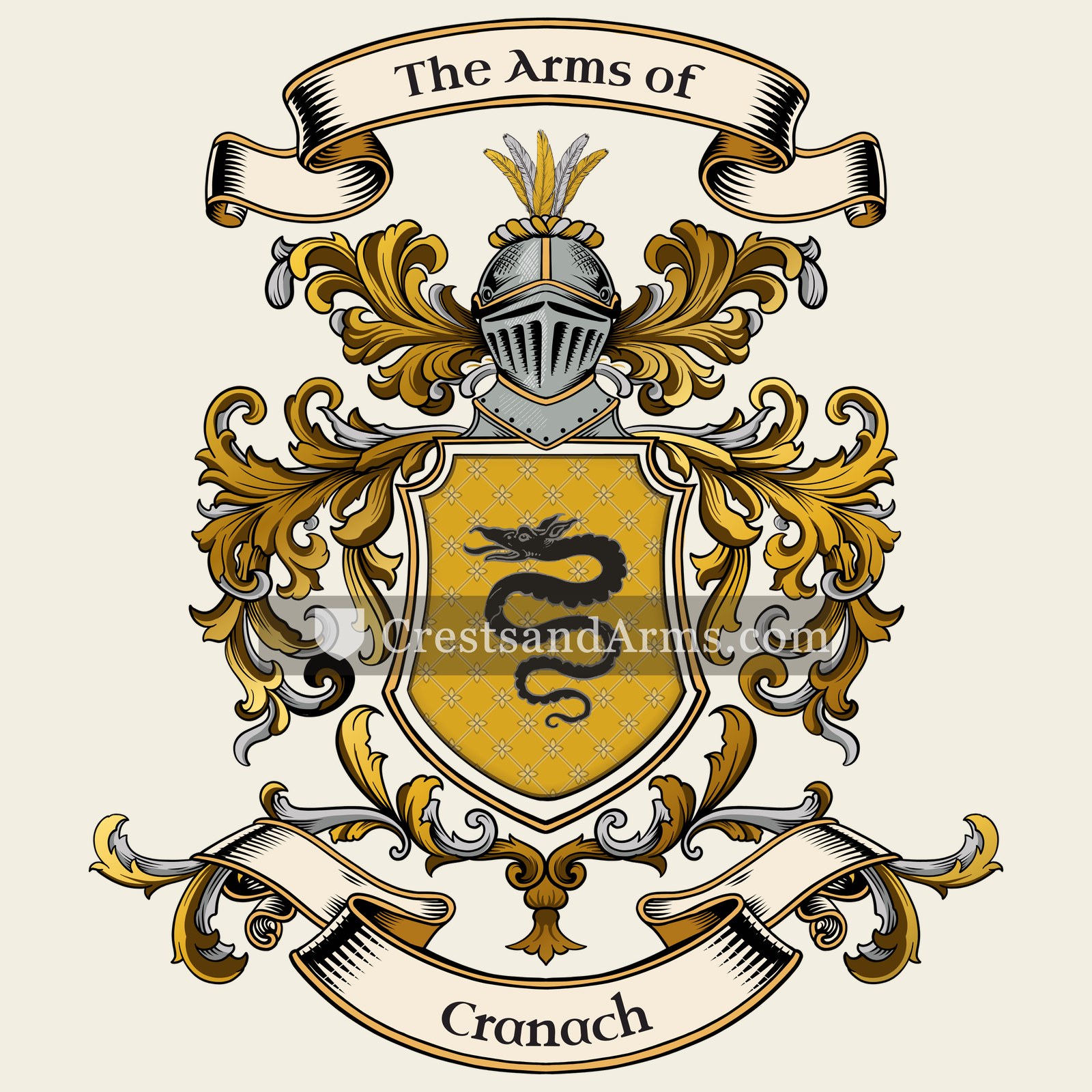


 chevronProtection, and faithful service completed
 roundelA coin, and one who has been to the crusades
 mulletThe third son, and a divine quality from above