Map of Scotland showing where the Craw arms are recorded
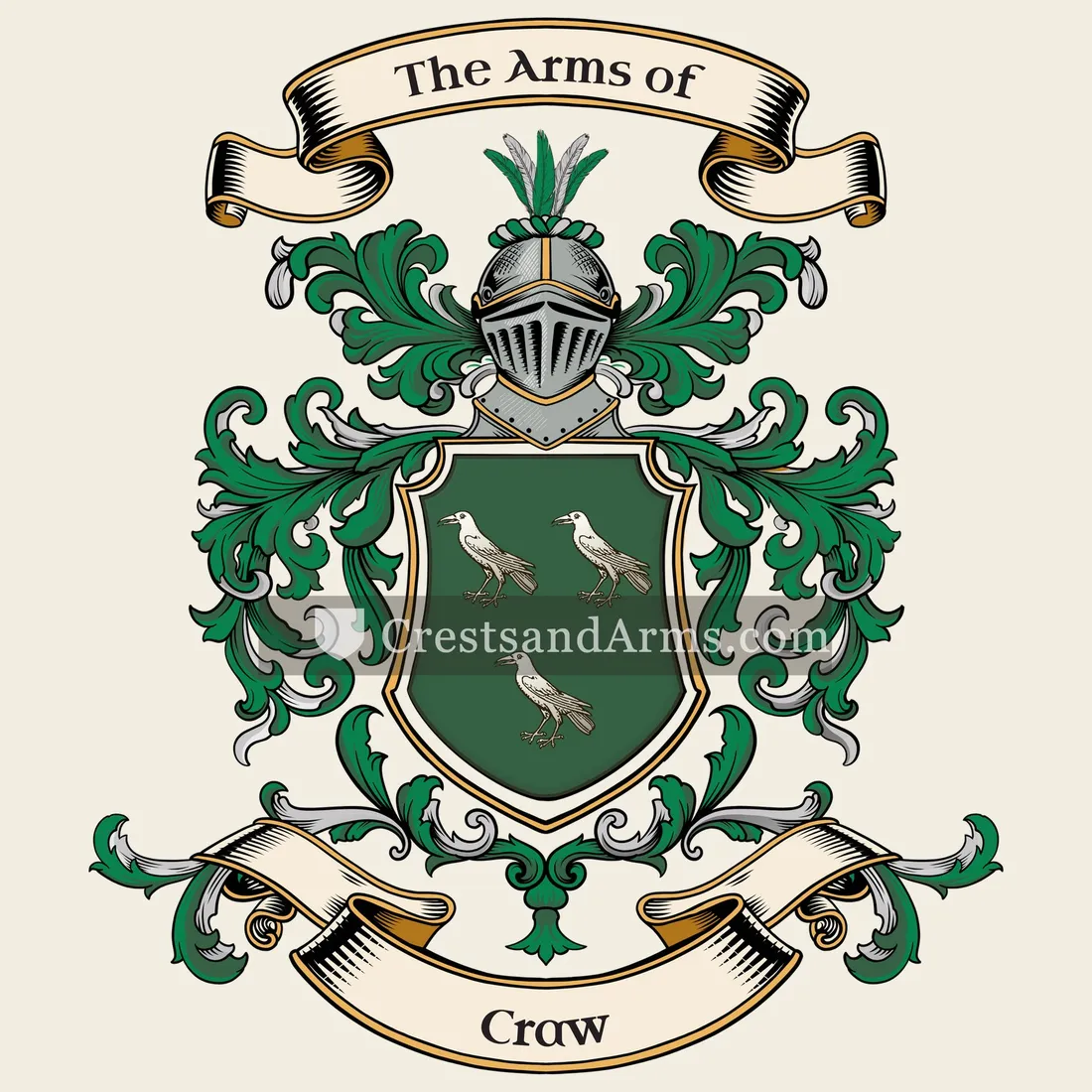
The Craw arms were recorded in Haddington, c. 1748.
Haddington, now East Lothian, was the best farmland in Scotland and lay close to Edinburgh. Good land near the capital stayed in the hands of families of standing, and standing brought arms.
This is where the arms were entered in the register. Families often moved to other parts of the country, so the same name can turn up in more than one region.
The body that granted and recorded arms in Scotland in this period.
George II of Great Britain
Sovereign of the period
George II of Great Britain
1727–1760
Reigning in Scotland when the Craw arms are first recorded.
How Arms Worked in Scotland
Scottish heraldry is unique because it treats a coat of arms as a piece of personal property protected by law. Only one person can own a specific design at any given time. When a family grows, the head keeps the original shield while other relatives must apply for their own distinct version with slight changes to prove their specific identity.
Granting authority
The Court of the Lord Lyon acts as the official body that regulates and controls all heraldic matters throughout Scotland.
How they got arms
Individuals obtain a legal right to their arms through a formal petition process that confirms their identity and family connection.
Where arms were recorded
All valid coats of arms are officially entered into the Public Register of All Arms and Bearings starting from 1672.
The family's standing
Recorded among the armigerous families of Haddington.
Origin & History of the Craw Family in Scotland
The surname Craw is deeply rooted in the history of the Scottish Lowlands, particularly within the county of East Lothian. The name is derived from the Middle English word for a crow, which suggests it may have originally been a descriptive nickname for a person with dark hair or a sharp, observant personality. By the mid-eighteenth century, the family had established a notable presence in the market town of Haddington. During this period, Haddington served as a bustling center for agriculture and trade, and local records confirm that members of the Craw family were active participants in the community life of the town by 1748. As the family grew, they became integrated into the local economy, contributing to the development of the region through their work and social connections. Their long-standing residence in Haddington highlights the deep ties that many Scottish families maintained with their ancestral lands over several generations.
Craw Meaning & Related Branches
Root word
Crawe
Old English word for the bird known as a crow.
This name
CrawA nickname for a person with dark hair or a harsh voice.
also spelled
Crow
Related arms
Crowvariant spelling
Documented Sources
Sir Bernard Burke, The General Armory of England, Scotland, Ireland and Wales, London: Harrison & Sons, 1884
Black, George F., The Surnames of Scotland: Their Origin, Meaning, and History, 1946
National Records of Scotland, Haddington Burgh Records, B30/1/1
National Records of Scotland, Kirk Session Records of Haddington, CH2/185
Digital archive packCoat of arms PNG, gold border print PDF, vector SVG and the certificate of authenticity. Sent to your email in minutes.


 ravenConstancy and divine providence
 ravenConstancy and divine providence