Map of France showing where the Crayon arms are recorded
The Crayon arms were recorded in Anjou, c. 1330.
Anjou was rich valley country along the Loire, with a dense scatter of small manors. Its gentry were numerous rather than wealthy, and even a modest holding was enough to justify a shield of one's own.
This is where the arms were entered in the register. Families often moved to other parts of the country, so the same name can turn up in more than one region.
The body that granted and recorded arms in France in this period.
Philip VI of France
Sovereign of the period
Philip VI of France
1328–1350
Reigning in France when the Crayon arms are first recorded.
How Arms Worked in France
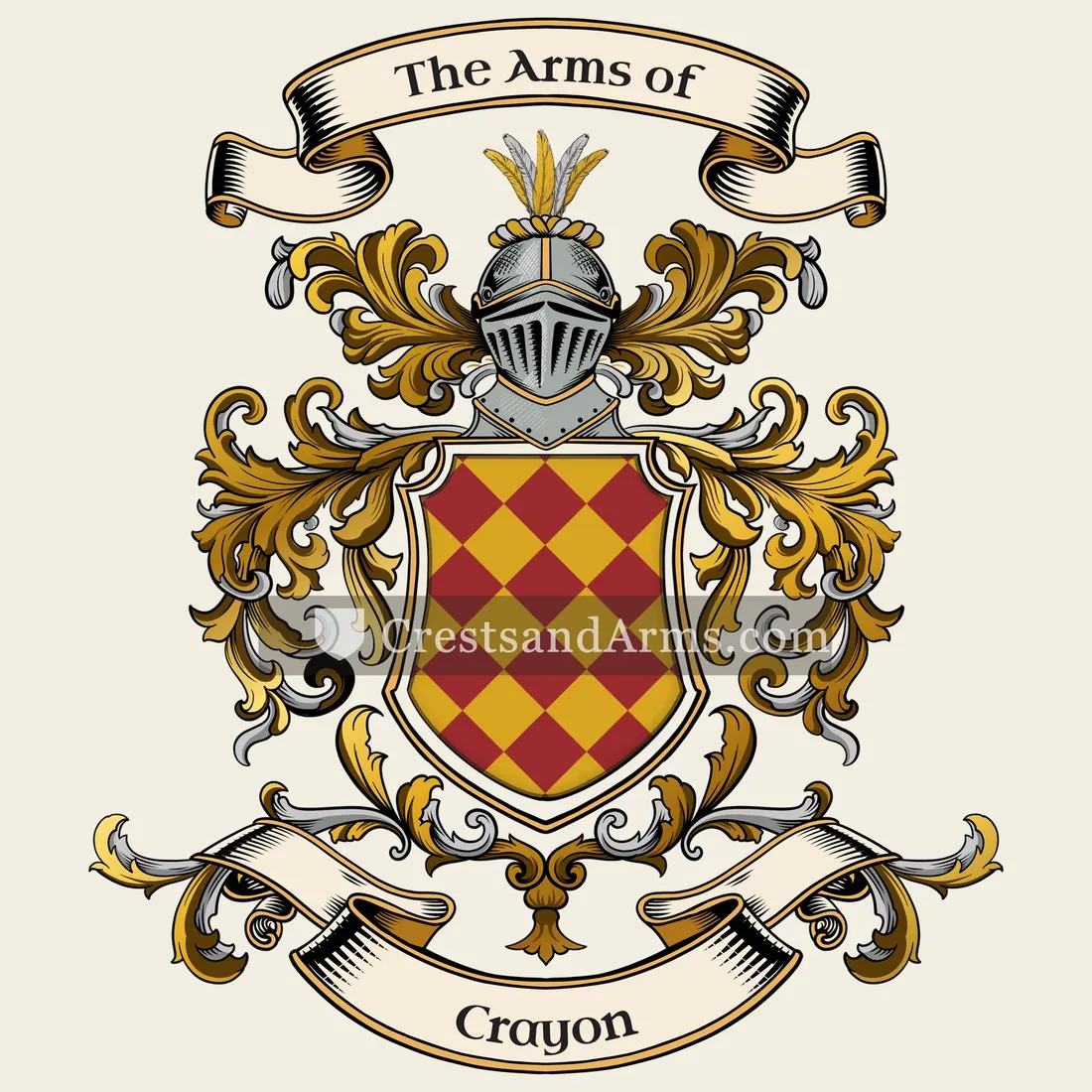
In France, a coat of arms was a mark of honor that passed down through the male line to all legitimate descendants. Families often used the same shield without changes to show their shared heritage. If a branch wanted to stand out, they could add a small mark to their shield to show their specific place in the family tree.
Granting authority
The Juge d'armes de France acted as the official authority that regulated and verified coats of arms across the country.
How they got arms
Families typically inherited their arms from ancestors, though they could also receive them through royal grants or by proving their noble status.
Where arms were recorded
Coats of arms were officially recorded in the Armorial Général de France, which began its main collection in the year 1696.
The family's standing
Recorded among the armigerous families of Anjou.
Origin & History of the Crayon Family in France
The family name Crayon traces its historical roots to the province of Anjou in western France, where records confirm the presence of family members as early as 1330. In the medieval period, the name likely emerged as a descriptive term or a nickname linked to the local dialect of the region. During the fourteenth century, the people of Anjou were deeply involved in the agricultural and feudal life of the Loire Valley, and families often adopted names based on their trade or specific physical traits. While the name has evolved over many centuries, its origins remain tied to the social landscape of this historic French province. The early Crayon family lived through a time of significant transition in France, witnessing the shifting power structures of the late Middle Ages while maintaining their presence in the Angevin territory.
Crayon Meaning & Related Branches
Root word
craie
A soft white porous sedimentary carbonate rock or chalk.
This name
CrayonA topographic name for someone who lived near a chalk deposit or a chalky area.
also spelled
Craonne
Kraon
Documented Sources
J. B. Rietstap, Armorial Général, Gouda: G. B. van Goor Zonen, 1884–87
Célestin Port, Dictionnaire historique, géographique et biographique de Maine-et-Loire et de l'ancienne province d'Anjou, 1874
Archives départementales de Maine-et-Loire, Série E, Titres de famille et de seigneuries
Digital archive packCoat of arms PNG, gold border print PDF, vector SVG and the certificate of authenticity. Sent to your email in minutes.