Map of France showing where the Crespi arms are recorded
The Crespi arms were recorded in Flandre, c. 1663.
Flandre grew rich on cloth, and its towns were among the busiest in Europe. Merchant families bought land with their profits and took arms to go with it, so trade put as many names in the registers here as land did.
This is where the arms were entered in the register. Families often moved to other parts of the country, so the same name can turn up in more than one region.
The body that granted and recorded arms in France in this period.
Louis XIV of France
Sovereign of the period
Louis XIV of France
1643–1715
Reigning in France when the Crespi arms are first recorded.
How Arms Worked in France
In France, a coat of arms was a mark of honor that passed down through the male line to all legitimate descendants. Families often used the same shield without changes to show their shared heritage. If a branch wanted to stand out, they could add a small mark to their shield to show their specific place in the family tree.
Granting authority
The Juge d'armes de France acted as the official authority that regulated and verified coats of arms across the country.
How they got arms
Families typically inherited their arms from ancestors, though they could also receive them through royal grants or by proving their noble status.
Where arms were recorded
Coats of arms were officially recorded in the Armorial Général de France, which began its main collection in the year 1696.
The family's standing
Recorded among the armigerous families of Flandre.
Origin & History of the Crespi Family in France
The family name Crespi carries a rich history that traces back to the northern regions of France and the neighboring territories of Flanders. By the year 1663, records confirm that members of the family were well-established in the Flemish region, which was a major center for trade and cultural exchange during the seventeenth century. The name itself is often linked to the linguistic roots of the area, reflecting the diverse populations that moved through the crossroads of French and Flemish lands. As the family settled into these communities, they became part of the local social fabric, likely participating in the agricultural or merchant activities that defined the economy of the time. This early presence in Flanders suggests that the family was deeply connected to the shifting borders and the complex political landscape of northern France, where they navigated the transition between different regional powers while maintaining their distinct identity.
Coat of Arms & Family Crest Details
Symbols on this shield
paleMilitary strength, and a fortified defence
roundelA coin, and one who has been to the crusades
Colours
Silver (Argent)Means: Peace and sincerity
Red (Gules)Means: Military strength
Gold (Or)Means: Generosity
Historical info
Source
J. B. Rietstap, Armorial Général, Gouda: G. B. van Goor Zonen, 1884–87
Blazon (the actual original written record)
“D'arg. au pal de gu., ch. de deux bes d'or.”
SpainAvila Esp, c. 1722
Digital archive packCoat of arms PNG, gold border print PDF, vector SVG and the certificate of authenticity. Sent to your email in minutes.
Map of Spain showing where the Crespi arms are recorded
The Crespi arms were recorded in Avila Esp, c. 1722.
This is where the arms were entered in the register. Families often moved to other parts of the country, so the same name can turn up in more than one region.
The body that granted and recorded arms in Spain in this period.
Philip V of Spain
Sovereign of the period
Philip V of Spain
1714–1724
Reigning in France when the Crespi arms are first recorded.
How Arms Worked in Spain
In Spain, a coat of arms was considered a form of property that belonged to the entire family line. These arms were passed down from a father to all his children equally. Younger branches of the family usually kept the original design without needing to add any special marks to distinguish their specific line.
Granting authority
The Cronista Rey de Armas was the official body that regulated and granted coats of arms throughout Spain.
How they got arms
Families often obtained their arms through royal grants or by proving their noble status to the official heraldic authority.
Where arms were recorded
Coats of arms were officially recorded in the registers of the Cronista Rey de Armas starting in 1496.
The family's standing
Recorded among the armigerous families of Spain.
Origin & History of the Crespi Family in Spain
The family name Crespi has deep roots in the Iberian Peninsula, where it emerged as a distinct identifier during the centuries of social and geographic movement in Spain. By the early 18th century, records confirm that members of the family were firmly established in the historic city of Avila by 1722. During this period, Avila was a center of religious and administrative importance, and families like the Crespis often played roles in the local economy or the management of land. The name itself is thought to be linked to the Latin word for curly or crisp hair, a common way to distinguish individuals in medieval communities before official surnames became mandatory. As the family settled in the rugged landscape of Castile, they became part of the local social fabric, contributing to the growth of the region during a time of significant transition in Spanish history.
Coat of Arms & Family Crest Details
Symbols on this shield
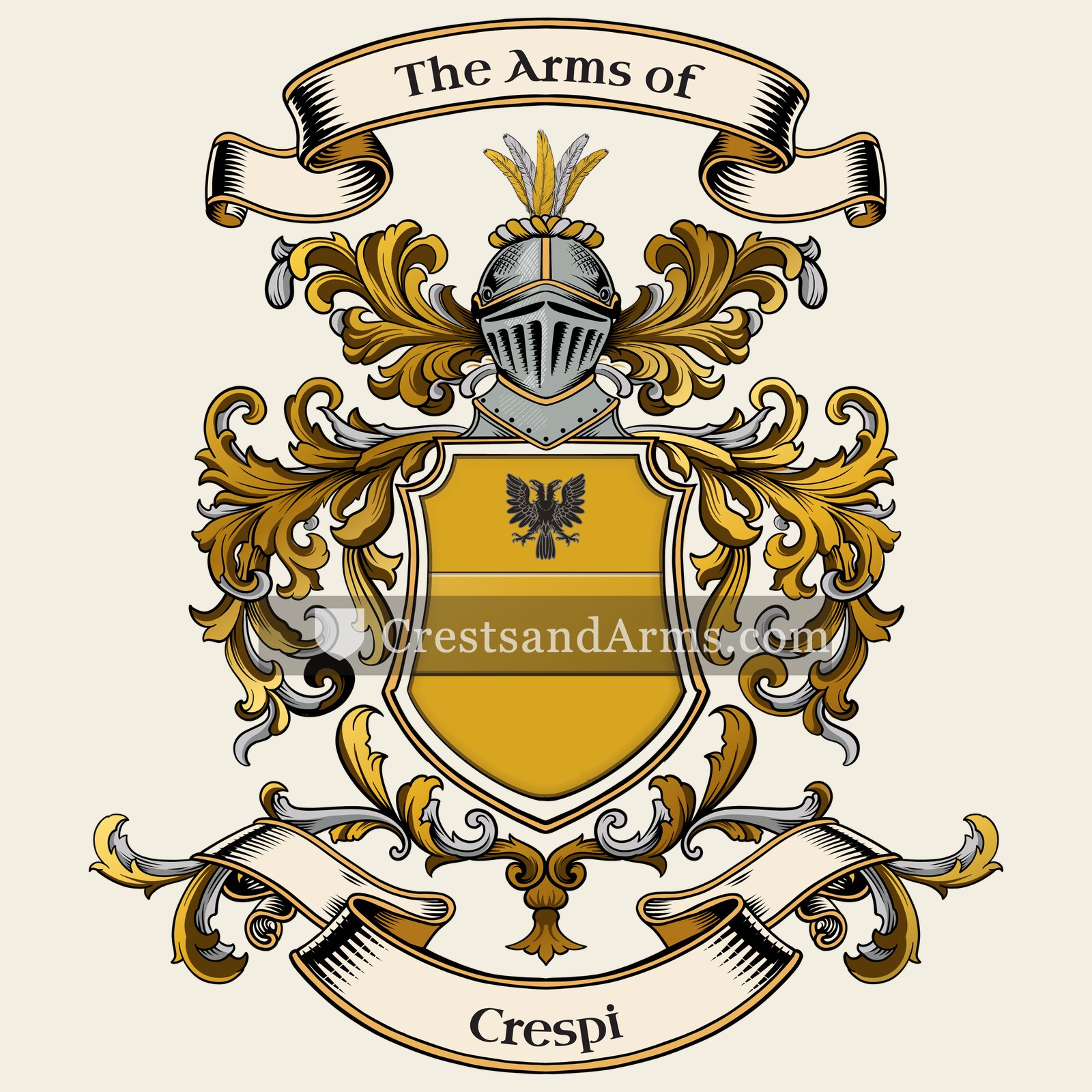
fessThe military belt, and readiness to serve
eagleNobility, strength and a keen mind
Colours
Gold (Or)Means: Generosity
Blue (Azure)Means: Loyalty and truth
Black (Sable)Means: Constancy
Historical info
Source
J. B. Rietstap, Armorial Général, Gouda: G. B. van Goor Zonen, 1884–87
Blazon (the actual original written record)
“Coupé: au 1 d'or à l'aigle de sa., cour. d'or; au 2 d'azur à la fasce d'or, ch. d'un C d'azur.”
ItalyMilan, c. 1775
Digital archive packCoat of arms PNG, gold border print PDF, vector SVG and the certificate of authenticity. Sent to your email in minutes.
Map of Italy showing where the Crespi arms are recorded
The Crespi arms were recorded in Milan, c. 1775.
This is where the arms were entered in the register. Families often moved to other parts of the country, so the same name can turn up in more than one region.
The body that granted and recorded arms in Italy in this period.
Alvise Giovanni Mocenigo
Sovereign of the period
Alvise Giovanni Mocenigo
1763–1778
Reigning in France when the Crespi arms are first recorded.
How Arms Worked in Italy
In the Italian states, coats of arms were often used by noble families to show their status and history. These symbols were passed down through the generations to all legitimate male descendants. Younger branches of a family usually kept the original design but sometimes added small changes to distinguish their specific line from the main branch.
Granting authority
Various local rulers and city governments controlled the use of coats of arms across the different Italian states.
How they got arms
Families often assumed their own arms or received them as official grants from local lords, popes, or city councils.
Where arms were recorded
Arms were recorded in local city archives or private family books rather than in one single national register.
The family's standing
Recorded among the armigerous families of Italy.
Origin & History of the Crespi Family in Italy
The family name Crespi is deeply rooted in the history of Lombardy, particularly within the city of Milan. The name itself is thought to be derived from the Italian word "crispo," which historically described someone with curly hair. By the time the family was firmly established in Milan in 1775, they were already becoming part of the city’s vibrant social and economic landscape. During the late 18th century, Milan was a center of enlightenment and industrial growth under Austrian rule, providing a unique environment for families like the Crespis to thrive. As the family grew, they transitioned from their early origins into roles that would eventually see them become key figures in the textile industry and the cultural development of the region. Their presence in Milan during this era marks the beginning of a long legacy that helped shape the identity of northern Italy.
Crespi Meaning & Related Branches
Root word
Crispus
Latin term meaning curly-haired or having curled hair.
This name
CrespiA topographic or descriptive surname referring to an individual with curly hair.
also spelled
Crespy
Krespi
Related arms
Crespyvariant spelling
Documented Sources
J. B. Rietstap, Armorial Général, Gouda: G. B. van Goor Zonen, 1884–87
Archives départementales du Nord, Série G: Clergé séculier et paroisses, 1663
De Smet, J., Geschiedenis van de Vlaamse families, 1954
Lottin, A., Chronique de la vie quotidienne dans le Nord de la France, 1979
Digital archive packCoat of arms PNG, gold border print PDF, vector SVG and the certificate of authenticity. Sent to your email in minutes.


 bendDefence, and the scarf of a commander
 roundelA coin, and one who has been to the crusades
 bendDefence, and the scarf of a commander
 roundelA coin, and one who has been to the crusades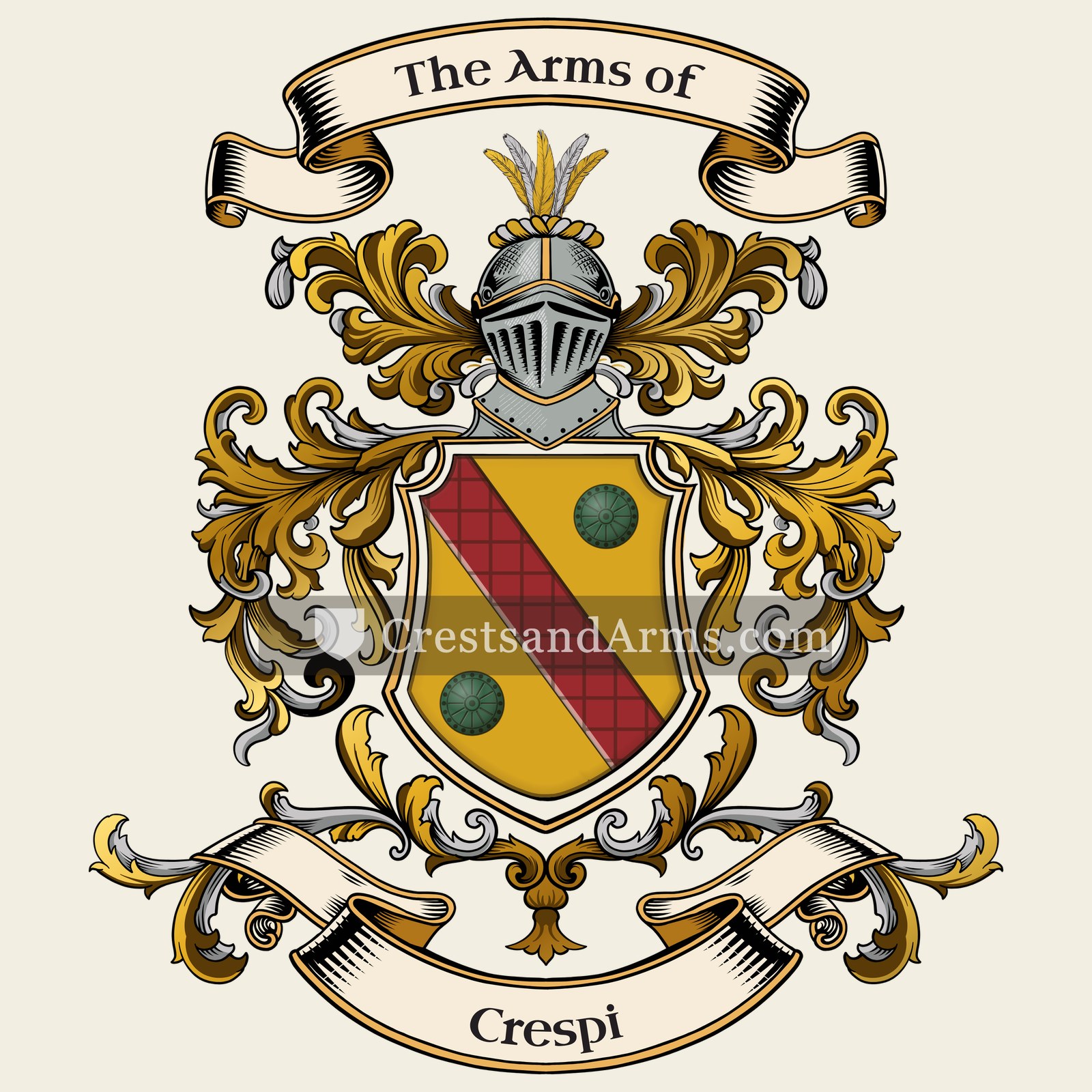


 paleMilitary strength, and a fortified defence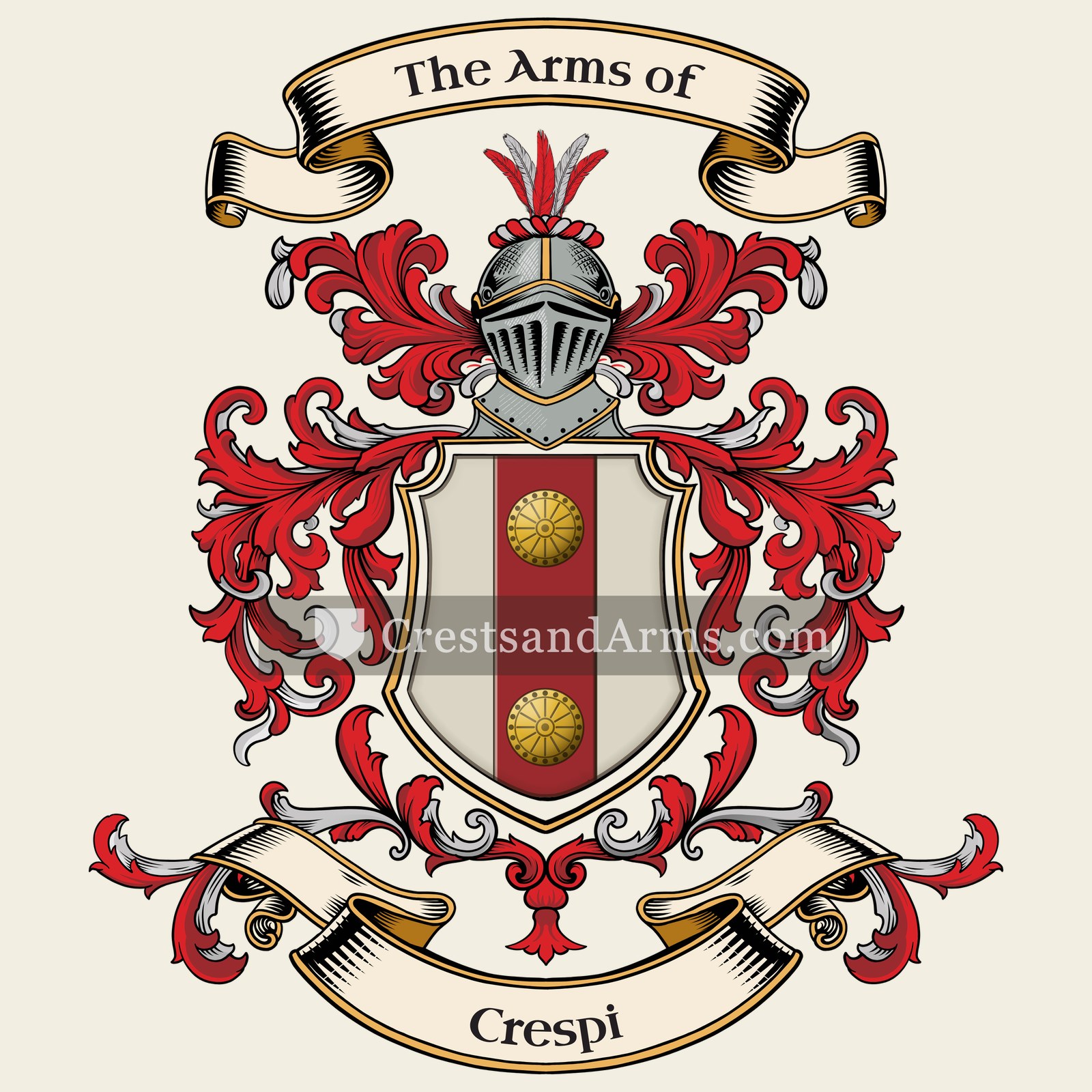


 fessThe military belt, and readiness to serve
 eagleNobility, strength and a keen mind