Map of Sweden showing where the Creutz arms are recorded
The Creutz arms were recorded in Sweden, c. 1569.
Arms such as these were typically recorded in Stockholm.
Stockholm held the Swedish court and the House of Nobility, where every noble family's arms were entered and kept. Families ennobled for service registered there, which is why so many are recorded around the city.
This is where the arms were entered in the register. Families often moved to other parts of the country, so the same name can turn up in more than one region.
The body that granted and recorded arms in Sweden in this period.
John III of Sweden
Sovereign of the period
John III of Sweden
1568–1592
Reigning in Sweden when the Creutz arms are first recorded.
How Arms Worked in Sweden
In Sweden, a coat of arms belonged to a noble family as a whole rather than just one individual. These arms were passed down through the generations to all legitimate descendants. Younger branches of the family used the same shield without needing to change it. This system ensured that the entire lineage shared the same identity and status under the law.
Granting authority
The Riddarhuset, or House of Nobility, regulated all noble coats of arms in Sweden under royal authority.
How they got arms
Families received their coats of arms through royal grants of nobility which were then officially registered with the House.
Where arms were recorded
Coats of arms were officially recorded in the Swedish House of Nobility register starting in the year 1626.
The family's standing
Recorded among the armigerous families of Sweden.
Origin & History of the Creutz Family in Sweden
The Creutz family name first emerged in Swedish records during the sixteenth century, establishing a notable presence in Stockholm by 1569. The family originated from the region of Pernå in present-day Finland, which was then a part of the Swedish realm. Early members of the family were primarily known for their service to the Swedish Crown, acting as loyal administrators and military officers during a time of significant national expansion. As the family grew in influence, they became deeply integrated into the political life of the capital. Their transition from local landowners to prominent figures in the royal court helped solidify the name within the upper ranks of Swedish society. This early period set the stage for the family to play a major role in the governance and history of the Swedish Empire for several generations.
Coat of Arms & Family Crest Details
Symbols on this shield
saltireResolution, and St Andrew's cross
portcullisProtection of the household, and the guarded gate
lionCourage, strength and royalty
starThe celestial goddess, and nobility
Colours
Red (Gules)Means: Military strength
Silver (Argent)Means: Peace and sincerity
Black (Sable)Means: Constancy
Historical info
Source
J. B. Rietstap, Armorial Général, Gouda: G. B. van Goor Zonen, 1884–87
Blazon (the actual original written record)
“Ec.: aux 1 et 4 de gu. à une herse sarasine d'arg.; aux 2 et 3 d'or au lion de sa., tenant de ses pattes une croix pattée au pied fiché de gu. Sur le tout d'azur au saut. d'arg., cant. de quatre étoiles (5) du même. Trois cq. cour. C.: 1º le lion iss., la croix d'arg.; 2º deux pl. d'aut. d'arg., sommées chacune d'une étoile (5) du même; 3º un senestrochère, arm. d'arg., posé sur le coude, la main de carn. supp. un chapeau de gu.”
Finlandc. 1719
Digital archive packCoat of arms PNG, gold border print PDF, vector SVG and the certificate of authenticity. Sent to your email in minutes.
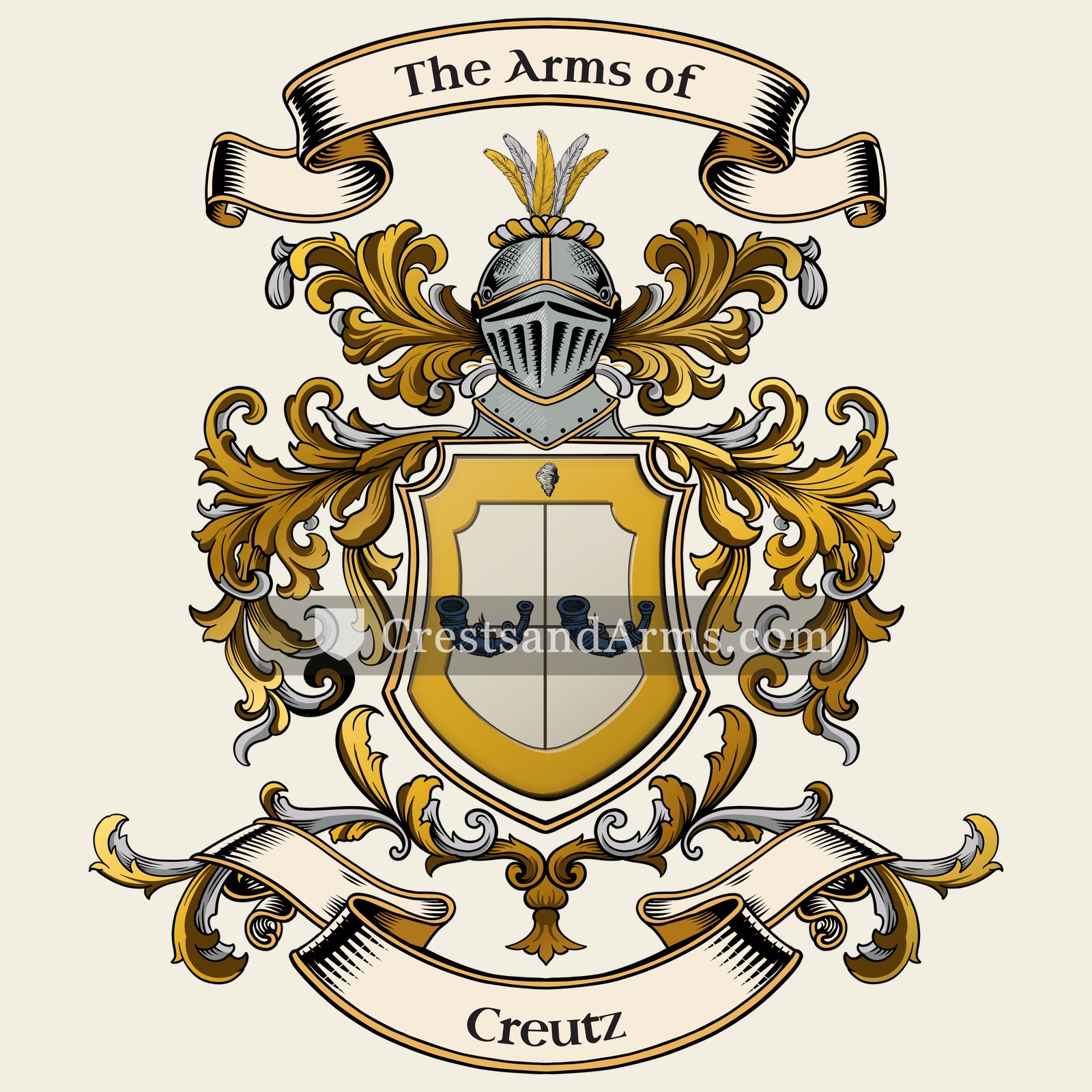
Map of Finland showing where the Creutz arms are recorded
The Creutz arms were recorded in Finland, c. 1719.
Arms such as these were typically recorded in Uusimaa.
Uusimaa was the Finnish coast facing Sweden, and the part of the country most closely tied to Stockholm. Its landowners and officers served the Swedish crown, and that service is what put their arms on record.
This is where the arms were entered in the register. Families often moved to other parts of the country, so the same name can turn up in more than one region.
The body that granted and recorded arms in Finland in this period.
How Arms Worked in Finland
Nobility in Finland held the exclusive right to register their coats of arms with the House of Nobility. These symbols were tied to the family name and were inherited by all members of the noble house. If a family branch moved or changed status, they kept their original design to maintain their identity within the official records.
Granting authority
The Finnish House of Nobility served as the official body that managed and protected all noble coats of arms.
How they got arms
Families received their arms through formal letters of nobility or by having their existing ancestral symbols confirmed by the House.
Where arms were recorded
All approved coats of arms were officially recorded in the Finnish House of Nobility Armorial starting in 1818.
The family's standing
Recorded among the armigerous families of Finland.
Origin & History of the Creutz Family in Finland
The Creutz family name holds a significant place in the history of Finland, particularly within the region of Uusimaa. While the family had roots in the broader Nordic nobility, their presence in Uusimaa became well-documented by the early eighteenth century. By 1719, members of the family were established figures in the local social and administrative landscape during a period of great political transition. They were deeply integrated into the landowning class, which allowed them to influence the development of local estates and regional governance. Over time, the family became synonymous with the cultural and political life of southern Finland, bridging the gap between their ancestral origins and their lasting impact on Finnish society. Their history reflects the broader movement of noble families who helped shape the administrative structure of the region during the Swedish era.
Coat of Arms & Family Crest Details
Symbols on this shield
wingSwiftness, and protection under a raised wing
hunting horn stringedOne who delights in the chase
whelkThe pilgrim's shell, and safe travel
Colours
Silver (Argent)Means: Peace and sincerity
Gold (Or)Means: Generosity
Black (Sable)Means: Constancy
Blue (Azure)Means: Loyalty and truth
Historical info
Source
J. B. Rietstap, Armorial Général, Gouda: G. B. van Goor Zonen, 1884–87
Blazon (the actual original written record)
“Ec.: aux 1 et 4 d'arg. à un demi-vol de sa.; aux 2 et 3 d'arg. à un cor-de-chasse d'azur, lié de gu. L'écu bordé d'or. Sur le tout d'azur à une conque marine d'arg. Cq. cour. C.: une fleur-de-lis d'arg. L. d'arg., de sa. et d'azur.”
Germanyc. 1708
Digital archive packCoat of arms PNG, gold border print PDF, vector SVG and the certificate of authenticity. Sent to your email in minutes.
Map of Germany showing where the Creutz arms are recorded
The Creutz arms were recorded in Germany, c. 1708.
Arms such as these were typically recorded in Bavaria.
Bavaria was a country of old landed families and walled market towns. Estates passed down the same line for centuries, and both the landowners and the leading townsmen kept arms, which is why so many Bavarian names sit in the registers.
This is where the arms were entered in the register. Families often moved to other parts of the country, so the same name can turn up in more than one region.
The body that granted and recorded arms in Germany in this period.
Joseph I, Holy Roman Emperor
Sovereign of the period
Joseph I, Holy Roman Emperor
1705–1711
Reigning in Sweden when the Creutz arms are first recorded.
How Arms Worked in Germany
In the Holy Roman Empire, coats of arms were often granted to individuals by the Emperor or his representatives. These arms were then passed down through the generations to all legitimate descendants of the original holder. Younger branches of a family usually kept the same shield design without needing to change it, as the arms belonged to the entire lineage.
Granting authority
The Holy Roman Emperor held the sole power to grant new coats of arms throughout his vast imperial territories.
How they got arms
Families typically obtained their coats of arms through a formal imperial grant or by proving their noble status to the authorities.
Where arms were recorded
These grants were officially recorded in the Imperial Chancery registers, which began keeping formal records of such honors during the Middle Ages.
The family's standing
Recorded among the armigerous families of Germany.
Origin & History of the Creutz Family in Germany
The family name Creutz originates from the Middle High German word "kriuze," which translates to cross. During the medieval period, names were often adopted to describe a person’s location, occupation, or a significant personal characteristic. Families bearing this name likely lived near a prominent roadside cross or a marketplace marked by a religious monument. By the year 1708, records confirm the presence of the Creutz family in Bavaria. At this time, Bavaria was a region defined by strong agricultural traditions and the influence of the Holy Roman Empire. The family members living there were likely part of the local community of farmers or craftsmen who helped sustain the economy of the southern German states. Their presence in the early eighteenth century reflects a period of stability where families began to establish deep roots in specific villages and towns across the Bavarian landscape.
Creutz Meaning & Related Branches
Root word
Crux
A Latin term referring to a cross or a torture instrument.
This name
CreutzDerived from the Swedish word for cross, often associated with heraldic symbols or religious significance.
also spelled
Kreutz
Kroyts
Documented Sources
J. B. Rietstap, Armorial Général, Gouda: G. B. van Goor Zonen, 1884–87
Elgenstierna, Gustaf. Den introducerade svenska adelns ättartavlor. 1926
Riksarkivet (National Archives of Sweden). Riksregistraturet. 1569
Digital archive packCoat of arms PNG, gold border print PDF, vector SVG and the certificate of authenticity. Sent to your email in minutes.


 saltireResolution, and St Andrew's cross
 starThe celestial goddess, and nobility
 saltireResolution, and St Andrew's cross
 starThe celestial goddess, and nobility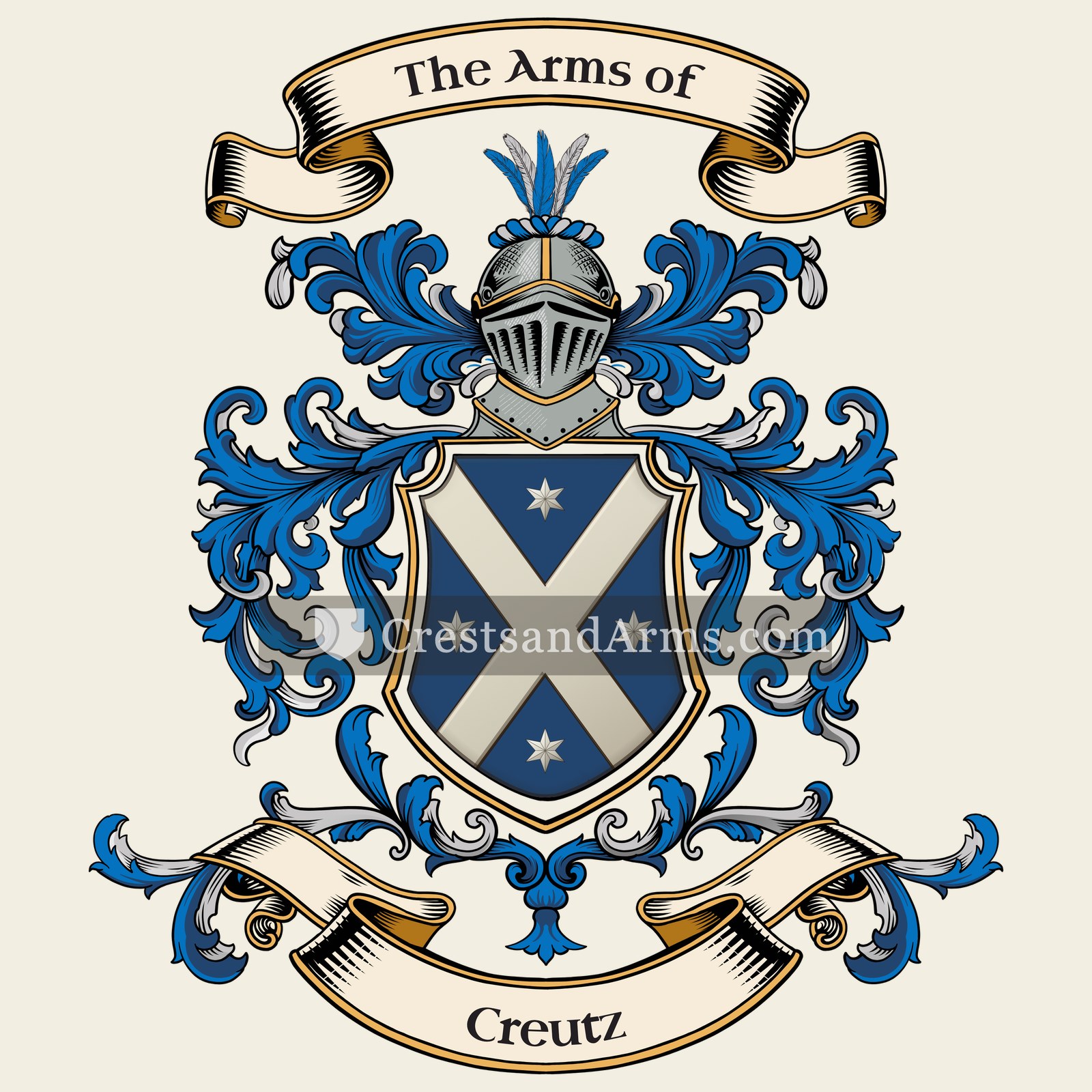


 portcullisProtection of the household, and the guarded gate
 lionCourage, strength and royalty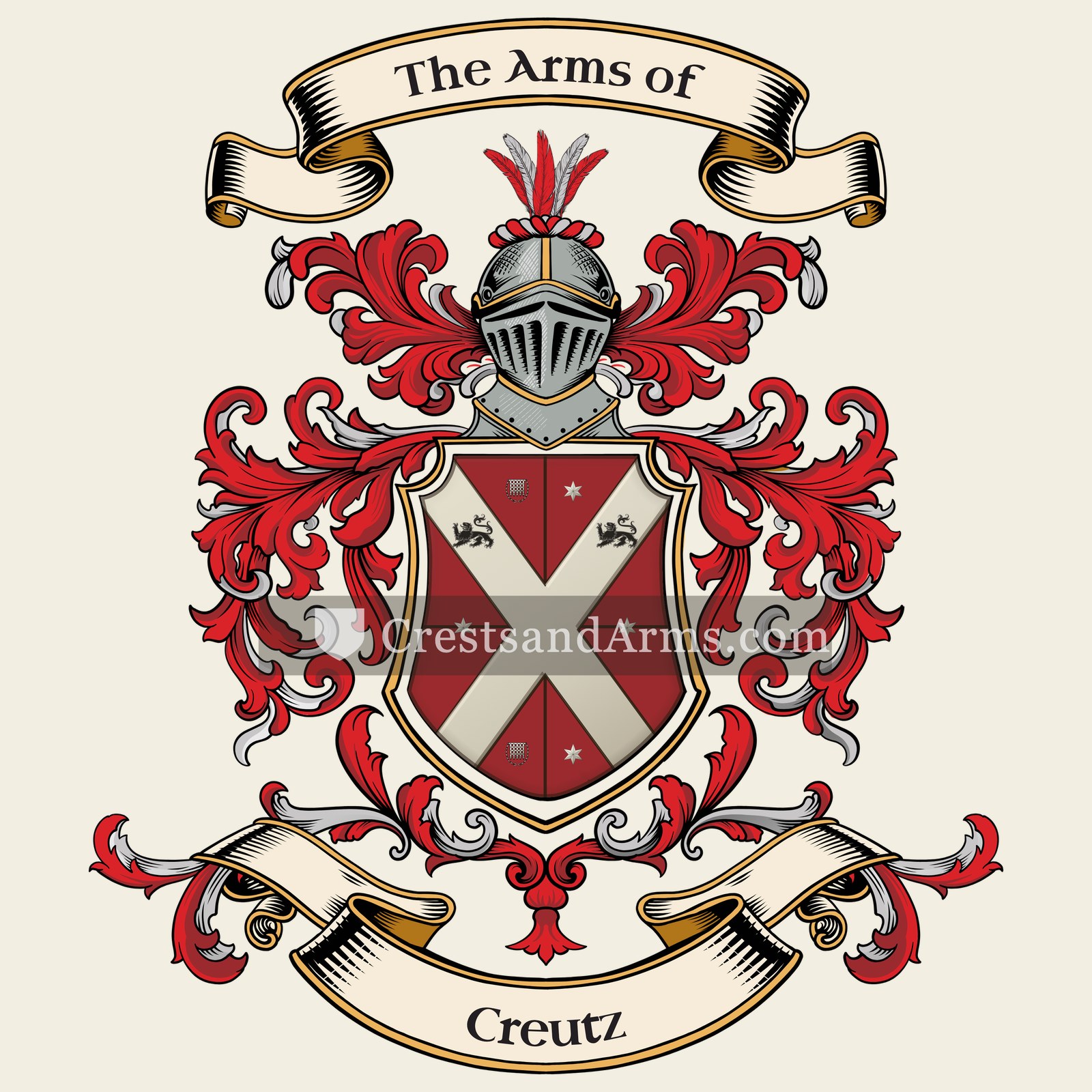

 wingSwiftness, and protection under a raised wing
 hunting horn stringedOne who delights in the chase
 whelkThe pilgrim's shell, and safe travel