Map of France showing where the Croak arms are recorded
The Croak arms were recorded in Flandre, c. 1663.
Flandre grew rich on cloth, and its towns were among the busiest in Europe. Merchant families bought land with their profits and took arms to go with it, so trade put as many names in the registers here as land did.
This is where the arms were entered in the register. Families often moved to other parts of the country, so the same name can turn up in more than one region.
The body that granted and recorded arms in France in this period.
Louis XIV of France
Sovereign of the period
Louis XIV of France
1643–1715
Reigning in France when the Croak arms are first recorded.
How Arms Worked in France
In France, a coat of arms was a mark of honor that passed down through the male line to all legitimate descendants. Families often used the same shield without changes to show their shared heritage. If a branch wanted to stand out, they could add a small mark to their shield to show their specific place in the family tree.
Granting authority
The Juge d'armes de France acted as the official authority that regulated and verified coats of arms across the country.
How they got arms
Families typically inherited their arms from ancestors, though they could also receive them through royal grants or by proving their noble status.
Where arms were recorded
Coats of arms were officially recorded in the Armorial Général de France, which began its main collection in the year 1696.
The family's standing
Recorded among the armigerous families of Flandre.
Origin & History of the Croak Family in France
The family name Croak traces its roots to the northern regions of France, specifically within the historical territory of Flandre. By the year 1663, records confirm that members of the family were well-established in this area, which was a bustling center of trade and cultural exchange between France and the Low Countries. During the seventeenth century, Flandre was a place of significant political transition as the region shifted between various European powers. Families living there often adapted to these changes by working in local industries like textile production or agriculture. The name itself likely evolved from regional dialects spoken in the borderlands, reflecting the unique mix of linguistic influences found in northern France during that era. By maintaining a presence in this strategic location, the early Croak family became part of the long history of people who helped shape the identity of the French border provinces.
Meaning of the Croak family crest colors & symbols
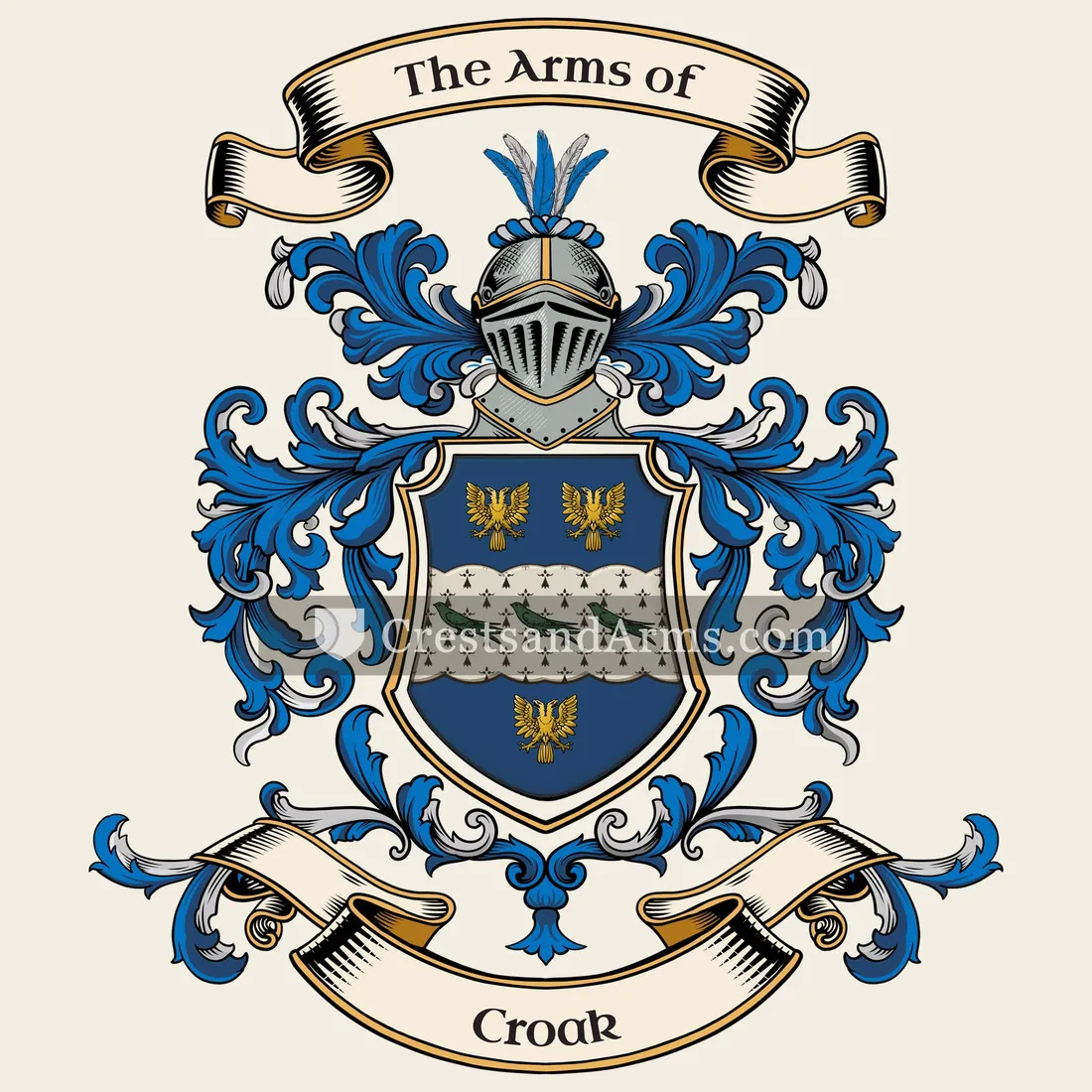
Symbols on this shield
fessThe military belt, and readiness to serve
eagleNobility, strength and a keen mind
martletA younger son, who must win his own land
Colours
Blue (Azure)Means: Loyalty and truth
ErmineMeans: Dignity
Gold (Or)Means: Generosity
Green (Vert)Means: Hope
Historical info
Source
Sir Bernard Burke, The General Armory of England, Scotland, Ireland and Wales, London: Harrison & Sons, 1884
Blazon (the actual original written record)
“Az. on a fesse engr. erm. betw. three eagles displ. or, as many birds vert”
Englandc. 1620
Digital archive packCoat of arms PNG, gold border print PDF, vector SVG and the certificate of authenticity. Sent to your email in minutes.
Map of England showing where the Croak arms are recorded
The Croak arms were recorded in England, c. 1620.
Arms such as these were typically recorded in York.
Yorkshire is the largest of the English counties, and it held more gentry families than any other. Land there was split among a great many households rather than a few, so a great many of them carried arms.
This is where the arms were entered in the register. Families often moved to other parts of the country, so the same name can turn up in more than one region.
The body that granted and recorded arms in England in this period.
James VI and I
Sovereign of the period
James VI and I
1603–1625
Reigning in France when the Croak arms are first recorded.
How Arms Worked in England
English heraldry allowed arms to be shared by all legitimate descendants of the original owner. These symbols were treated as personal property that moved through the generations to all children. While the eldest son kept the original design, other family members could use the same shield without needing to change it or register their own unique versions.
Granting authority
The College of Arms in London has regulated the use of coats of arms throughout England and Wales since 1484.
How they got arms
Families typically obtained their coats of arms through a formal grant from the Crown or by proving their ancient right to them.
Where arms were recorded
All official coats of arms are recorded in the registers kept at the College of Arms, which date back to the fifteenth century.
The family's standing
Recorded among the armigerous families of England.
Origin & History of the Croak Family in England
The family name Croak has deep roots in the northern English city of York, where records confirm members of the family were living as early as 1620. During this period, York was a bustling center of trade and religious life, and families like the Croaks were often part of the growing merchant or artisan classes that defined the city. The name itself likely evolved from older linguistic roots, possibly serving as a descriptive nickname or a variation of local occupational terms common in the Yorkshire region. Life in seventeenth-century York was shaped by the city’s long history as a northern capital, and the Croak family would have navigated the social and economic changes of the Stuart era. By establishing themselves in such a prominent urban hub, these early ancestors helped set the foundation for the family’s presence in England before the name eventually spread to other parts of the world.
Croak Meaning & Related Branches
Root word
croc
Old French term referring to a hook or a curved object.
This name
CroakA nickname for a person with a hooked nose or a curved physical feature.
also spelled
Krook
Croock
Croke
Crokes
Documented Sources
J. B. Rietstap, Armorial Général, Gouda: G. B. van Goor Zonen, 1884–87
Archives départementales du Nord, Série B (Chambre des comptes de Lille)
Lottin, Alain, Histoire des provinces françaises du Nord, 1989
Pirenne, Henri, Histoire de Belgique, 1900
Digital archive packCoat of arms PNG, gold border print PDF, vector SVG and the certificate of authenticity. Sent to your email in minutes.


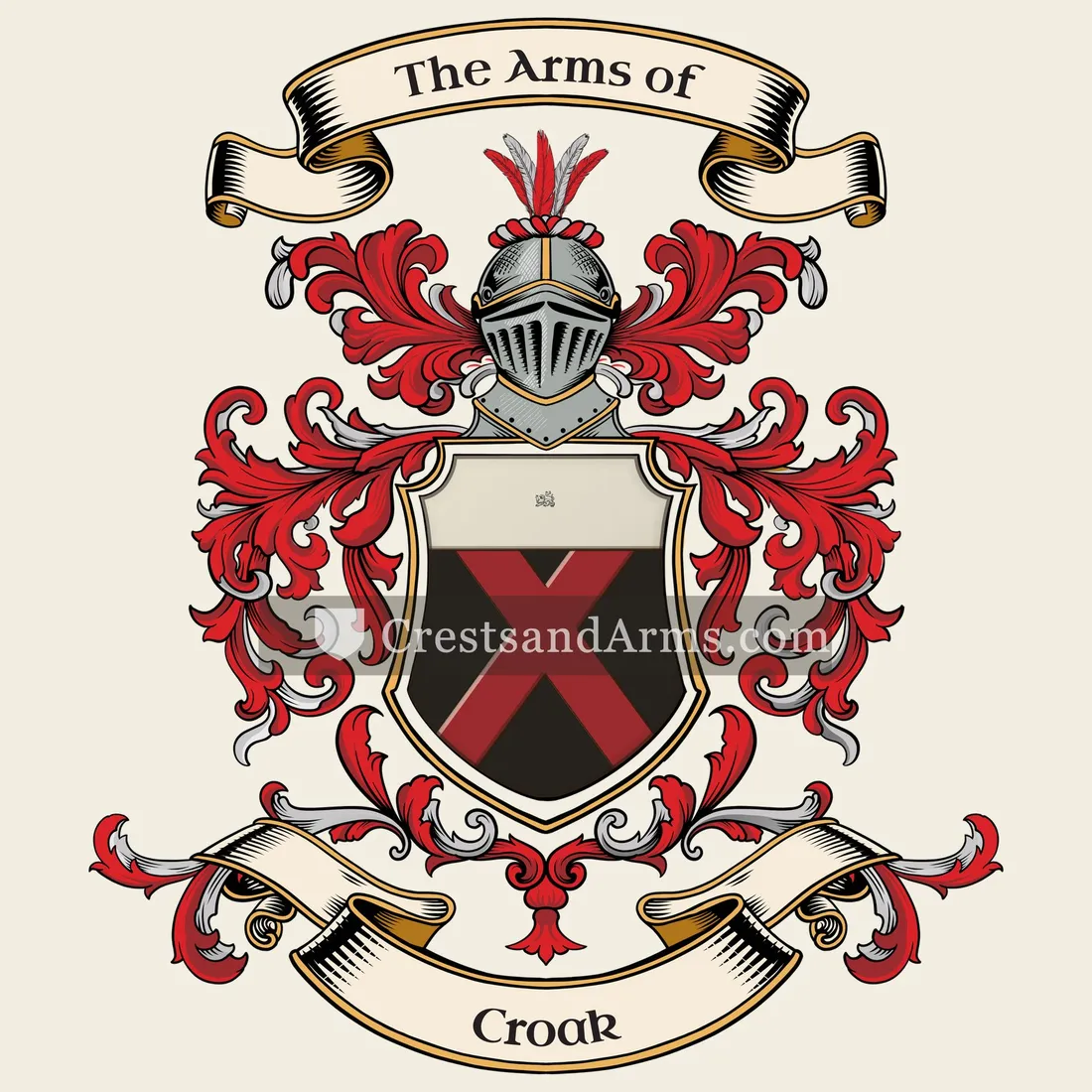
 chiefAuthority, wisdom and dominion
 saltireResolution, and St Andrew's cross
 lionCourage, strength and royalty
 chiefAuthority, wisdom and dominion
 saltireResolution, and St Andrew's cross
 lionCourage, strength and royalty


 fessThe military belt, and readiness to serve
 eagleNobility, strength and a keen mind
 martletA younger son, who must win his own land