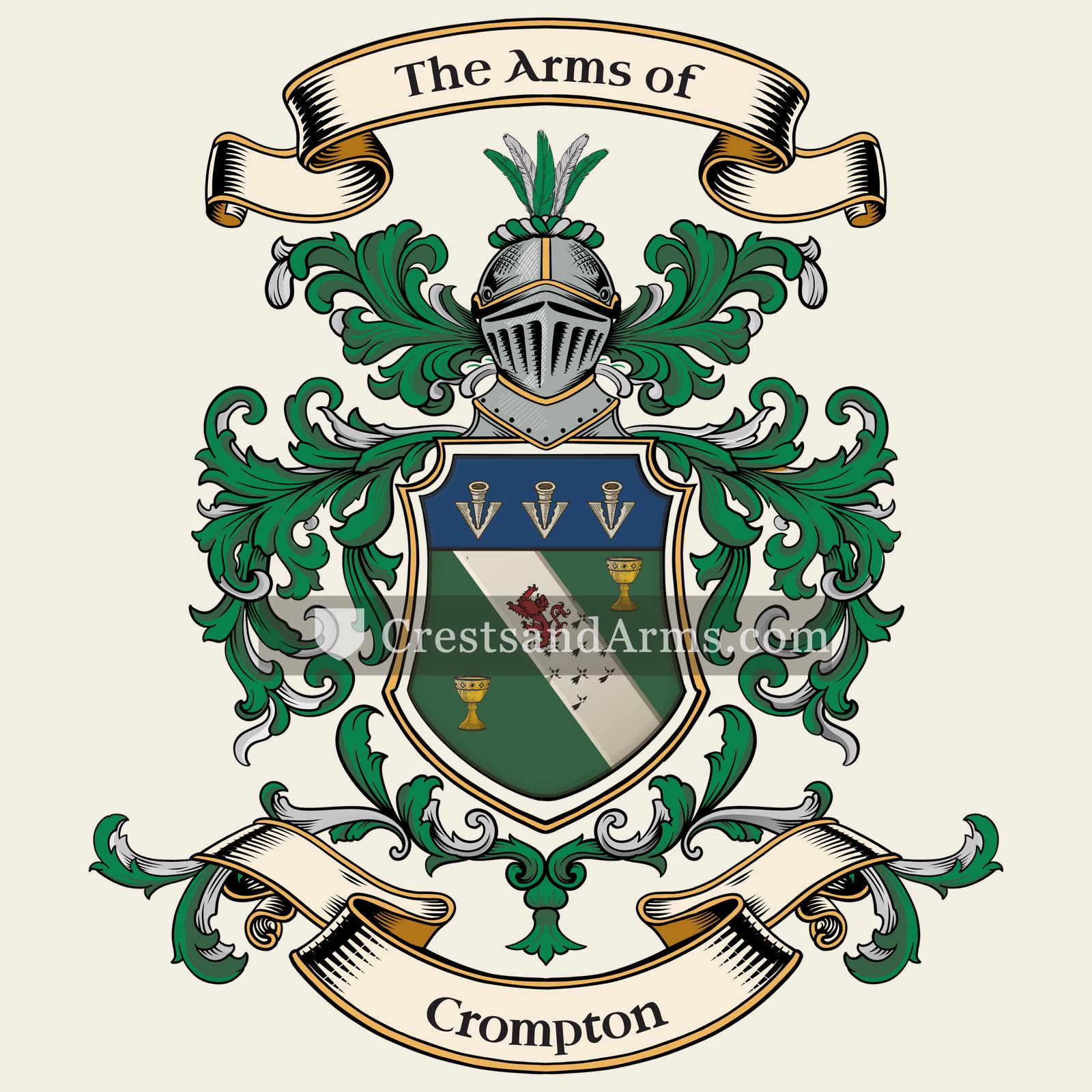
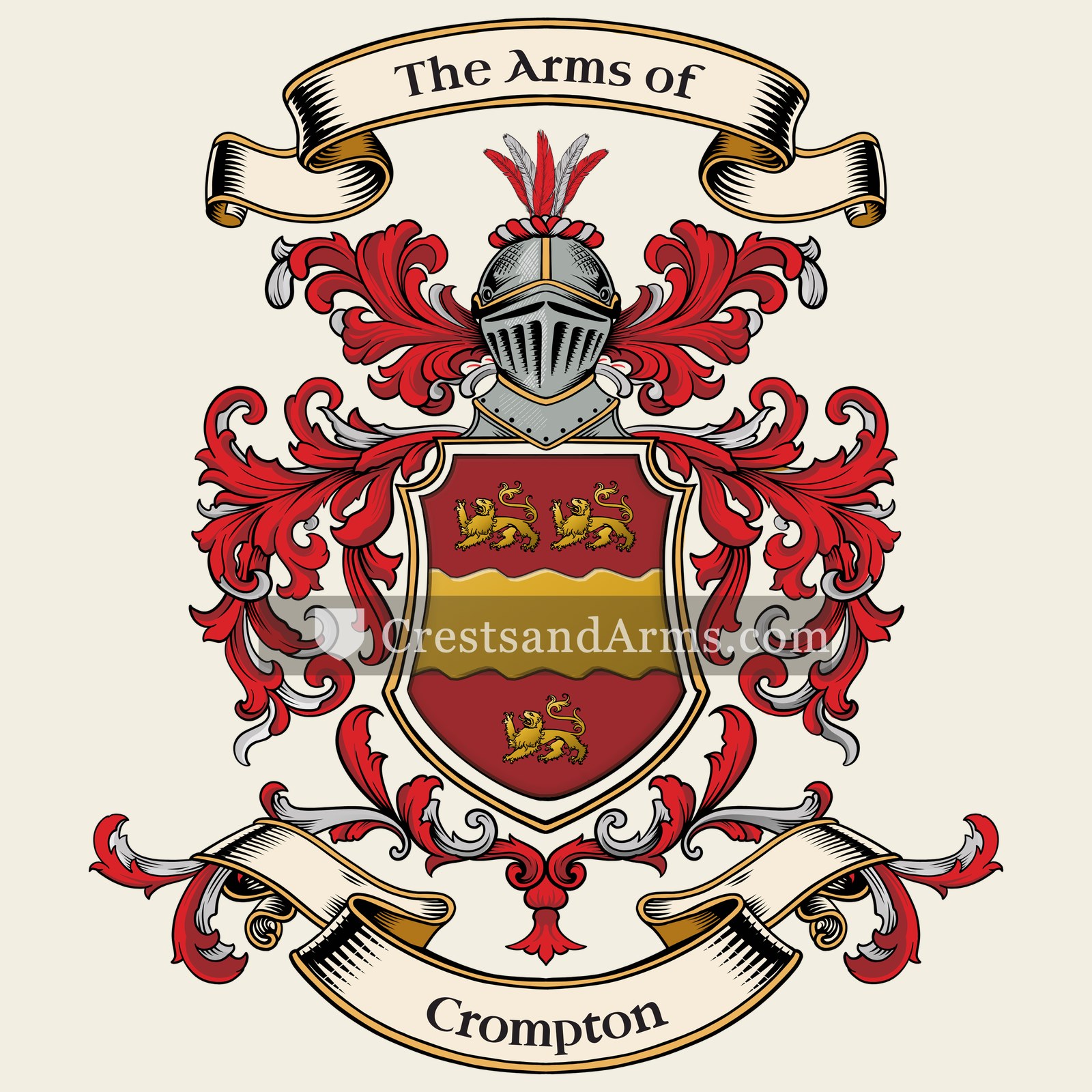
A record of documented arms, meaning and origin, researched for the Crompton family lines. Documented in 2 countries.
Reg. 4623 · Britain, A–C
Coat of Arms & Family Crest Details
Symbols on this shield
bendDefence, and the scarf of a commander
chiefAuthority, wisdom and dominion
lionCourage, strength and royalty
cupFaith, office, and a trust discharged
arms pheon arrowheadReadiness for battle, and the broad arrow of the sovereign
Colours
Silver (Argent)Means: Peace and sincerity
ErmineMeans: Dignity
Blue (Azure)Means: Loyalty and truth
Red (Gules)Means: Military strength
Gold (Or)Means: Generosity
Historical info
Source
J. B. Rietstap, Armorial Général, Gouda: G. B. van Goor Zonen, 1884–87
Blazon (the actual original written record)
“De sin. à la bande d'arg., doublement coticée d'herm., ch. d'un lion léopardé de gu. et acc. de deux coupes couvertes d'or; au chef d'azur, ch. de trois phéons d'herm., les pointes en bas. C.: un cheval iss. au nat., la poitrine percée d'une flèche d'arg., arm. d'or, en bande, la pointe en bas. D.: LOVE AND LOYALTY.”
YorkshireYorkshire, c. 1838
Where the Crompton Arms Were Recorded
Yorkshire
Map of Britain showing where the Crompton arms are recorded
The Crompton arms were recorded in Yorkshire, c. 1838.
This is where the arms were entered in the register. Families often moved to other parts of the country, so the same name can turn up in more than one region.
The body that granted and recorded arms in Britain in this period.
Victoria
Sovereign of the period
Victoria
1837–1901
Reigning in Britain when the Crompton arms are first recorded.
How Arms Worked in Britain
English heraldry allowed arms to be shared by all legitimate descendants of the original owner. These symbols were treated as personal property that moved through the generations to all children. While the eldest son kept the original design, other family members could use the same shield without needing to change it or register their own unique versions.
Granting authority
The College of Arms in London has regulated the use of coats of arms throughout England and Wales since 1484.
How they got arms
Families typically obtained their coats of arms through a formal grant from the Crown or by proving their ancient right to them.
Where arms were recorded
All official coats of arms are recorded in the registers kept at the College of Arms, which date back to the fifteenth century.
The family's standing
Recorded among the armigerous families of Yorkshire.
Origin & History of the Crompton Family in Britain
The surname Crompton is a locational name that originated in the historic county of Lancashire, though branches of the family eventually spread into neighboring Yorkshire. The name is derived from the Old English words "crumb," meaning crooked or bent, and "tun," meaning an enclosure or settlement. This suggests that the earliest ancestors to carry the name lived near a curved piece of land or a winding stream. By the time the family was firmly established in Yorkshire during the early nineteenth century, the name had already been associated with the region for several hundred years. The family likely moved across northern England as the Industrial Revolution began to reshape the landscape, transitioning from rural agricultural roots to the growing urban centers of the north. This movement reflects the broader history of families in Britain who migrated to find new opportunities in the textile mills and emerging industries that defined the Victorian era.
Coat of Arms & Family Crest Details
Symbols on this shield
fessThe military belt, and readiness to serve
lionCourage, strength and royalty
Colours
Red (Gules)Means: Military strength
Gold (Or)Means: Generosity
Historical info
Source
Sir Bernard Burke, The General Armory of England, Scotland, Ireland and Wales, London: Harrison & Sons, 1884
Blazon (the actual original written record)
“Gu. a fesse wavy, betw. three lions ramp. or”
LancasterCrompton · Lancaster, c. 1664
Where the Crompton Arms Were Recorded
Lancaster
Map of England showing where the Crompton arms are recorded
The Crompton arms were recorded in Lancaster, c. 1664.
Lancashire was divided among a great many small landed families, more than most northern counties. Estates were passed down whole rather than split up, so the same names hold the same ground for centuries in the records.
This is where the arms were entered in the register. Families often moved to other parts of the country, so the same name can turn up in more than one region.
The body that granted and recorded arms in England in this period.
Charles II of England
Sovereign of the period
Charles II of England
1660–1685
Reigning in Britain when the Crompton arms are first recorded.
How Arms Worked in England
English heraldry allowed arms to be shared by all legitimate descendants of the original owner. These symbols were treated as personal property that moved through the generations to all children. While the eldest son kept the original design, other family members could use the same shield without needing to change it or register their own unique versions.
Granting authority
The College of Arms in London has regulated the use of coats of arms throughout England and Wales since 1484.
How they got arms
Families typically obtained their coats of arms through a formal grant from the Crown or by proving their ancient right to them.
Where arms were recorded
All official coats of arms are recorded in the registers kept at the College of Arms, which date back to the fifteenth century.
The family's standing
Recorded among the armigerous families of Lancaster.
Origin & History of the Crompton Family in England
The surname Crompton is a locational name that originated in the historic county of Lancashire, England. It is derived from the Old English words "crumb," meaning crooked or bent, and "tun," which refers to a farmstead or settlement. This suggests that the earliest members of the family likely lived near a winding river or a curved piece of land. By the mid-17th century, the family was well-established in the region, as evidenced by records of Cromptons living in Lancaster in 1664. During this era, many families in Lancashire were deeply involved in the local agricultural and early textile economies that defined the area. As the population grew, members of the family spread from these rural settlements into the expanding towns, helping to shape the social and economic landscape of Northern England.
Related Branches & Arms
Root word
Crumb and tun
Old English for a crooked or bent area and an enclosure.
This name
CromptonRefers to a settlement located near a winding river or a crooked piece of land.
also spelled
Cromptont
Cromptone
Krompton
Crumpton
Related arms
Lukerecorded with Crompton, same area
Documented Sources
J. B. Rietstap, Armorial Général, Gouda: G. B. van Goor Zonen, 1884–87
Bardsley, Charles Wareing, A Dictionary of English and Welsh Surnames, 1901
Ekwall, Eilert, The Concise Oxford Dictionary of English Place-names, 1960
The National Archives, Census Returns of England and Wales, 1841, HO 107
Digital archive packCoat of arms PNG, gold border print PDF, vector SVG and the certificate of authenticity. Sent to your email in minutes.


 bendDefence, and the scarf of a commander
 chiefAuthority, wisdom and dominion
 lionCourage, strength and royalty
 cupFaith, office, and a trust discharged
 arms pheon arrowheadReadiness for battle, and the broad arrow of the sovereign
 bendDefence, and the scarf of a commander
 chiefAuthority, wisdom and dominion
 lionCourage, strength and royalty
 cupFaith, office, and a trust discharged
 arms pheon arrowheadReadiness for battle, and the broad arrow of the sovereign

 fessThe military belt, and readiness to serve