Map of Britain showing where the Cromwell arms are recorded
The Cromwell arms were recorded in Lincolnshire, c. 1471.
This is where the arms were entered in the register. Families often moved to other parts of the country, so the same name can turn up in more than one region.
The body that granted and recorded arms in Britain in this period.
Henry VI of England
Sovereign of the period
Henry VI of England
1470–1471
Reigning in Britain when the Cromwell arms are first recorded.
How Arms Worked in Britain
English heraldry allowed arms to be shared by all legitimate descendants of the original owner. These symbols were treated as personal property that moved through the generations to all children. While the eldest son kept the original design, other family members could use the same shield without needing to change it or register their own unique versions.
Granting authority
The College of Arms in London has regulated the use of coats of arms throughout England and Wales since 1484.
How they got arms
Families typically obtained their coats of arms through a formal grant from the Crown or by proving their ancient right to them.
Where arms were recorded
All official coats of arms are recorded in the registers kept at the College of Arms, which date back to the fifteenth century.
The family's standing
Recorded among the armigerous families of Lincolnshire.
Origin & History of the Cromwell Family in Britain
The Cromwell family name originated as a locational surname, derived from the village of Cromwell in Nottinghamshire. By the late fifteenth century, the family had established a significant presence in Lincolnshire, where they became influential figures in local society. Records from 1471 confirm that members of the family were active in this region, marking the beginning of their rise toward national prominence. During this period, the family transitioned from local landowners to key players in English political life. Their history is closely tied to the shifting power structures of the late Middle Ages, as they navigated the complex social landscape of the English countryside. This early foundation in Lincolnshire provided the necessary wealth and status that allowed later generations to exert a profound influence on the governance and history of Britain.
Coat of Arms & Family Crest Details
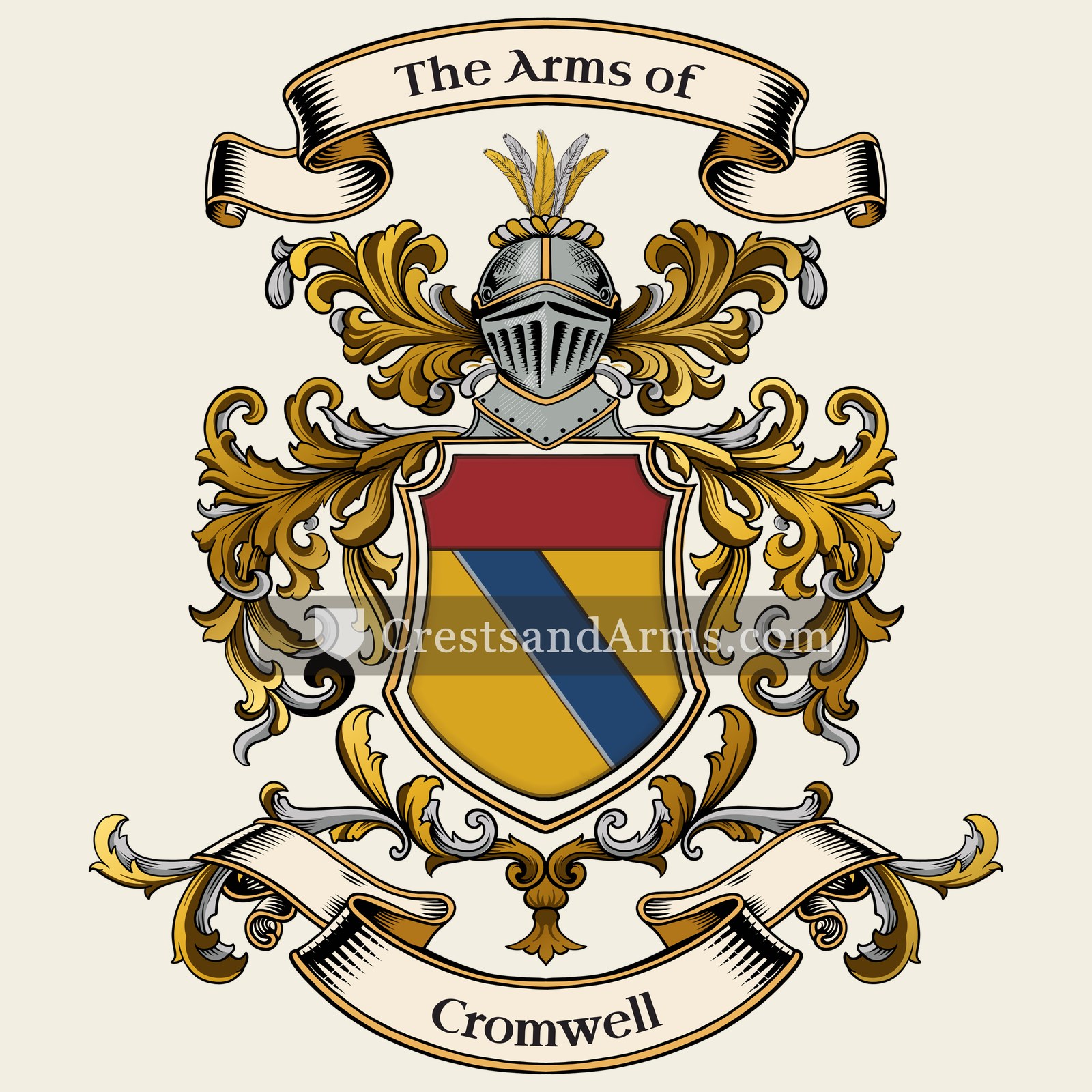
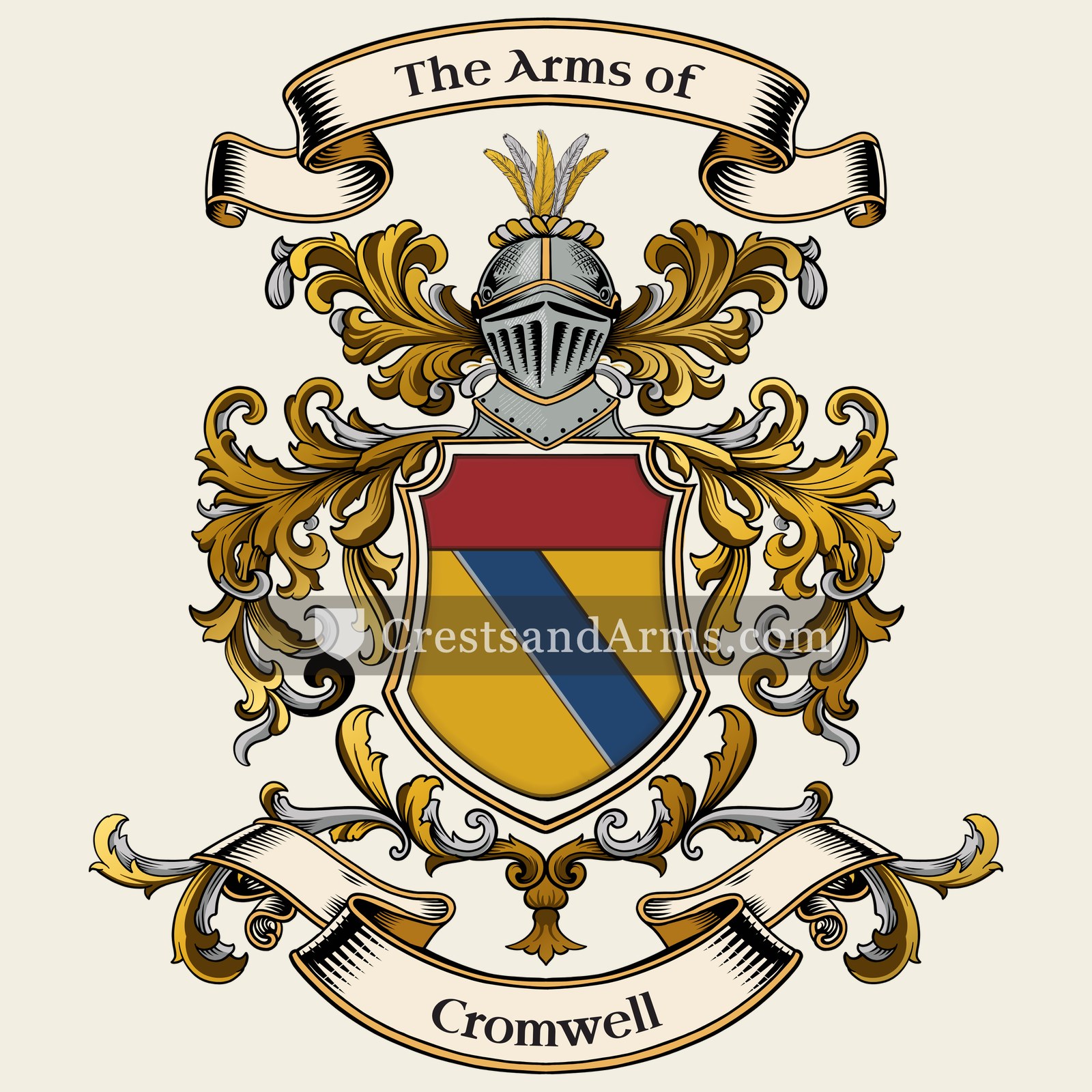
Symbols on this shield
chiefAuthority, wisdom and dominion
bendDefence, and the scarf of a commander
Colours
Gold (Or)Means: Generosity
Blue (Azure)Means: Loyalty and truth
Red (Gules)Means: Military strength
Historical info
Source
Sir Bernard Burke, The General Armory of England, Scotland, Ireland and Wales, London: Harrison & Sons, 1884
Blazon (the actual original written record)
“Or, a chief gu. over all a bend az”
LincolnLincoln, c. 1308
Digital archive packCoat of arms PNG, gold border print PDF, vector SVG and the certificate of authenticity. Sent to your email in minutes.
Map of England showing where the Cromwell arms are recorded
The Cromwell arms were recorded in Lincoln, c. 1308.
Lincolnshire was rich farming country, and its wealth was spread across many middling families. Households of that size bought land and took arms, and the county holds a large share of English names.
This is where the arms were entered in the register. Families often moved to other parts of the country, so the same name can turn up in more than one region.
The body that granted and recorded arms in England in this period.
Edward II of England
Sovereign of the period
Edward II of England
1307–1327
Reigning in Britain when the Cromwell arms are first recorded.
How Arms Worked in England
English heraldry allowed arms to be shared by all legitimate descendants of the original owner. These symbols were treated as personal property that moved through the generations to all children. While the eldest son kept the original design, other family members could use the same shield without needing to change it or register their own unique versions.
Granting authority
The College of Arms in London has regulated the use of coats of arms throughout England and Wales since 1484.
How they got arms
Families typically obtained their coats of arms through a formal grant from the Crown or by proving their ancient right to them.
Where arms were recorded
All official coats of arms are recorded in the registers kept at the College of Arms, which date back to the fifteenth century.
The family's standing
Recorded among the armigerous families of Lincoln.
Origin & History of the Cromwell Family in England
The Cromwell family name originated as a locative surname, meaning it was derived from the specific place where the earliest members lived. The name comes from the village of Cromwell in Nottinghamshire, which was recorded in the Domesday Book of 1086 as *Crumbwelle*. This name is rooted in Old English, combining words that describe a winding stream or a crooked spring. By the early 14th century, the family had established a significant presence in Lincolnshire, particularly with records confirming their activity in the region by 1308. Over time, the family moved from being identified by their local village to becoming prominent landholders and political figures. Their rise in status helped transition the name from a simple geographical marker into a well-known identifier for a lineage that would eventually play a major role in English national history.
Cromwell Meaning & Related Branches
Root word
Crumb Well
Derived from Old English words for crooked and a water spring.
This name
CromwellRefers to a person who lived near a winding or crooked stream.
also spelled
Cromwelle
Cromwells
Kromwell
Crumwell
Related arms
Cronwellvariant spelling
Powtrellrecorded with Cromwell, same area
Documented Sources
J. B. Rietstap, Armorial Général, Gouda: G. B. van Goor Zonen, 1884–87
Fraser, Antonia, Cromwell: Our Chief of Men, 1973
Gaunt, Peter, Oliver Cromwell, 1996
The National Archives, Chancery: Inquisitions Post Mortem, Series I, 1471
Digital archive packCoat of arms PNG, gold border print PDF, vector SVG and the certificate of authenticity. Sent to your email in minutes.


 chiefAuthority, wisdom and dominion
 bendDefence, and the scarf of a commander
 chiefAuthority, wisdom and dominion
 bendDefence, and the scarf of a commander