Map of Belgium showing where the Crosse arms are recorded
The Crosse arms were recorded in Tournai, c. 1737.
This is where the arms were entered in the register. Families often moved to other parts of the country, so the same name can turn up in more than one region.
The body that granted and recorded arms in Belgium in this period.
Charles VI, Holy Roman Emperor
Sovereign of the period
Charles VI, Holy Roman Emperor
1711–1740
Reigning in Belgium when the Crosse arms are first recorded.
How Arms Worked in Belgium
In Belgium, a coat of arms is considered personal property that is passed down through the male line to legitimate descendants. Families often use the same shield design across generations to show their shared heritage. If a branch of the family wants to change the design, they must apply for an official update to their specific version of the arms.
Granting authority
The Conseil héraldique is the official body that regulates and approves all coats of arms in Belgium.
How they got arms
Families obtain their coats of arms through formal royal grants or by confirming their historical right to use existing designs.
Where arms were recorded
All approved coats of arms are officially recorded in the public registers of the Conseil héraldique since 1844.
The family's standing
Recorded among the armigerous families of Belgium.
Origin & History of the Crosse Family in Belgium
The history of the Crosse family in Belgium is deeply rooted in the historic city of Tournai, where records confirm their presence by the year 1737. During the eighteenth century, Tournai served as a vital center for trade and craftsmanship within the Austrian Netherlands. Families like the Crosses often integrated into the local urban fabric by engaging in the city’s thriving textile industries or administrative roles. Because the name is associated with the cross, it likely originated as a descriptive label for individuals who lived near a prominent roadside crucifix or a marketplace cross. As the family established themselves in Tournai, they became part of a resilient community that navigated the complex political shifts of the region. By settling in this ancient city, the early members of the Crosse family contributed to the long-standing cultural and economic development of the area.
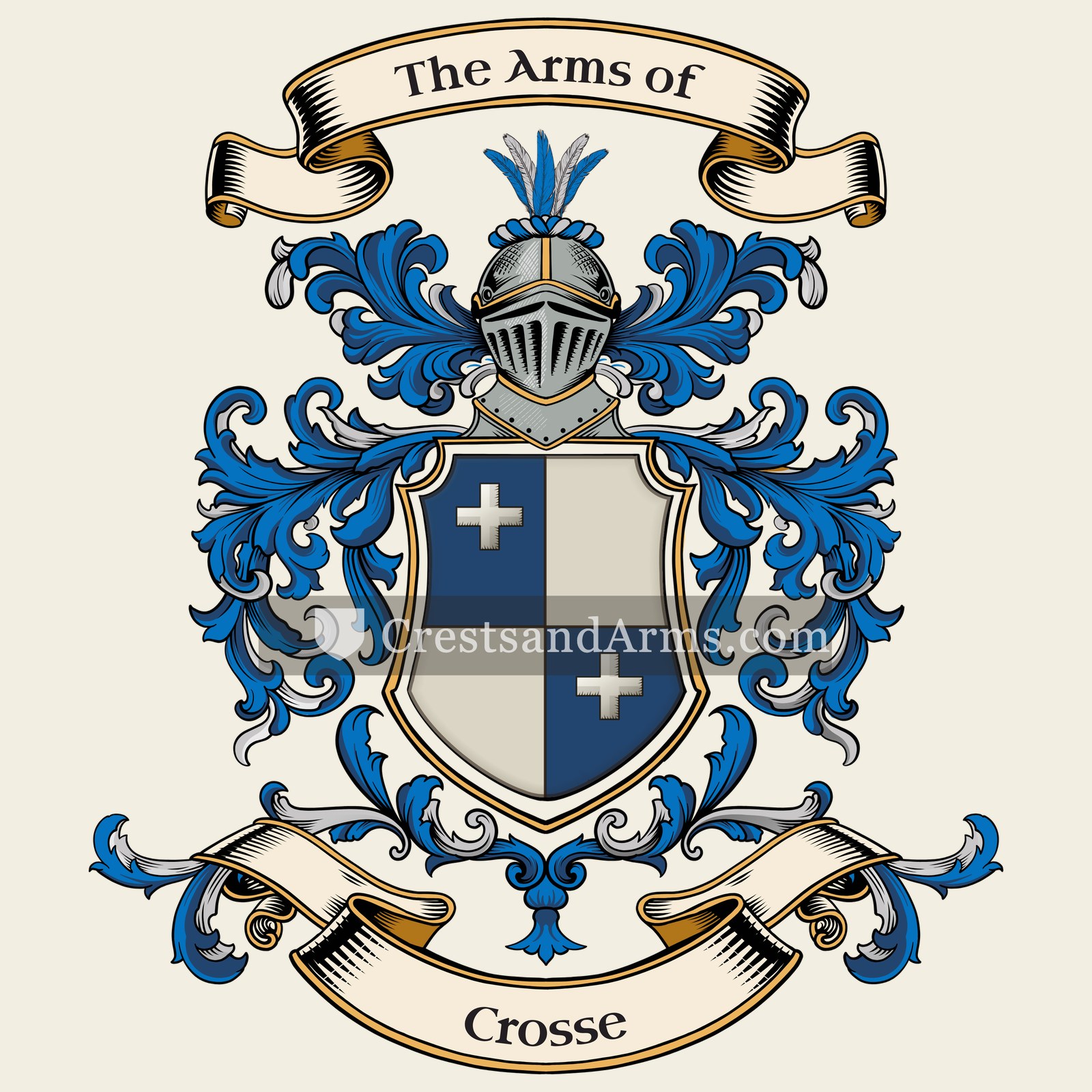
Coat of Arms & Family Crest Details
Symbols on this shield
cross symbolChristian faith and service
Colours
Blue (Azure)Means: Loyalty and truth
Silver (Argent)Means: Peace and sincerity
Historical info
Source
J. B. Rietstap, Armorial Général, Gouda: G. B. van Goor Zonen, 1884–87
Blazon (the actual original written record)
“Ec. d'azur et d'arg.; chaque quartier d'azur ch. d'une croix ancrée du sec. C.: une cigogne d'azur, la patte dextre posée sur une croisette ancrée d'arg.; le tout soutenu d'un chapeau de tournoi de gu., retr. d'herm.”
BritainLondres, c. 1713
Digital archive packCoat of arms PNG, gold border print PDF, vector SVG and the certificate of authenticity. Sent to your email in minutes.
Map of Britain showing where the Crosse arms are recorded
The Crosse arms were recorded in Londres, c. 1713.
Arms such as these were typically recorded in Kent.
Kent sits between London and the short crossing to Europe, and the trade passing through made it wealthy. Merchant families bought land with that money, and it was landowners who took coats of arms.
This is where the arms were entered in the register. Families often moved to other parts of the country, so the same name can turn up in more than one region.
The body that granted and recorded arms in Britain in this period.
Anne of Great Britain
Sovereign of the period
Anne of Great Britain
1707–1714
Reigning in Belgium when the Crosse arms are first recorded.
How Arms Worked in Britain
English heraldry allowed arms to be shared by all legitimate descendants of the original owner. These symbols were treated as personal property that moved through the generations to all children. While the eldest son kept the original design, other family members could use the same shield without needing to change it or register their own unique versions.
Granting authority
The College of Arms in London has regulated the use of coats of arms throughout England and Wales since 1484.
How they got arms
Families typically obtained their coats of arms through a formal grant from the Crown or by proving their ancient right to them.
Where arms were recorded
All official coats of arms are recorded in the registers kept at the College of Arms, which date back to the fifteenth century.
The family's standing
Recorded among the armigerous families of Britain.
Origin & History of the Crosse Family in Britain
The name Crosse is a topographic surname, which means it was originally given to people based on where they lived or worked. In medieval Britain, the name identified individuals who resided near a prominent stone cross, a market cross, or a crossroads in their local village. By the time members of the family were documented in Kent in 1713, the name had already been established across England for several centuries as a way to track families in parish registers and tax rolls. Because these markers were common features in town squares and along trade routes, the name emerged independently in various regions rather than coming from a single ancestor. This history reflects the transition from a society where people were identified by their trade or location to one where surnames became permanent family markers passed down through generations.
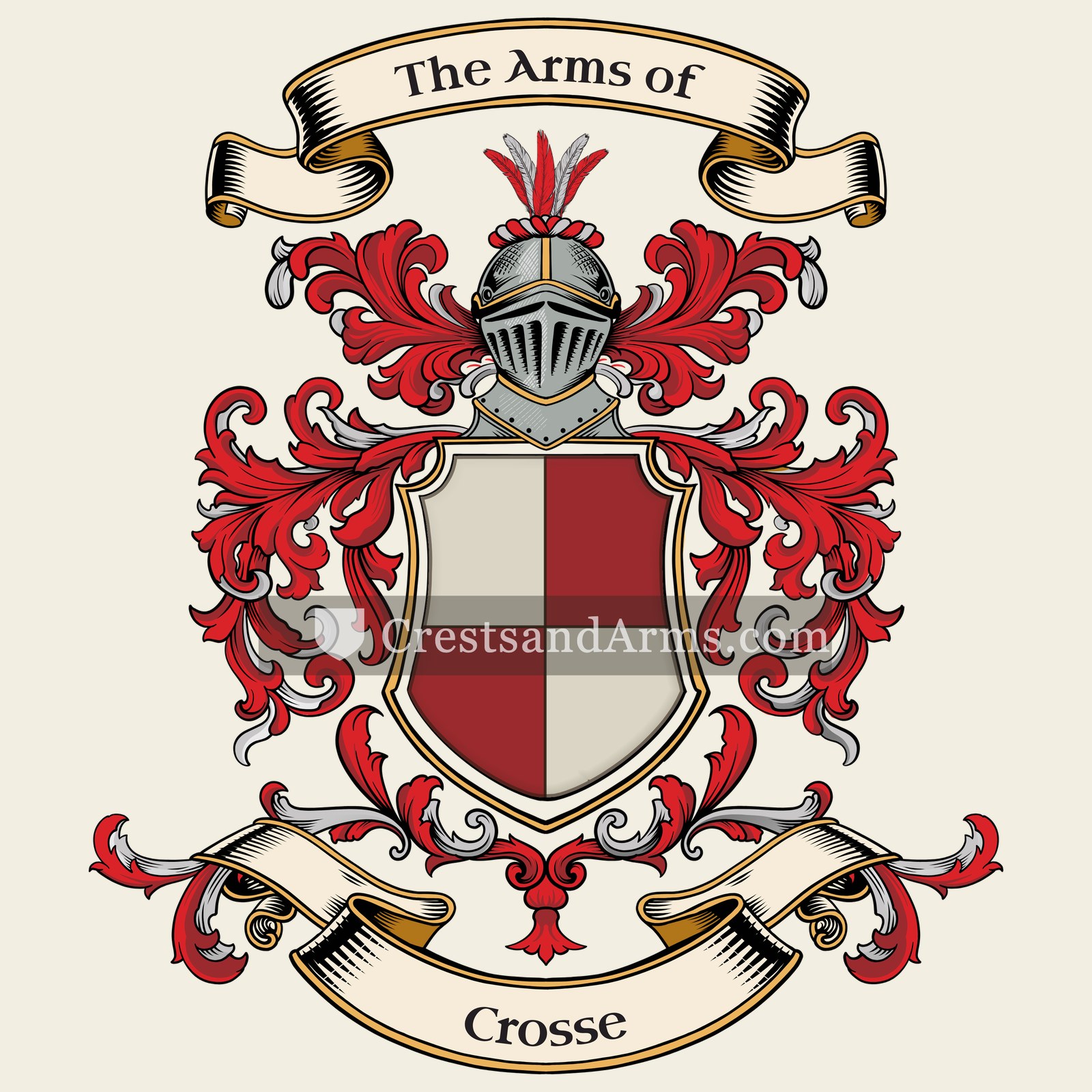
Coat of Arms & Family Crest Details
Colours
Silver (Argent)Means: Peace and sincerity
Red (Gules)Means: Military strength
Historical info
Source
Sir Bernard Burke, The General Armory of England, Scotland, Ireland and Wales, London: Harrison & Sons, 1884
Blazon (the actual original written record)
“Quarterly, ar. and gu. in the first quarter a cross crosslet of the second”
Englandc. 1602
Digital archive packCoat of arms PNG, gold border print PDF, vector SVG and the certificate of authenticity. Sent to your email in minutes.
Map of England showing where the Crosse arms are recorded
The Crosse arms were recorded in England, c. 1602.
Arms such as these were typically recorded in York.
Yorkshire is the largest of the English counties, and it held more gentry families than any other. Land there was split among a great many households rather than a few, so a great many of them carried arms.
This is where the arms were entered in the register. Families often moved to other parts of the country, so the same name can turn up in more than one region.
The body that granted and recorded arms in England in this period.
Elizabeth I of England
Sovereign of the period
Elizabeth I of England
1558–1603
Reigning in Belgium when the Crosse arms are first recorded.
How Arms Worked in England
English heraldry allowed arms to be shared by all legitimate descendants of the original owner. These symbols were treated as personal property that moved through the generations to all children. While the eldest son kept the original design, other family members could use the same shield without needing to change it or register their own unique versions.
Granting authority
The College of Arms in London has regulated the use of coats of arms throughout England and Wales since 1484.
How they got arms
Families typically obtained their coats of arms through a formal grant from the Crown or by proving their ancient right to them.
Where arms were recorded
All official coats of arms are recorded in the registers kept at the College of Arms, which date back to the fifteenth century.
The family's standing
Recorded among the armigerous families of England.
Origin & History of the Crosse Family in England
The surname Crosse originated as a topographical name, which means it was given to people who lived near a prominent landmark. In medieval England, families often took their names from local features like a stone cross, a marketplace, or a crossroads in their village. By the time members of the Crosse family were documented in York in 1602, the name had already been established in various regions across the country for several centuries. During this era, the family likely lived in a bustling urban center where the name helped distinguish them from neighbors. Because the name was tied to common physical markers found in many towns, different branches of the family often emerged independently in separate parts of England. These early ancestors were part of a growing class of citizens who were increasingly identified by their specific location and their role within their local community.
Crosse Meaning & Related Branches
Root word
Crux
A Latin term referring to a cross or a wooden frame.
This name
CrosseA topographical name for someone who lived near a roadside cross or a church crucifix.
also spelled
Krosse
Cros
Cross
Croce
Related arms
Cressesame arms
Crosssimilar arms
Everardrecorded with Crosse, same area
Documented Sources
J. B. Rietstap, Armorial Général, Gouda: G. B. van Goor Zonen, 1884–87
Archives de l'État à Tournai, Registres paroissiaux de la ville de Tournai (1737)
Hocquet, Jean-Claude, Tournai et son histoire, 1982
Moke, Henri-Guillaume, Histoire de la Belgique, 1840
Digital archive packCoat of arms PNG, gold border print PDF, vector SVG and the certificate of authenticity. Sent to your email in minutes.


 heronPatience and quiet watchfulness
 heronPatience and quiet watchfulness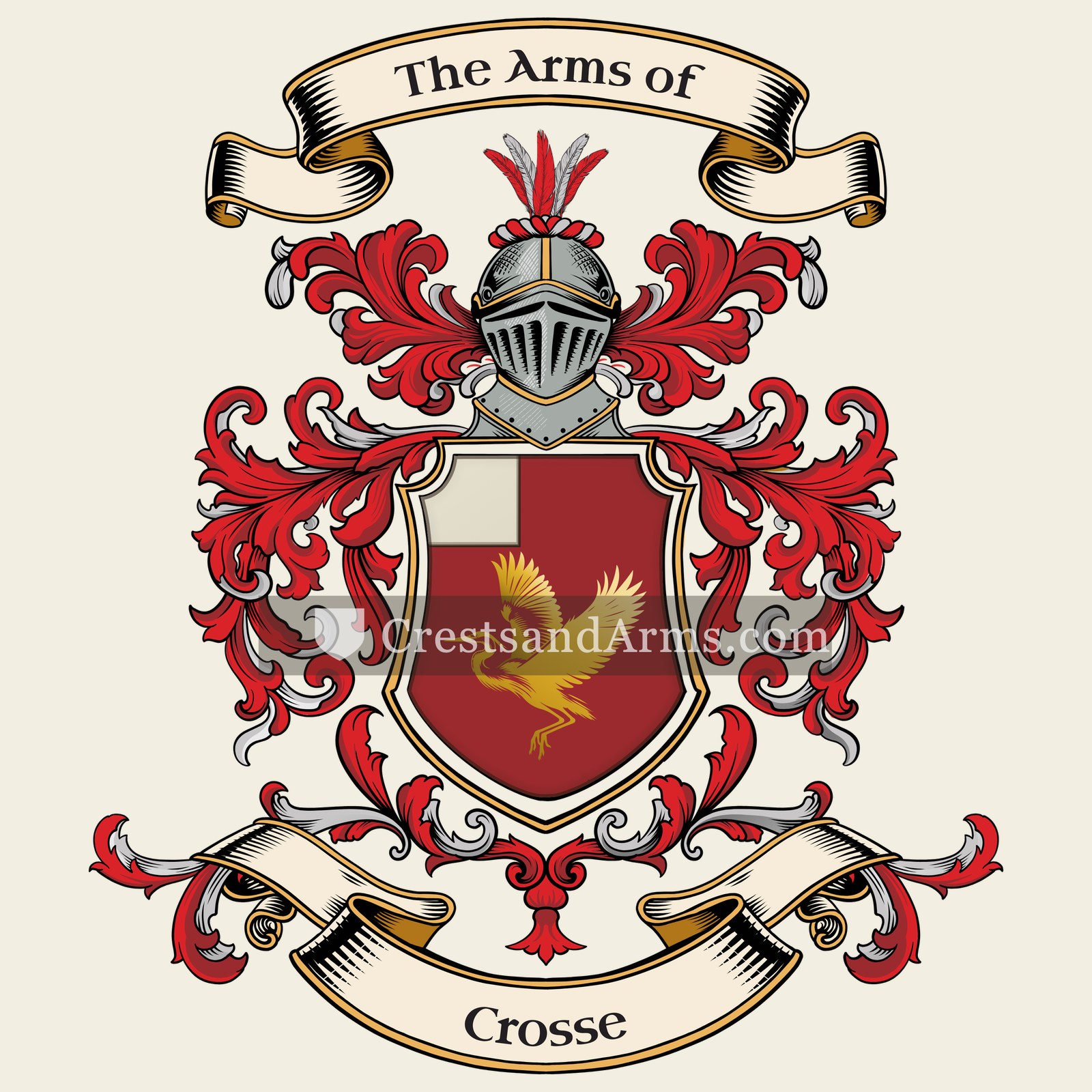


 cross symbolChristian faith and service