Map of Ireland showing where the Crumpler arms are recorded
The Crumpler arms were recorded in Ireland, c. 1623.
Arms such as these were typically recorded in Dublin.
Dublin was the seat of government in Ireland and the place where grants were sought and recorded. Families with business at the castle or the courts settled nearby, and settling there put their arms on record.
This is where the arms were entered in the register. Families often moved to other parts of the country, so the same name can turn up in more than one region.
The body that granted and recorded arms in Ireland in this period.
James VI and I
Sovereign of the period
James VI and I
1603–1625
Reigning in Ireland when the Crumpler arms are first recorded.
How Arms Worked in Ireland
The Ulster King of Arms granted coats of arms to individuals who proved their social standing and good character. These symbols were typically inherited by all legitimate descendants of the original holder. If a family branch wanted a unique look, they could apply for a specific change to their design through the office to ensure their identity remained distinct.
Granting authority
The Ulster King of Arms acted as the official body that regulated and issued all coats of arms throughout Ireland.
How they got arms
Families obtained their arms through formal grants issued by the office after proving their eligibility and paying the required fees.
Where arms were recorded
All official grants were recorded in the registers held by the Ulster King of Arms starting from the year 1552.
The family's standing
Recorded among the armigerous families of Ireland.
Origin & History of the Crumpler Family in Ireland
The history of the Crumpler family in Ireland begins with documented evidence of their presence in Dublin as early as 1623. During this period, Dublin was a growing center of trade and administration, attracting families who sought new opportunities within the city walls. The name itself is believed to have English origins, likely describing a person who worked with cloth or lived near a specific type of winding landscape. When these early family members arrived in Ireland, they became part of a shifting social landscape defined by the movement of people between Britain and the Irish capital. By settling in Dublin, the Crumplers integrated into a community of merchants and tradespeople who helped shape the city during the seventeenth century. Their early presence suggests they were part of the migration patterns that defined urban life in Ireland during that era.
Meaning of the Crumpler family crest colors & symbols
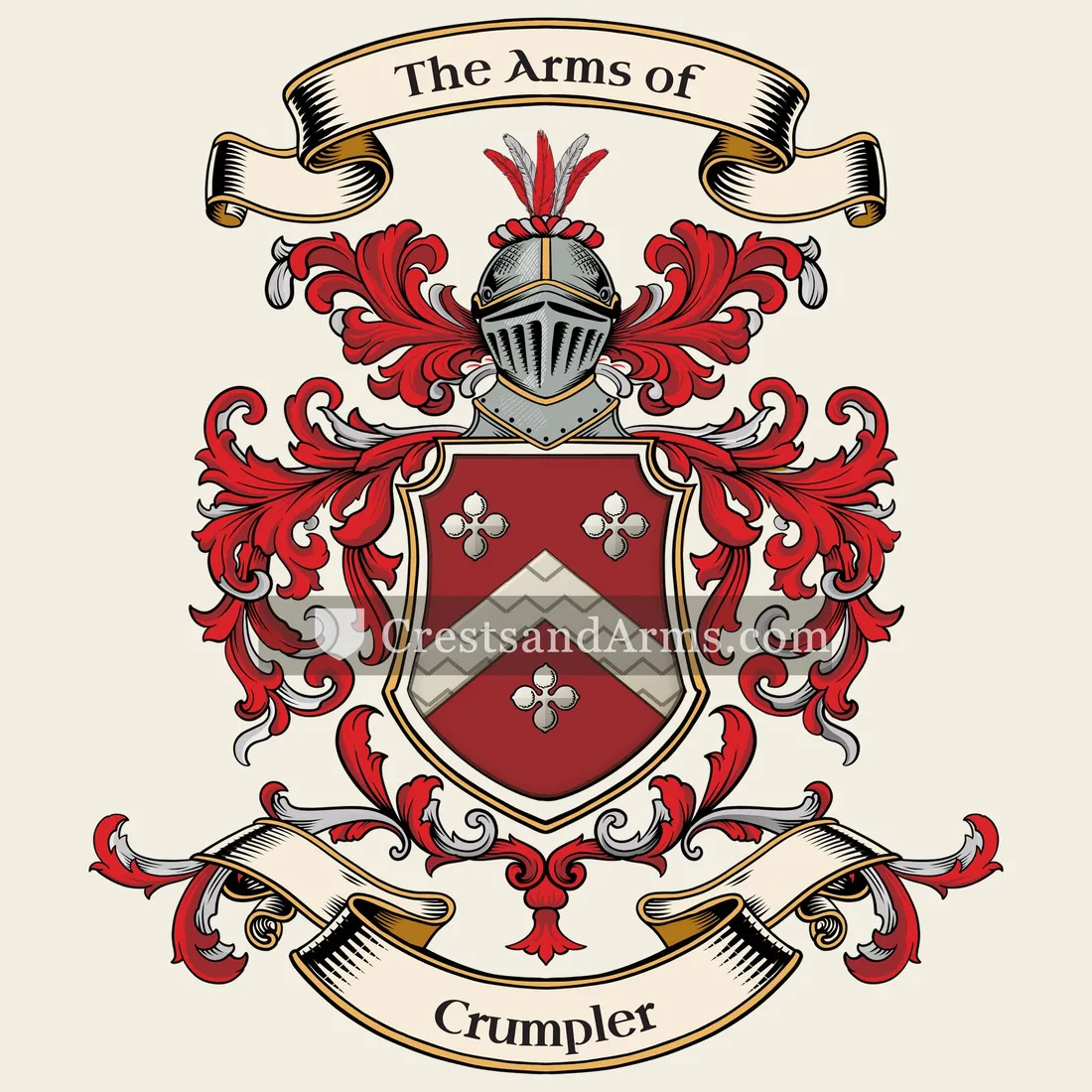
Symbols on this shield
chevronProtection, and faithful service completed
plant quatrefoilGood fortune and the fourfold gospel
Colours
Red (Gules)Means: Military strength
Silver (Argent)Means: Peace and sincerity
Historical info
Source
Sir Bernard Burke, The General Armory of England, Scotland, Ireland and Wales, London: Harrison & Sons, 1884
Blazon (the actual original written record)
“Gu. a chev. betw. three quatrefoils ar”
KentKent, c. 1620
Digital archive packCoat of arms PNG, gold border print PDF, vector SVG and the certificate of authenticity. Sent to your email in minutes.
Map of England showing where the Crumpler arms are recorded
The Crumpler arms were recorded in Kent, c. 1620.
Kent sits between London and the short crossing to Europe, and the trade passing through made it wealthy. Merchant families bought land with that money, and it was landowners who took coats of arms.
This is where the arms were entered in the register. Families often moved to other parts of the country, so the same name can turn up in more than one region.
The body that granted and recorded arms in England in this period.
James VI and I
Sovereign of the period
James VI and I
1603–1625
Reigning in Ireland when the Crumpler arms are first recorded.
How Arms Worked in England
English heraldry allowed arms to be shared by all legitimate descendants of the original owner. These symbols were treated as personal property that moved through the generations to all children. While the eldest son kept the original design, other family members could use the same shield without needing to change it or register their own unique versions.
Granting authority
The College of Arms in London has regulated the use of coats of arms throughout England and Wales since 1484.
How they got arms
Families typically obtained their coats of arms through a formal grant from the Crown or by proving their ancient right to them.
Where arms were recorded
All official coats of arms are recorded in the registers kept at the College of Arms, which date back to the fifteenth century.
The family's standing
Recorded among the armigerous families of Kent.
Origin & History of the Crumpler Family in England
The family name Crumpler is rooted in the landscape of medieval England, where it likely originated as a descriptive nickname for a person who lived near a crooked or winding feature of the land. By the early 17th century, records confirm that members of the family were established in the county of Kent. This region was a bustling hub of trade and agriculture, placing the family in a prime position to participate in the social and economic shifts of the era. As the 1620s approached, the family was part of a stable local population that helped shape the rural character of southeastern England. Their presence in Kent during this period suggests they were integrated into the local parish life, which served as the primary way for families to document their births, marriages, and daily activities before the era of modern census taking.
Crumpler Meaning & Related Branches
Root word
Crump
Derived from the Middle English word for crooked or bent.
This name
CrumplerAn occupational or descriptive surname referring to a person with a physical deformity.
also spelled
Crumpp
Documented Sources
Sir Bernard Burke, The General Armory of England, Scotland, Ireland and Wales, London: Harrison & Sons, 1884
National Archives of Ireland, Calendar of the State Papers Relating to Ireland, 1615–1625
Royal Irish Academy, A New History of Ireland, Volume III: Early Modern Ireland 1534–1691, 1976
Digital archive packCoat of arms PNG, gold border print PDF, vector SVG and the certificate of authenticity. Sent to your email in minutes.


 chevronProtection, and faithful service completed
 cinquefoilHope and joy
 chevronProtection, and faithful service completed
 cinquefoilHope and joy
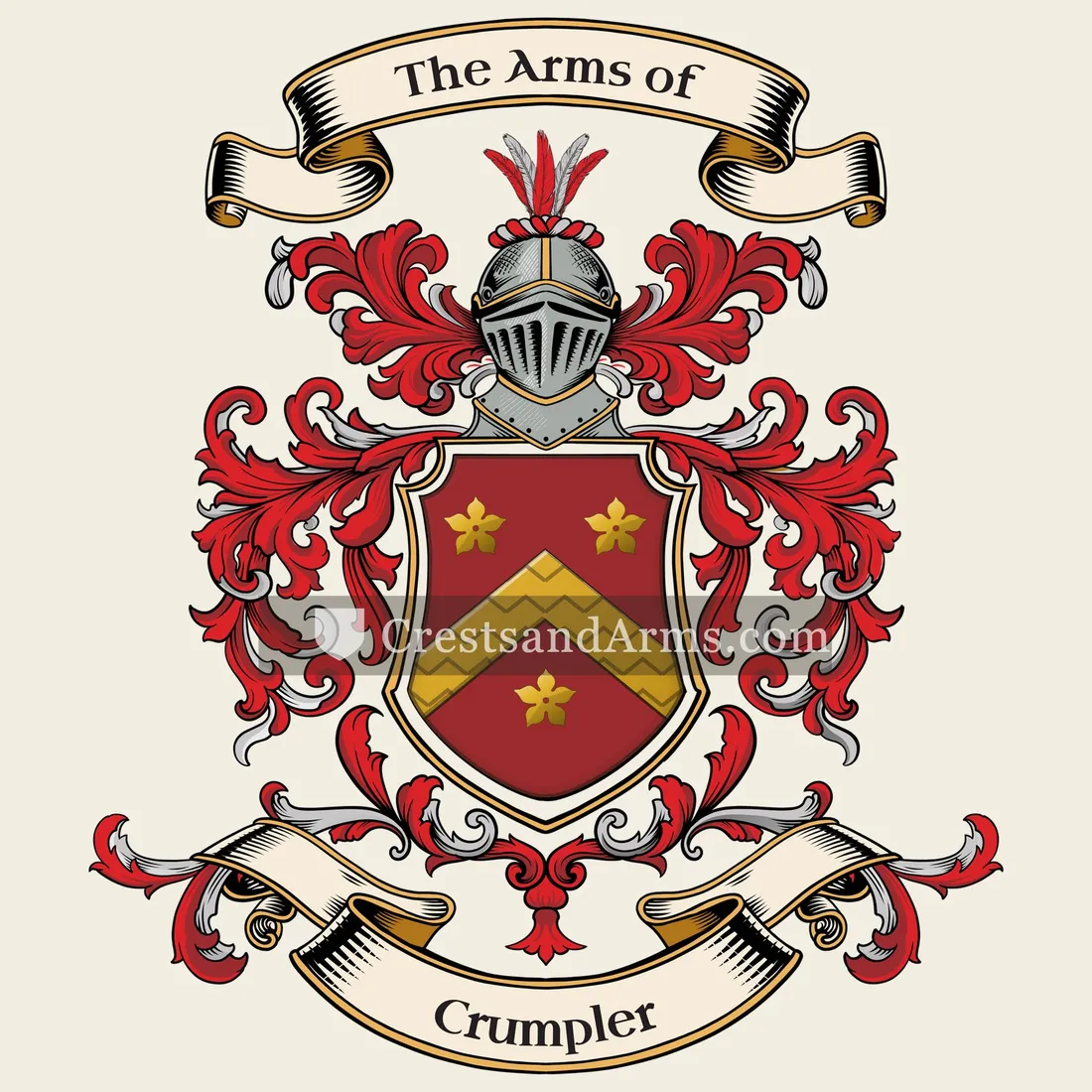


 plant quatrefoilGood fortune and the fourfold gospel