Map of France showing where the Cuen arms are recorded
The Cuen arms were recorded in Lorraine, c. 1624.
Lorraine sat on the border between France and the German lands, and border country bred soldiers. Families here held small estates and served in arms, and a fighting man was exactly the sort who carried a shield of his own.
This is where the arms were entered in the register. Families often moved to other parts of the country, so the same name can turn up in more than one region.
The body that granted and recorded arms in France in this period.
Louis XIII of France
Sovereign of the period
Louis XIII of France
1617–1643
Reigning in France when the Cuen arms are first recorded.
How Arms Worked in France
In France, a coat of arms was a mark of honor that passed down through the male line to all legitimate descendants. Families often used the same shield without changes to show their shared heritage. If a branch wanted to stand out, they could add a small mark to their shield to show their specific place in the family tree.
Granting authority
The Juge d'armes de France acted as the official authority that regulated and verified coats of arms across the country.
How they got arms
Families typically inherited their arms from ancestors, though they could also receive them through royal grants or by proving their noble status.
Where arms were recorded
Coats of arms were officially recorded in the Armorial Général de France, which began its main collection in the year 1696.
The family's standing
Recorded among the armigerous families of Lorraine.
Origin & History of the Cuen Family in France
The history of the Cuen family in France is deeply rooted in the eastern region of Lorraine, where records confirm their presence as early as 1624. During the seventeenth century, Lorraine was a crossroads of European culture and a frequent site of territorial conflict, which shaped the lives of families living in the area. The name Cuen likely evolved from local linguistic traditions in this border region, where French and Germanic influences often blended together in everyday speech. Families like the Cuens were typically part of the rural or merchant classes who maintained strong ties to their local parishes and village communities. By staying in this specific region, the family navigated the shifting political borders of the era while maintaining their identity through generations of agricultural or trade-based work. Their survival in Lorraine during this volatile period suggests a resilient group that adapted to the changing social landscape of early modern France.
Meaning of the Cuen family crest colors & symbols
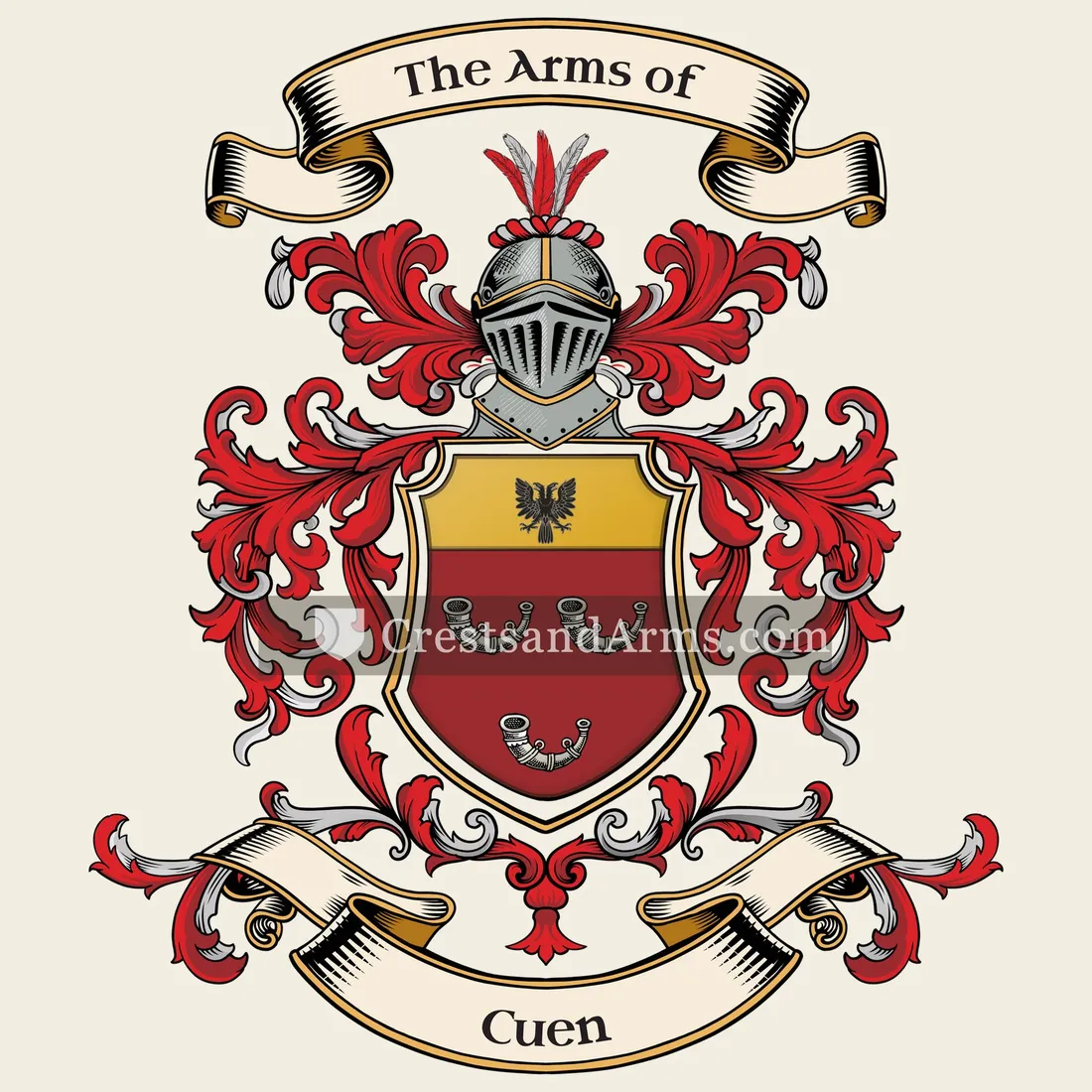
Symbols on this shield
chiefAuthority, wisdom and dominion
hunting horn stringedOne who delights in the chase
eagleNobility, strength and a keen mind
Colours
Red (Gules)Means: Military strength
Gold (Or)Means: Generosity
Silver (Argent)Means: Peace and sincerity
Black (Sable)Means: Constancy
Historical info
Source
J. B. Rietstap, Armorial Général, Gouda: G. B. van Goor Zonen, 1884–87
Blazon (the actual original written record)
“De gu. à trois huchets d'arg., vir. et eng. d'or, les embouchures à dextre; au chef d'or, ch. d'une aigle ép. de sa. Cq. cour. C.: un homme iss. de carn., tort. de gu. et d'arg., donnant dans un huchet de l'écu. L.: à dextre d'or et de sa., à sen. d'arg. et de gu.”
Germanyc. 1840
Digital archive packCoat of arms PNG, gold border print PDF, vector SVG and the certificate of authenticity. Sent to your email in minutes.
Map of Germany showing where the Cuen arms are recorded
The Cuen arms were recorded in Germany, c. 1840.
Arms such as these were typically recorded in Bavaria.
Bavaria was a country of old landed families and walled market towns. Estates passed down the same line for centuries, and both the landowners and the leading townsmen kept arms, which is why so many Bavarian names sit in the registers.
This is where the arms were entered in the register. Families often moved to other parts of the country, so the same name can turn up in more than one region.
The body that granted and recorded arms in Germany in this period.
Frederick William III of Prussia
Sovereign of the period
Frederick William III of Prussia
1797–1840
Reigning in France when the Cuen arms are first recorded.
How Arms Worked in Germany
Prussian heraldry was strictly tied to social rank and noble status rather than being a free choice for every citizen. These symbols were treated as permanent family property that moved through the generations to all legitimate heirs. If a family branch wanted to change their design to stand out, they had to apply for official permission to alter their specific version of the shield.
Granting authority
The Prussian Heroldsamt acted as the central state office that managed and strictly controlled all noble titles and coats of arms.
How they got arms
Families usually obtained their arms through formal royal grants or by proving their long-standing noble status to the state authorities.
Where arms were recorded
All official coats of arms were kept in the rolls of the Prussian Heroldsamt, which functioned from 1706 until 1918.
The family's standing
Recorded among the armigerous families of Germany.
Origin & History of the Cuen Family in Germany
The family name Cuen has deep roots in the southern German region of Bavaria, where records confirm members of the family were established by the year 1840. During this period, Bavaria was undergoing significant social and economic changes as it transitioned from a traditional agrarian society into a more modern state. Families with names like Cuen often lived in rural villages or small towns where they were deeply connected to the local landscape and the rhythms of seasonal farming. Because the name is relatively rare, it likely originated as a localized identifier used to distinguish a specific household or a person from a particular geographic spot within the Bavarian countryside. As the nineteenth century progressed, many families in this region began to move toward larger urban centers or eventually sought new opportunities abroad, carrying their ancestral name with them as a link to their Bavarian heritage.
Cuen Meaning & Related Branches
Root word
Cun
Old French term for a dog or hound.
This name
CuenA topographic name for someone living near a dog kennel or breeding area.
also spelled
Cunie
Cuni
Kuny
Documented Sources
J. B. Rietstap, Armorial Général, Gouda: G. B. van Goor Zonen, 1884–87
Archives: Archives départementales de Meurthe-et-Moselle, Série B: Cours et juridictions
Archives: Archives départementales de la Moselle, Série E: État civil et registres paroissiaux
Book: Lepage, Henri, Les communes de la Meurthe: journal historique des villes, bourgs, villages, hameaux et censes, 1853
Book: Cabourdin, Guy, Quand Stanislas régnait en Lorraine, 1980
Digital archive packCoat of arms PNG, gold border print PDF, vector SVG and the certificate of authenticity. Sent to your email in minutes.


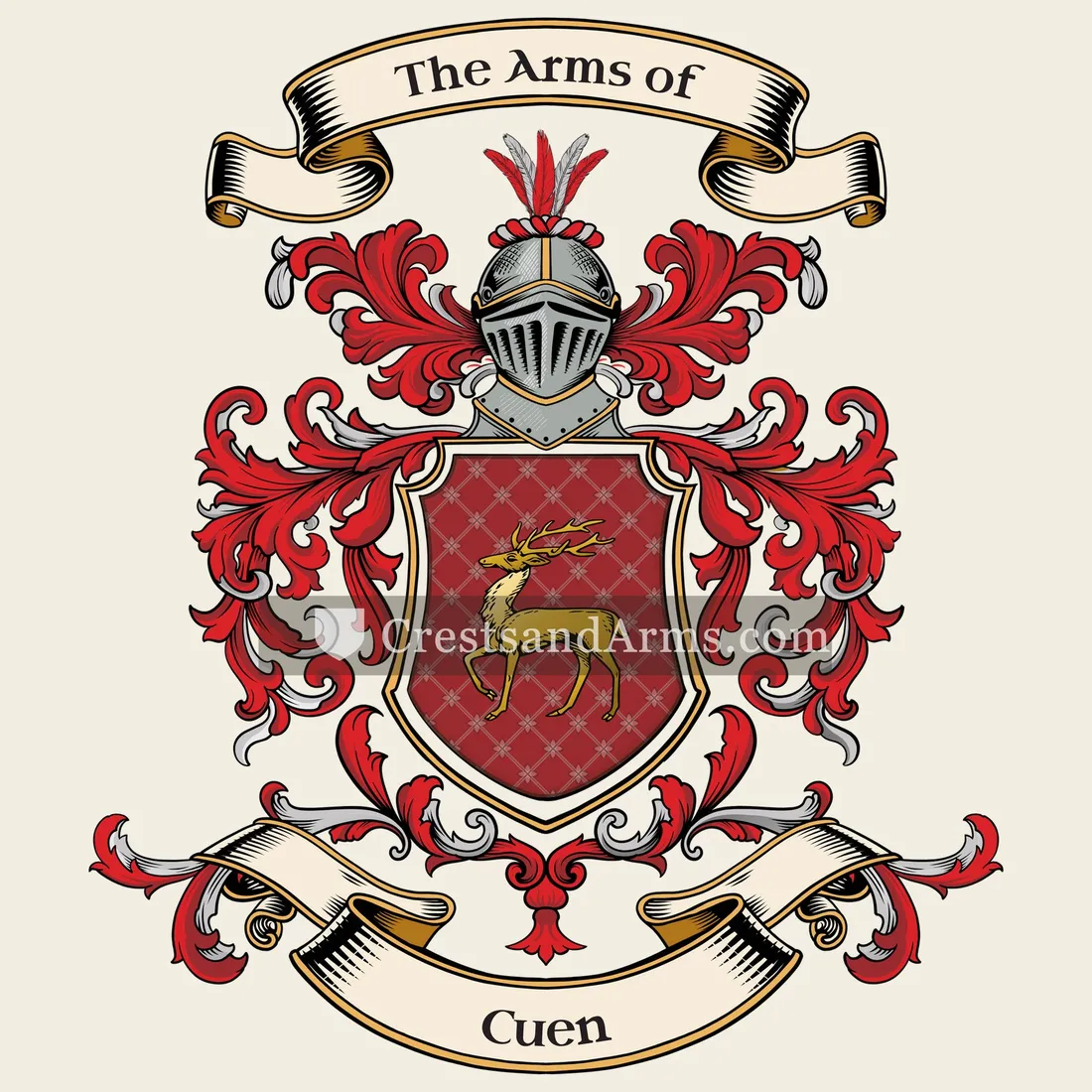
 stagPeace and harmony, and one who will not fight unprovoked
 stagPeace and harmony, and one who will not fight unprovoked


 chiefAuthority, wisdom and dominion
 hunting horn stringedOne who delights in the chase
 eagleNobility, strength and a keen mind