A record of documented arms, meaning and origin, researched for the Cuffe family lines. Documented in 3 countries.
Reg. 1578 · Britain, A–C
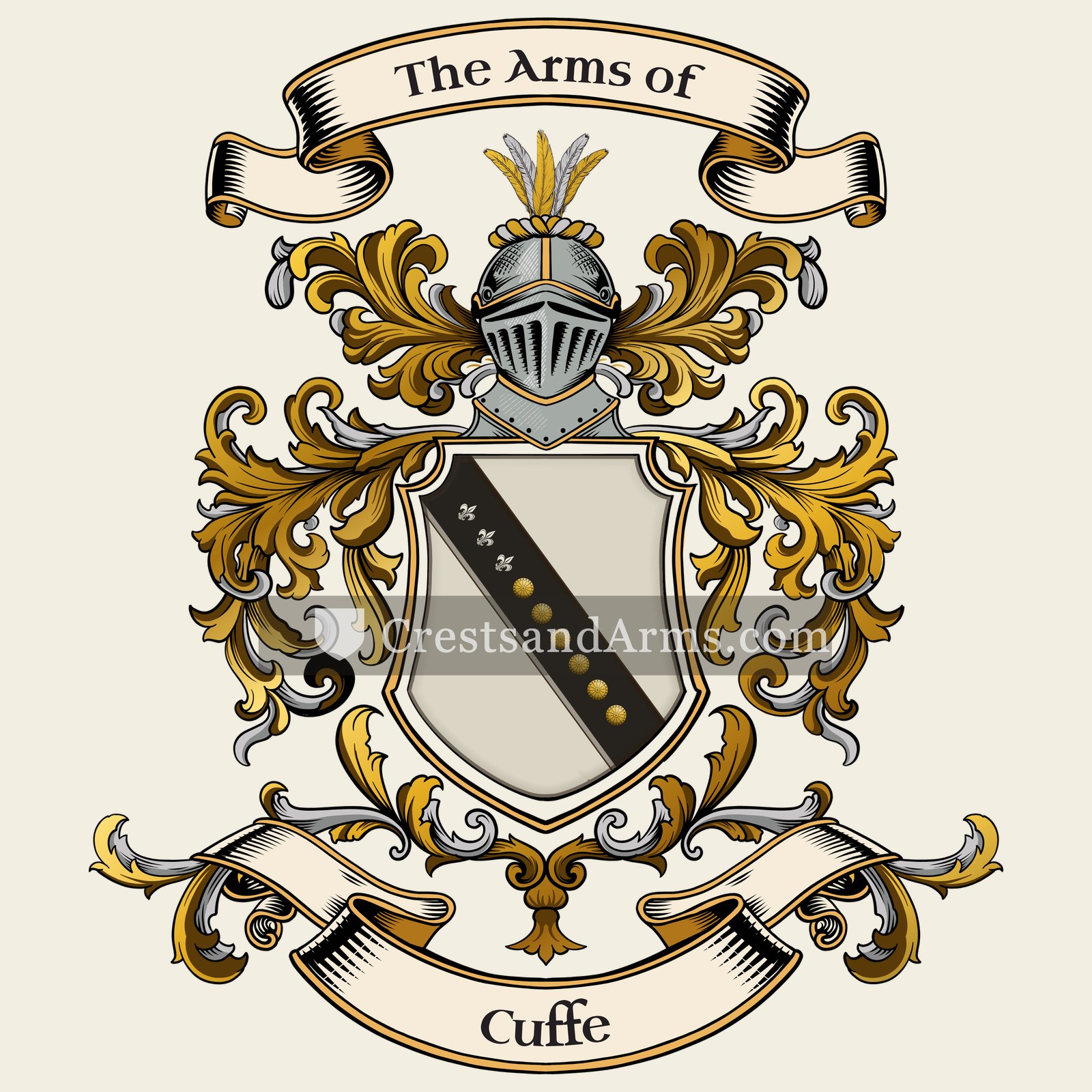
Coat of Arms & Family Crest Details
Symbols on this shield
bendDefence, and the scarf of a commander
fleur de lisPurity, light, and the sixth son
roundelA coin, and one who has been to the crusades
Colours
Silver (Argent)Means: Peace and sincerity
Black (Sable)Means: Constancy
Gold (Or)Means: Generosity
Historical info
Source
J. B. Rietstap, Armorial Général, Gouda: G. B. van Goor Zonen, 1884–87
Blazon (the actual original written record)
“D'arg. à la bande vivrée de sa., ch. de trois fleurs-de-lis du champ, posées dans le sens de la bande; celle-ci côtoyée de deux cotices d'azur, ch. chacune de trois bes. d'or. C.: un avant-bras en pal, paré d'or à deux cotices ondées d'azur, rebr. d'herm., la main de carn. tenant une hache d'armes d'or, emm. d'azur. S.: deux léopards reg. au nat., coll. chacun d'une fasce vivrée de sa., ch. de trois fleurs-de-lis d'arg.; chaque collier attaché à une chaîne de sa. D.: VIRTUS REPULSE NESCIA SORDIDE.”
Britainc. 1733
Digital archive packCoat of arms PNG, gold border print PDF, vector SVG and the certificate of authenticity. Sent to your email in minutes.
Map of Britain showing where the Cuffe arms are recorded
The Cuffe arms were recorded in Britain, c. 1733.
Arms such as these were typically recorded in Kent.
Kent sits between London and the short crossing to Europe, and the trade passing through made it wealthy. Merchant families bought land with that money, and it was landowners who took coats of arms.
This is where the arms were entered in the register. Families often moved to other parts of the country, so the same name can turn up in more than one region.
The body that granted and recorded arms in Britain in this period.
George II of Great Britain
Sovereign of the period
George II of Great Britain
1727–1760
Reigning in Britain when the Cuffe arms are first recorded.
How Arms Worked in Britain
English heraldry allowed arms to be shared by all legitimate descendants of the original owner. These symbols were treated as personal property that moved through the generations to all children. While the eldest son kept the original design, other family members could use the same shield without needing to change it or register their own unique versions.
Granting authority
The College of Arms in London has regulated the use of coats of arms throughout England and Wales since 1484.
How they got arms
Families typically obtained their coats of arms through a formal grant from the Crown or by proving their ancient right to them.
Where arms were recorded
All official coats of arms are recorded in the registers kept at the College of Arms, which date back to the fifteenth century.
The family's standing
Recorded among the armigerous families of Britain.
Origin & History of the Cuffe Family in Britain
The family name Cuffe has deep roots in the English landscape, with historical records placing early members of the family in the county of Kent by the year 1733. The name itself is thought to have originated as a descriptive nickname, likely referring to a person who wore distinctive or prominent cuffs on their clothing. During the eighteenth century, families with this name were often integrated into the local agricultural and tradesman communities of Southern England. As the family grew, they moved through various social layers, transitioning from local laborers to landowners and professionals. While the name remained relatively uncommon compared to larger surnames, those who carried it were part of the steady development of rural English society during the Georgian era. By establishing themselves in Kent, the early Cuffe family became part of the long history of families who helped shape the local economy and community life of the region.
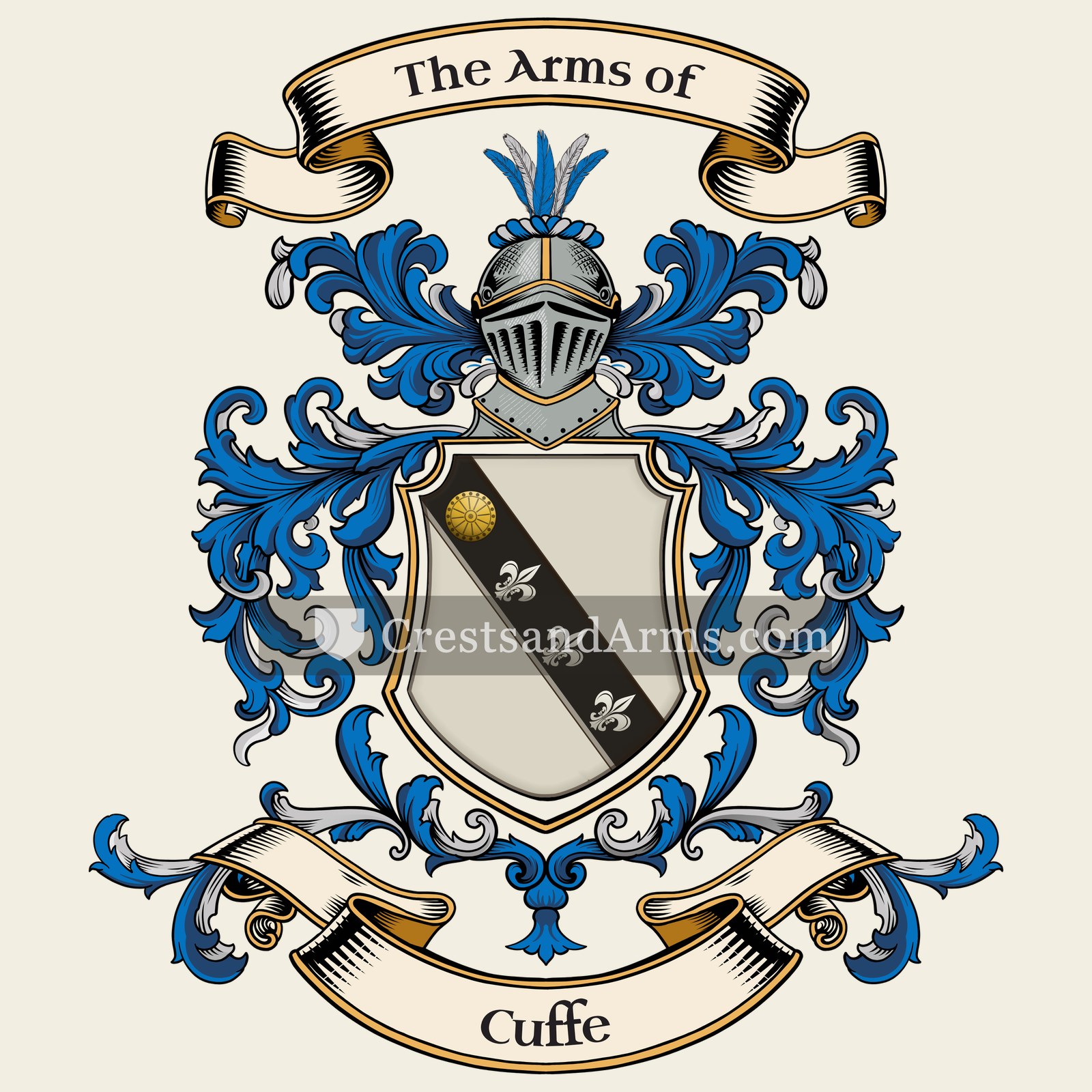
Coat of Arms & Family Crest Details
Symbols on this shield
bendDefence, and the scarf of a commander
roundelA coin, and one who has been to the crusades
fleur de lisPurity, light, and the sixth son
Colours
Silver (Argent)Means: Peace and sincerity
Black (Sable)Means: Constancy
Blue (Azure)Means: Loyalty and truth
Gold (Or)Means: Generosity
Historical info
Source
Sir Bernard Burke, The General Armory of England, Scotland, Ireland and Wales, London: Harrison & Sons, 1884
Blazon (the actual original written record)
“Ar. on a bend dancettée sa. cotised az. bezantée three fleurs-de-lis of the field”
SomersetIlchester · Somerset, c. 1620
Digital archive packCoat of arms PNG, gold border print PDF, vector SVG and the certificate of authenticity. Sent to your email in minutes.
Map of England showing where the Cuffe arms are recorded
The Cuffe arms were recorded in Somerset, c. 1620.
Somerset was rich farming country with a thick scattering of manor houses. Its gentry were numerous and long-settled, and a settled landed family almost always ended up with arms.
This is where the arms were entered in the register. Families often moved to other parts of the country, so the same name can turn up in more than one region.
The body that granted and recorded arms in England in this period.
James VI and I
Sovereign of the period
James VI and I
1603–1625
Reigning in Britain when the Cuffe arms are first recorded.
How Arms Worked in England
English heraldry allowed arms to be shared by all legitimate descendants of the original owner. These symbols were treated as personal property that moved through the generations to all children. While the eldest son kept the original design, other family members could use the same shield without needing to change it or register their own unique versions.
Granting authority
The College of Arms in London has regulated the use of coats of arms throughout England and Wales since 1484.
How they got arms
Families typically obtained their coats of arms through a formal grant from the Crown or by proving their ancient right to them.
Where arms were recorded
All official coats of arms are recorded in the registers kept at the College of Arms, which date back to the fifteenth century.
The family's standing
Recorded among the armigerous families of Somerset.
Origin & History of the Cuffe Family in England
The family name Cuffe has deep roots in the English county of Somerset, where records confirm members of the family were well established by the early 17th century. The name is thought to be a topographic or occupational surname, likely originating from the Old English word "cuff," which could refer to a person who wore distinctive cuffs or perhaps someone who lived near a specific landmark. By 1620, the Cuffe family was integrated into the local social fabric of the West Country, often appearing in parish registers and land records as landowners and community members. As the family grew, they became involved in the political and economic life of the region, eventually expanding their influence beyond Somerset. Their presence in the area during this period reflects the broader movement of families who helped shape the local history and governance of rural England during the Stuart era.
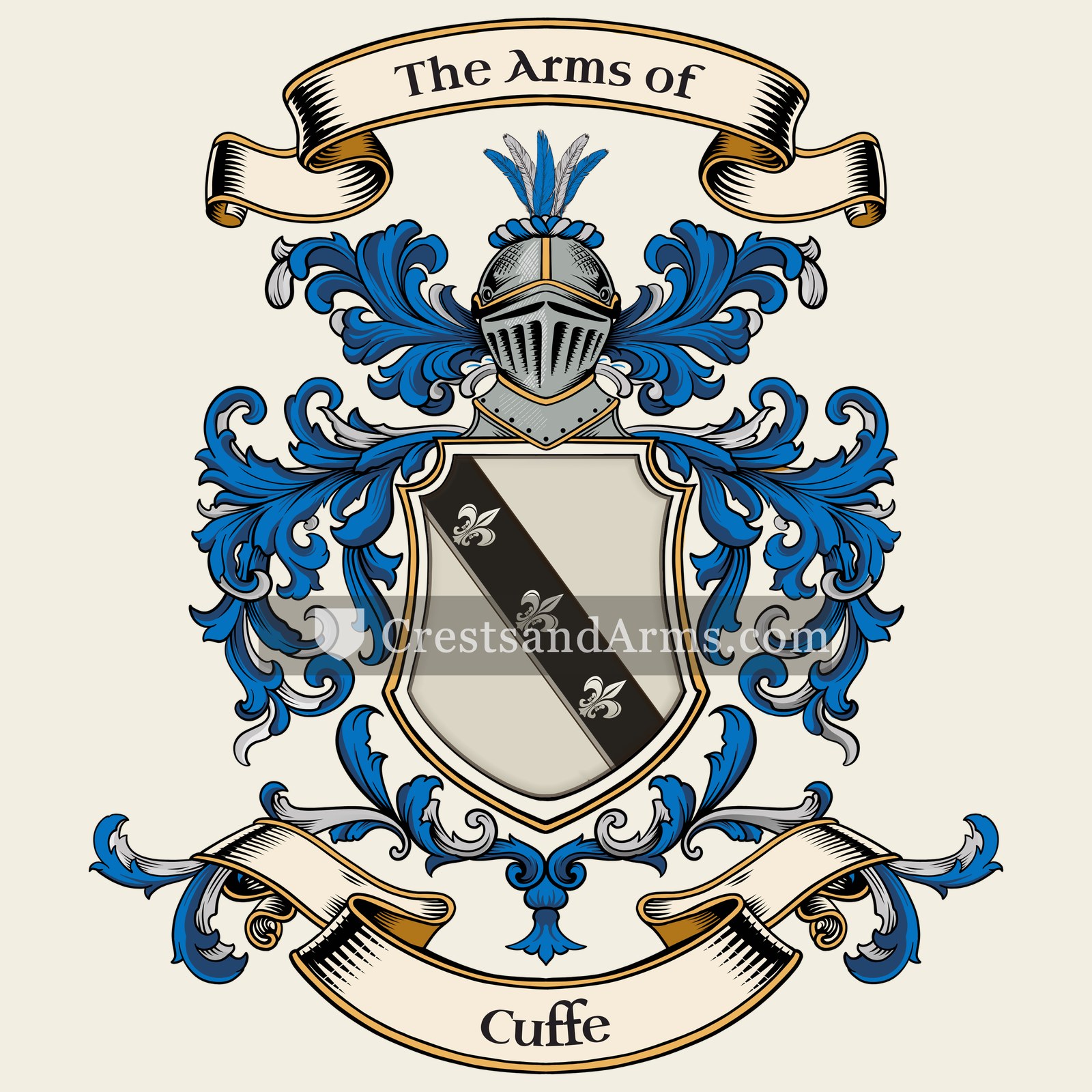
Coat of Arms & Family Crest Details
Symbols on this shield
bendDefence, and the scarf of a commander
fleur de lisPurity, light, and the sixth son
Colours
Silver (Argent)Means: Peace and sincerity
Black (Sable)Means: Constancy
Blue (Azure)Means: Loyalty and truth
Historical info
Source
Sir Bernard Burke, The General Armory of England, Scotland, Ireland and Wales, London: Harrison & Sons, 1884
Blazon (the actual original written record)
“Ar. on a bend dancettée sa. three fleurs-de-lis of the field betw. two cotises az. each charged with three bezants”
KilkennyLeyrath · Kilkenny, c. 1645
Digital archive packCoat of arms PNG, gold border print PDF, vector SVG and the certificate of authenticity. Sent to your email in minutes.
Map of Ireland showing where the Cuffe arms are recorded
The Cuffe arms were recorded in Kilkenny, c. 1645.
Kilkenny was rich farming country in south-eastern Ireland, held by Norman families who settled early and stayed. Long holding of good land is exactly what puts a name into the heraldic records.
This is where the arms were entered in the register. Families often moved to other parts of the country, so the same name can turn up in more than one region.
The body that granted and recorded arms in Ireland in this period.
Charles I of England
Sovereign of the period
Charles I of England
1625–1649
Reigning in Britain when the Cuffe arms are first recorded.
How Arms Worked in Ireland
The Ulster King of Arms granted coats of arms to individuals who proved their social standing and good character. These symbols were typically inherited by all legitimate descendants of the original holder. If a family branch wanted a unique look, they could apply for a specific change to their design through the office to ensure their identity remained distinct.
Granting authority
The Ulster King of Arms acted as the official body that regulated and issued all coats of arms throughout Ireland.
How they got arms
Families obtained their arms through formal grants issued by the office after proving their eligibility and paying the required fees.
Where arms were recorded
All official grants were recorded in the registers held by the Ulster King of Arms starting from the year 1552.
The family's standing
Recorded among the armigerous families of Kilkenny.
Origin & History of the Cuffe Family in Ireland
The Cuffe family established a significant presence in Ireland during the mid-seventeenth century, with historical records confirming their residence in County Kilkenny by 1645. The family originally arrived from England as part of the broader movement of settlers during a period of intense political and social transition in Ireland. Once settled in Kilkenny, they quickly integrated into the local administrative and landowning structures of the region. Over the following decades, members of the family became influential figures in Irish public life, often serving in local government and representing the area in parliament. Their rise to prominence was tied to the acquisition of land and the development of estates, which allowed them to play a central role in the economic and social history of the county for generations.
Cuffe Meaning & Related Branches
Root word
Cuff
A glove or a protective covering for the wrist.
This name
CuffeA nickname for someone who wore distinctive or ornate wrist coverings.
also spelled
Kuffe
Cuf
Kuf
Cuff
Cuffey
Related arms
Custesimilar arms
Fox-Strangwaysrecorded with Cuffe, same area
Greyrecorded with Cuffe, same area
Strangwaysrecorded with Cuffe, same area
Documented Sources
J. B. Rietstap, Armorial Général, Gouda: G. B. van Goor Zonen, 1884–87
Cottle, Basil. The Penguin Dictionary of Surnames. 1967
Reaney, P.H. A Dictionary of British Surnames. 1958
Kent Archives, Quarter Sessions Records: Q/S/P (Petitions and Papers), 1733
Digital archive packCoat of arms PNG, gold border print PDF, vector SVG and the certificate of authenticity. Sent to your email in minutes.


 bendDefence, and the scarf of a commander
 fleur de lisPurity, light, and the sixth son
 roundelA coin, and one who has been to the crusades
 bendDefence, and the scarf of a commander
 fleur de lisPurity, light, and the sixth son
 roundelA coin, and one who has been to the crusades