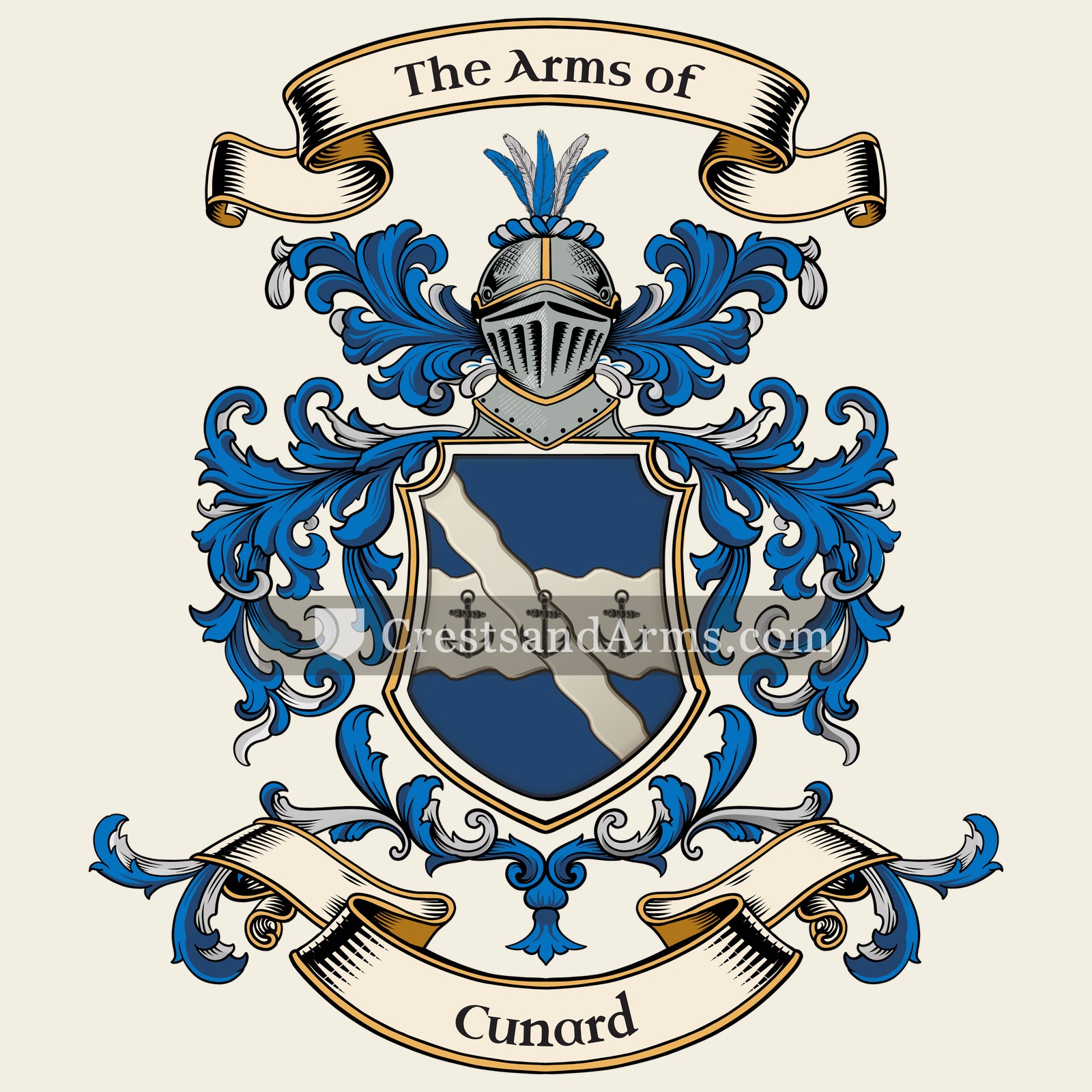
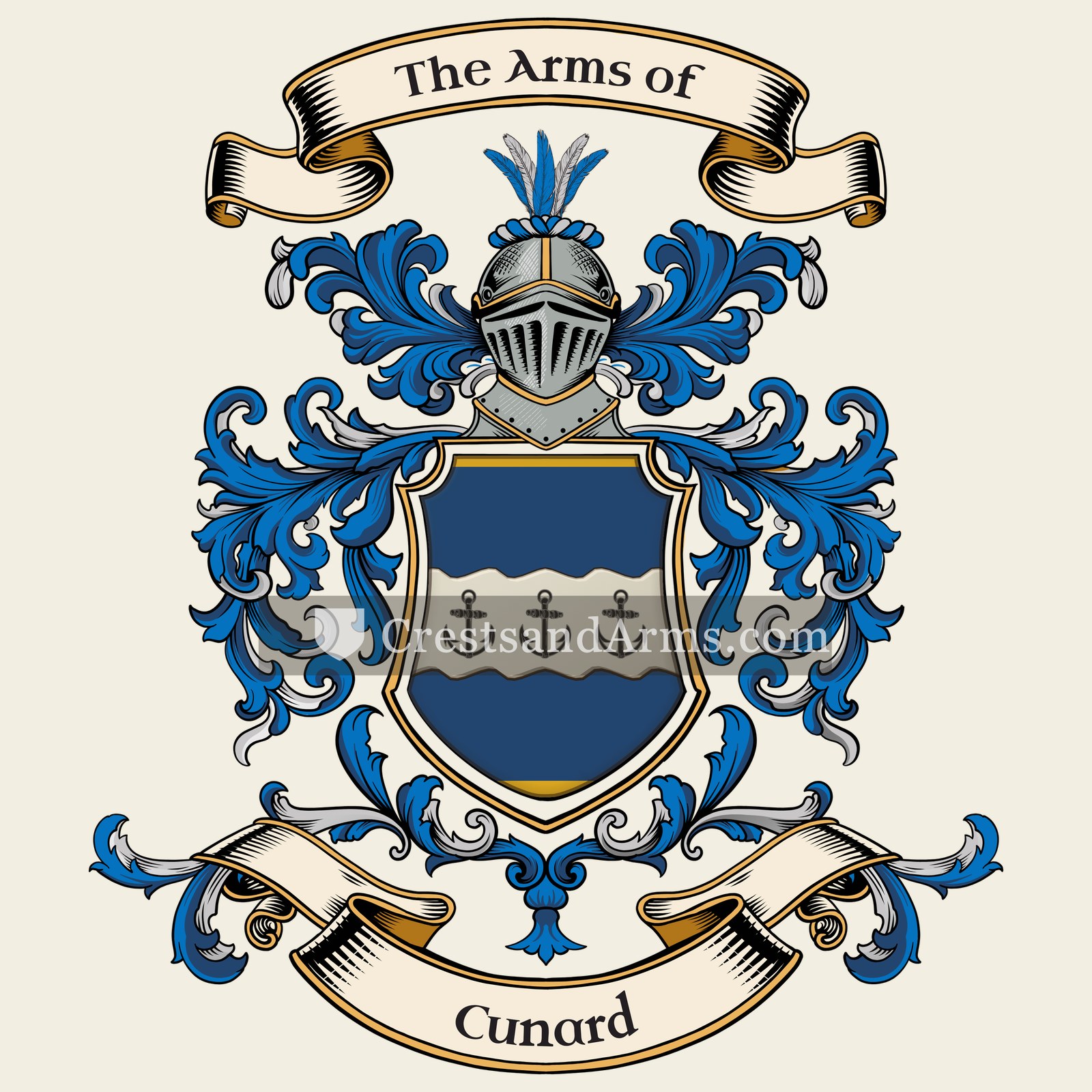
A record of documented arms, meaning and origin, researched for the Cunard family lines. Documented in 2 countries.
Reg. 0029 · French, A–C
Coat of Arms & Family Crest Details
Symbols on this shield
fessThe military belt, and readiness to serve
anchorHope, and steadfastness in trouble
Colours
Blue (Azure)Means: Loyalty and truth
Silver (Argent)Means: Peace and sincerity
Black (Sable)Means: Constancy
Historical info
Source
J. B. Rietstap, Armorial Général, Gouda: G. B. van Goor Zonen, 1884–87
Blazon (the actual original written record)
“D'azur à une fasce ondée d'arg., coticée-ondée du même et chargée de trois ancres accostées de sa. C.: un faucon d'arg., le vol levé, posé sur un rocher au nat. et appuyant sa patte dextre sur une quintefeuille d'azur. D.: BY PERSEVERANCE.”
MiddlesexMiddlesex, c. 1859
Digital archive packCoat of arms PNG, gold border print PDF, vector SVG and the certificate of authenticity. Sent to your email in minutes.
Map of France showing where the Cunard arms are recorded
The Cunard arms were recorded in Middlesex, c. 1859.
Middlesex was the county around London, and City money flowed straight into it. Merchants and officials bought estates within reach of the capital, and a new estate brought a coat of arms with it.
This is where the arms were entered in the register. Families often moved to other parts of the country, so the same name can turn up in more than one region.
The body that granted and recorded arms in France in this period.
Napoleon III
Sovereign of the period
Napoleon III
1852–1870
Reigning in France when the Cunard arms are first recorded.
How Arms Worked in France
In France, a coat of arms was a mark of honor that passed down through the male line to all legitimate descendants. Families often used the same shield without changes to show their shared heritage. If a branch wanted to stand out, they could add a small mark to their shield to show their specific place in the family tree.
Granting authority
The Juge d'armes de France acted as the official authority that regulated and verified coats of arms across the country.
How they got arms
Families typically inherited their arms from ancestors, though they could also receive them through royal grants or by proving their noble status.
Where arms were recorded
Coats of arms were officially recorded in the Armorial Général de France, which began its main collection in the year 1696.
The family's standing
Recorded among the armigerous families of Middlesex.
Origin & History of the Cunard Family in France
The family name Cunard is widely believed to have roots in the French region of Normandy, where the name likely evolved from the Old French term *connard* or similar variations. During the period following the Norman Conquest of England in 1066, many families migrated across the English Channel, carrying their surnames into British society. Over several centuries, the name underwent linguistic shifts as it moved from its French origins into the English language. By the time the family established a notable presence in Middlesex in the mid-19th century, the name had become firmly rooted in the British Isles. This transition reflects the broader movement of people and culture between France and England during the medieval era, which helped shape many of the surnames we recognize today.
Coat of Arms & Family Crest Details
Symbols on this shield
fessThe military belt, and readiness to serve
anchorHope, and steadfastness in trouble
Colours
Blue (Azure)Means: Loyalty and truth
Silver (Argent)Means: Peace and sincerity
Gold (Or)Means: Generosity
Black (Sable)Means: Constancy
Historical info
Source
Sir Bernard Burke, The General Armory of England, Scotland, Ireland and Wales, London: Harrison & Sons, 1884
Blazon (the actual original written record)
“Az. on a fess wavy ar. betw. two barrulets also wavy or, three anchors sa”
Englandc. 1620
Digital archive packCoat of arms PNG, gold border print PDF, vector SVG and the certificate of authenticity. Sent to your email in minutes.
Map of England showing where the Cunard arms are recorded
The Cunard arms were recorded in England, c. 1620.
Arms such as these were typically recorded in York.
Yorkshire is the largest of the English counties, and it held more gentry families than any other. Land there was split among a great many households rather than a few, so a great many of them carried arms.
This is where the arms were entered in the register. Families often moved to other parts of the country, so the same name can turn up in more than one region.
The body that granted and recorded arms in England in this period.
James VI and I
Sovereign of the period
James VI and I
1603–1625
Reigning in France when the Cunard arms are first recorded.
How Arms Worked in England
English heraldry allowed arms to be shared by all legitimate descendants of the original owner. These symbols were treated as personal property that moved through the generations to all children. While the eldest son kept the original design, other family members could use the same shield without needing to change it or register their own unique versions.
Granting authority
The College of Arms in London has regulated the use of coats of arms throughout England and Wales since 1484.
How they got arms
Families typically obtained their coats of arms through a formal grant from the Crown or by proving their ancient right to them.
Where arms were recorded
All official coats of arms are recorded in the registers kept at the College of Arms, which date back to the fifteenth century.
The family's standing
Recorded among the armigerous families of England.
Origin & History of the Cunard Family in England
The Cunard family name has deep roots in the northern English city of York, where records confirm members of the family were living as early as 1620. During the seventeenth century, the name was often spelled in various ways, such as Cunard, Cunerd, or Connard, which was common before spelling became standardized. Families in this region of England often worked in trade or local crafts, and the Cunards were likely part of the growing urban middle class that helped shape the economy of York. Over time, the family members moved away from their original home in Yorkshire, eventually spreading to other parts of the British Isles and across the Atlantic. This migration was typical for families of that era who sought new opportunities in commerce and maritime industries. By tracking these early residents of York, historians can see how a local family name began its journey from a specific English city to becoming a well-known name in international history.
Cunard Meaning & Related Branches
Root word
Cun
Derived from the Germanic word for bold or brave.
This name
CunardA habitational name for someone originating from a place associated with bold or courageous people.
also spelled
Cunnard
Cunart
Kunard
Cunnerd
Documented Sources
J. B. Rietstap, Armorial Général, Gouda: G. B. van Goor Zonen, 1884–87
Reaney, P.H. and Wilson, R.M., A Dictionary of English Surnames, 1991
The National Archives, Middlesex Parish Records, 1859
Digital archive packCoat of arms PNG, gold border print PDF, vector SVG and the certificate of authenticity. Sent to your email in minutes.


 fessThe military belt, and readiness to serve
 anchorHope, and steadfastness in trouble
 fessThe military belt, and readiness to serve
 anchorHope, and steadfastness in trouble