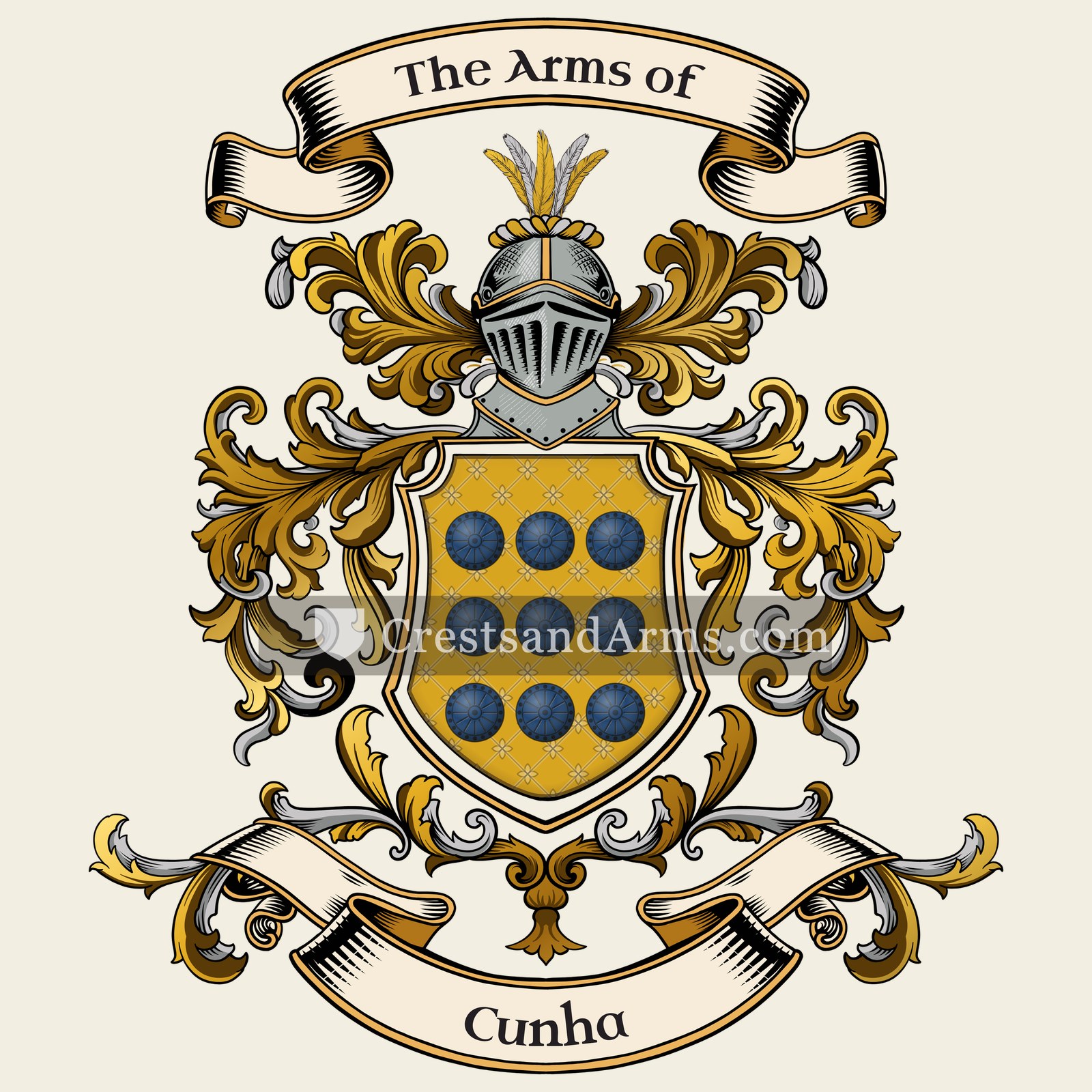
Map of Portugal showing where the Cunha arms are recorded
The Cunha arms were recorded in Portugal, c. 1706.
Arms such as these were typically recorded in Lisboa.
Lisbon was the seat of the Portuguese crown and the port its wealth came through. Families made rich by trade and by service to the king took arms, and the crown's heralds recorded them there.
This is where the arms were entered in the register. Families often moved to other parts of the country, so the same name can turn up in more than one region.
The body that granted and recorded arms in Portugal in this period.
Peter II of Portugal
Sovereign of the period
Peter II of Portugal
1683–1706
Reigning in Portugal when the Cunha arms are first recorded.
How Arms Worked in Portugal
In Portugal, a coat of arms was a family possession that passed from a father to his children. Every legitimate descendant had the right to use the family shield without needing to change it. Younger branches of the family kept the original design, though they sometimes added small symbols to distinguish their specific line from the main branch.
Granting authority
The Cartório da Nobreza acted as the official body that managed and regulated noble titles and coats of arms in Portugal.
How they got arms
Families typically inherited their arms through bloodline, though they could also receive new grants from the crown for distinguished service.
Where arms were recorded
Coats of arms were officially recorded in the books of the Cartório da Nobreza starting in the year 1512.
The family's standing
Recorded among the armigerous families of Portugal.
Origin & History of the Cunha Family in Portugal
The surname Cunha originates from the Portuguese word for a wedge, which historically referred to a tool used for splitting wood or stone. During the Middle Ages, families often adopted names based on their trade, their physical environment, or specific landmarks near their homes. By the time the family was firmly established in Lisbon in 1706, the name had already become a well-recognized identifier within Portuguese society. Members of the Cunha family during this era were often involved in the administrative and social life of the capital city as it rebuilt following the economic shifts of the eighteenth century. Because the name is tied to a common physical object, it likely emerged independently in different regions of Portugal before becoming a consolidated family line. This history reflects the broader trend of how surnames evolved from simple descriptions into permanent markers of lineage and identity.
Cunha Meaning & Related Branches
Root word
Cuneus
A Latin term referring to a wedge or a wedge-shaped piece of land.
This name
CunhaA topographic surname denoting someone who lived near a wedge-shaped plot of land or a corner.
also spelled
Cunia
Cunya
Koonyah
Documented Sources
J. B. Rietstap, Armorial Général, Gouda: G. B. van Goor Zonen, 1884–87
Machado, José Pedro. Dicionário Onomástico Etimológico da Língua Portuguesa. 1981
Sanches de Baena, Visconde de. Archivo Heráldico-Genealogico contendo noticias historico-heraldicas dos gentil-homens de casa real. 1872
Arquivo Nacional da Torre do Tombo. Registros Paroquiais de Lisboa. 1706
Digital archive packCoat of arms PNG, gold border print PDF, vector SVG and the certificate of authenticity. Sent to your email in minutes.


 roundelA coin, and one who has been to the crusades
 roundelA coin, and one who has been to the crusades