Map of Britain showing where the Cunliffe arms are recorded
The Cunliffe arms were recorded in Lancashire, c. 1759.
This is where the arms were entered in the register. Families often moved to other parts of the country, so the same name can turn up in more than one region.
The body that granted and recorded arms in Britain in this period.
George II of Great Britain
Sovereign of the period
George II of Great Britain
1727–1760
Reigning in Britain when the Cunliffe arms are first recorded.
How Arms Worked in Britain
English heraldry allowed arms to be shared by all legitimate descendants of the original owner. These symbols were treated as personal property that moved through the generations to all children. While the eldest son kept the original design, other family members could use the same shield without needing to change it or register their own unique versions.
Granting authority
The College of Arms in London has regulated the use of coats of arms throughout England and Wales since 1484.
How they got arms
Families typically obtained their coats of arms through a formal grant from the Crown or by proving their ancient right to them.
Where arms were recorded
All official coats of arms are recorded in the registers kept at the College of Arms, which date back to the fifteenth century.
The family's standing
Recorded among the armigerous families of Lancashire.
Origin & History of the Cunliffe Family in Britain
The surname Cunliffe originates from the historic county of Lancashire in North West England. The name itself is derived from Old English words meaning a valley belonging to a king or a royal official. By the middle of the eighteenth century, the family was well established in this region, particularly around the towns of Blackburn and Accrington. During this period, the family was deeply connected to the local landscape and the early growth of the textile industry that defined Lancashire. Members of the family were often involved in land management and local trade, which allowed them to build strong roots in their community long before the industrial expansion of the nineteenth century. Their history reflects the broader story of northern English families who transitioned from agricultural life to the emerging commercial economy of the 1700s.
Coat of Arms & Family Crest Details
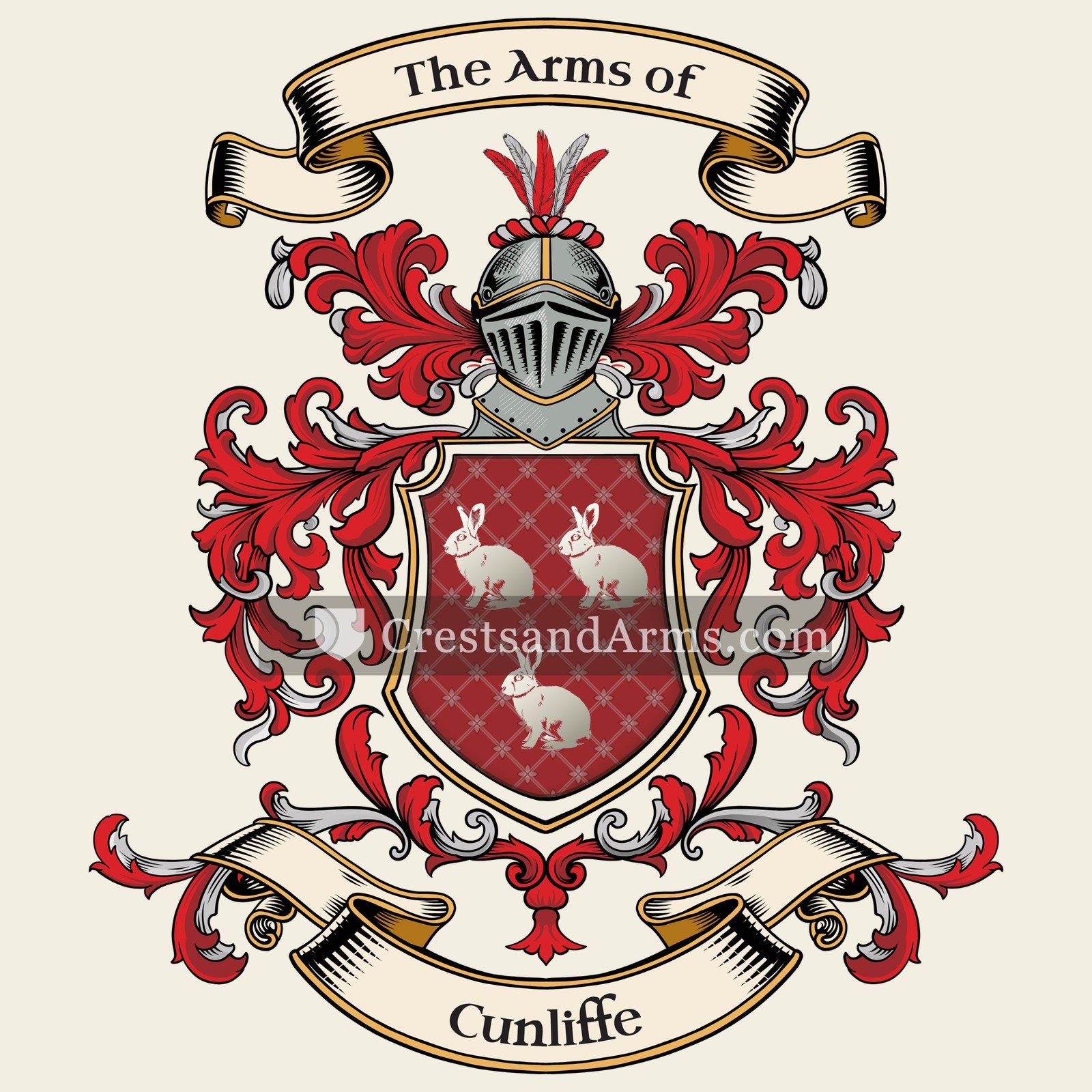
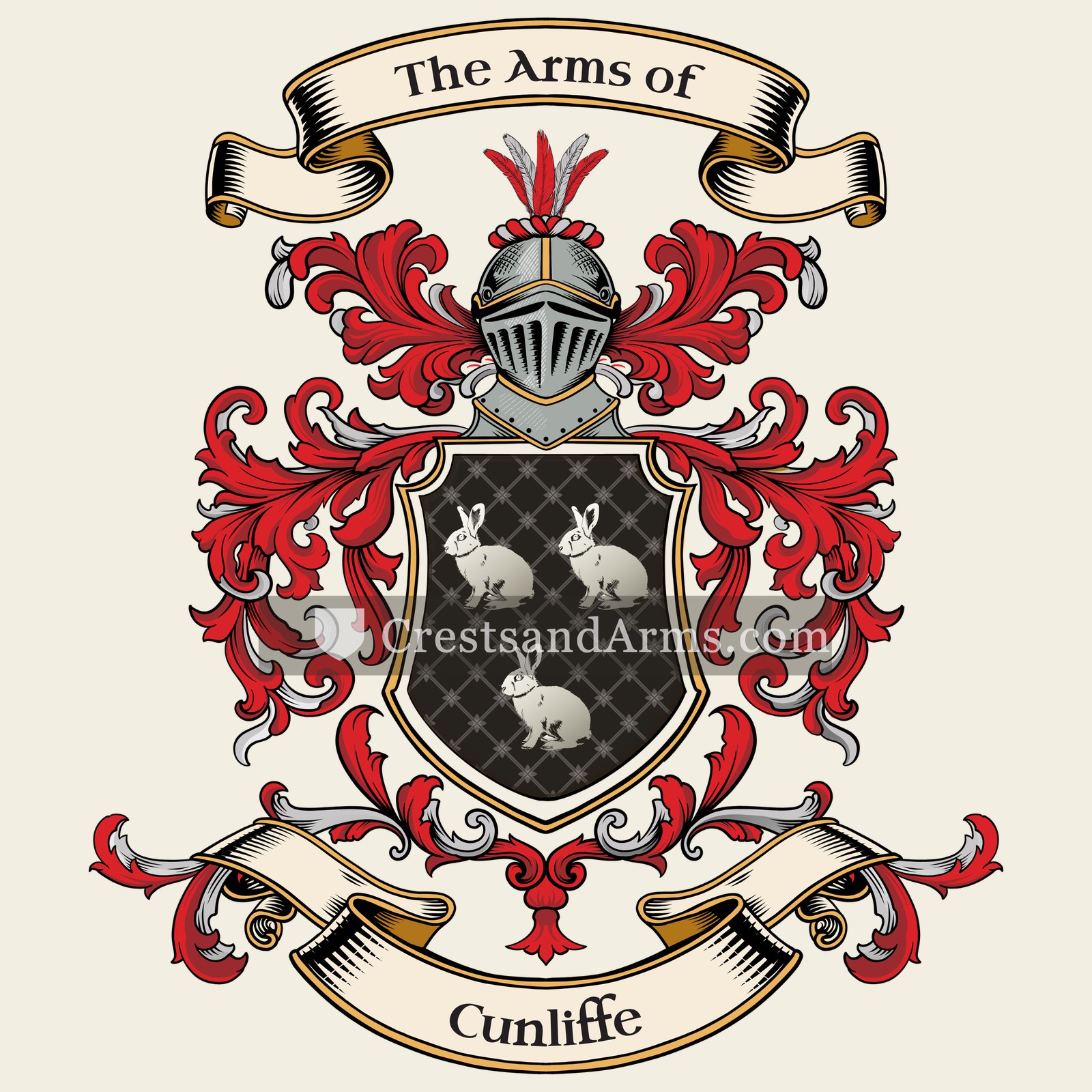
Symbols on this shield
rabbitOne who lives peaceably and well
Colours
Black (Sable)Means: Constancy
Silver (Argent)Means: Peace and sincerity
Historical info
Source
Sir Bernard Burke, The General Armory of England, Scotland, Ireland and Wales, London: Harrison & Sons, 1884
Blazon (the actual original written record)
“Sa. three conies courant ar”
EnglandLiverpool, c. 1620
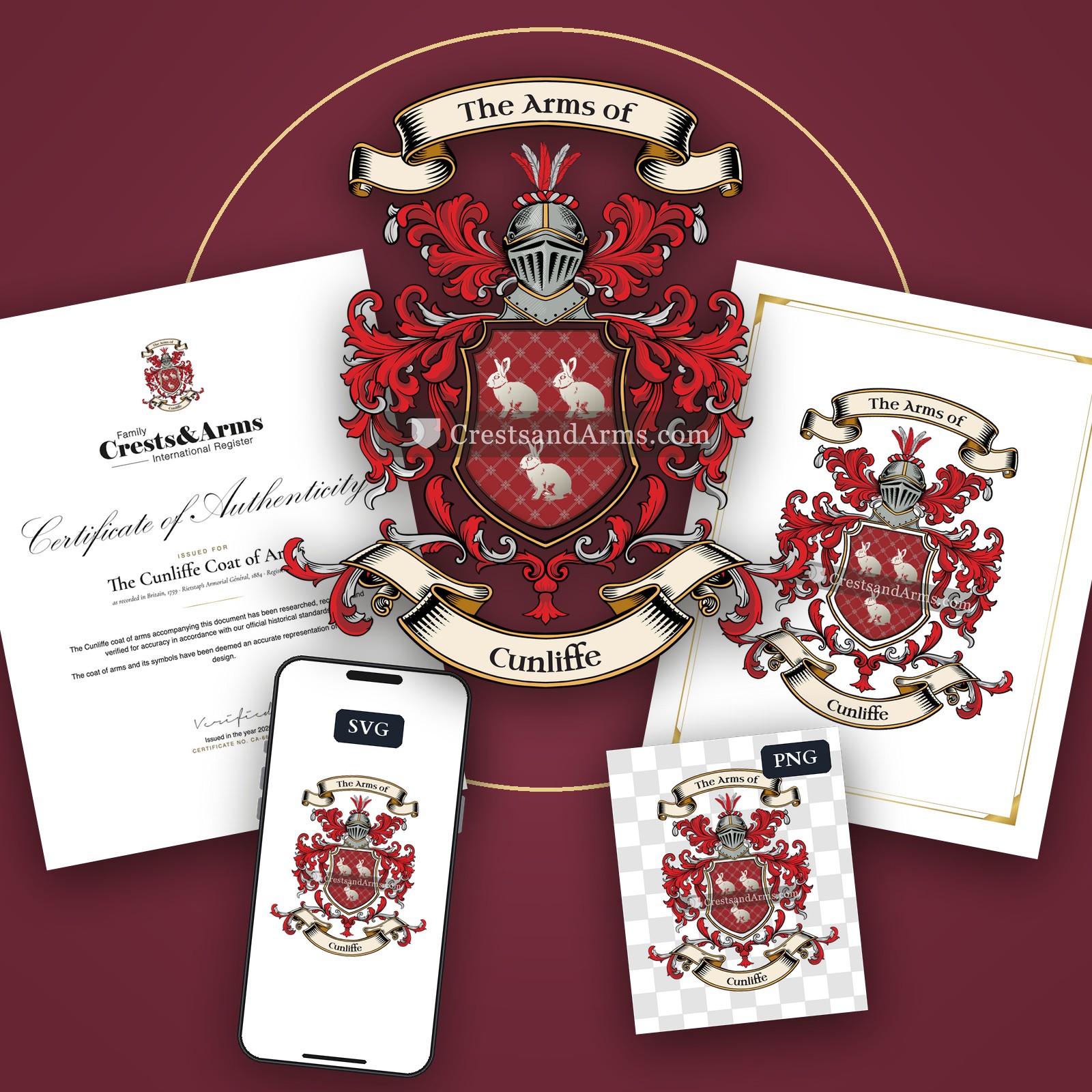
Digital archive packCoat of arms PNG, gold border print PDF, vector SVG and the certificate of authenticity. Sent to your email in minutes.
Map of England showing where the Cunliffe arms are recorded
The Cunliffe arms were recorded in Liverpool, c. 1620.
This is where the arms were entered in the register. Families often moved to other parts of the country, so the same name can turn up in more than one region.
The body that granted and recorded arms in England in this period.
James VI and I
Sovereign of the period
James VI and I
1603–1625
Reigning in Britain when the Cunliffe arms are first recorded.
How Arms Worked in England
English heraldry allowed arms to be shared by all legitimate descendants of the original owner. These symbols were treated as personal property that moved through the generations to all children. While the eldest son kept the original design, other family members could use the same shield without needing to change it or register their own unique versions.
Granting authority
The College of Arms in London has regulated the use of coats of arms throughout England and Wales since 1484.
How they got arms
Families typically obtained their coats of arms through a formal grant from the Crown or by proving their ancient right to them.
Where arms were recorded
All official coats of arms are recorded in the registers kept at the College of Arms, which date back to the fifteenth century.
The family's standing
Recorded among the armigerous families of England.
Origin & History of the Cunliffe Family in England
The family name Cunliffe originates from the ancient landscape of Lancashire, England, where it first appeared as a locational surname derived from a place called Cunliffe near the town of Blackburn. The name itself combines Old English words meaning a valley and a place where rabbits were kept. By the early 17th century, the family had established a significant presence in the growing port city of Liverpool. Records from 1620 confirm that members of the family were already active in the region, likely participating in the burgeoning maritime trade that would soon transform Liverpool into a global hub. As the family grew, they became deeply integrated into the civic and commercial life of the area, moving from their rural roots in the Lancashire countryside to become influential figures in the development of the city.
Cunliffe Meaning & Related Branches
Root word
Cunliffe
Derived from the Old English words for known and cliff or slope.
This name
CunliffeRefers to a person who lived near a well-known or recognizable hillside.
also spelled
Cunlif
Cunlyffe
Kunlif
Cunlyff
Documented Sources
J. B. Rietstap, Armorial Général, Gouda: G. B. van Goor Zonen, 1884–87
Ekwall, Eilert, The Place-Names of Lancashire, 1922
Farrer, William and Brownbill, John, The Victoria History of the County of Lancaster, 1906–1914
Lancashire Archives, Bishop’s Transcripts of Parish Registers, 1759
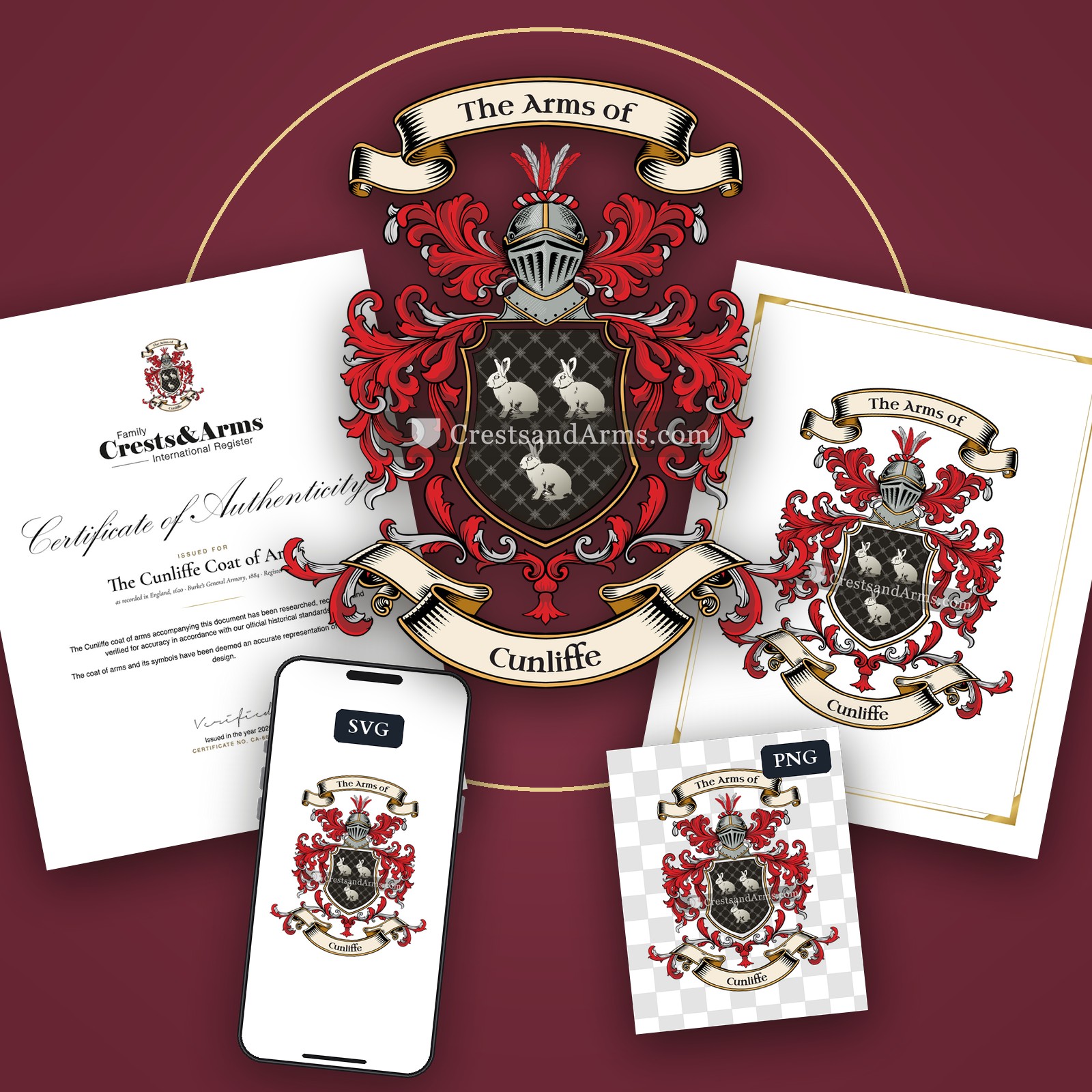
Digital archive packCoat of arms PNG, gold border print PDF, vector SVG and the certificate of authenticity. Sent to your email in minutes.


 rabbitOne who lives peaceably and well
 rabbitOne who lives peaceably and well