Map of France showing where the Cuny arms are recorded
The Cuny arms were recorded in Lorraine, c. 1624.
Lorraine sat on the border between France and the German lands, and border country bred soldiers. Families here held small estates and served in arms, and a fighting man was exactly the sort who carried a shield of his own.
This is where the arms were entered in the register. Families often moved to other parts of the country, so the same name can turn up in more than one region.
The body that granted and recorded arms in France in this period.
Louis XIII of France
Sovereign of the period
Louis XIII of France
1617–1643
Reigning in France when the Cuny arms are first recorded.
How Arms Worked in France
In France, a coat of arms was a mark of honor that passed down through the male line to all legitimate descendants. Families often used the same shield without changes to show their shared heritage. If a branch wanted to stand out, they could add a small mark to their shield to show their specific place in the family tree.
Granting authority
The Juge d'armes de France acted as the official authority that regulated and verified coats of arms across the country.
How they got arms
Families typically inherited their arms from ancestors, though they could also receive them through royal grants or by proving their noble status.
Where arms were recorded
Coats of arms were officially recorded in the Armorial Général de France, which began its main collection in the year 1696.
The family's standing
Recorded among the armigerous families of Lorraine.
Origin & History of the Cuny Family in France
The family name Cuny has deep roots in the historic province of Lorraine in northeastern France. By the year 1624, records confirm that members of the family were already established in this region, which served as a cultural bridge between the French and German worlds. The name likely evolved as a short form of the name Conrad, which was a popular choice among families in the area during the Middle Ages. Because Lorraine was a borderland that frequently changed political hands, the Cuny family lived through many periods of transition and conflict. They were often part of the local rural or artisan classes who helped maintain the social fabric of the villages during the seventeenth century. Over time, the family spread from their original heartland into other parts of France, carrying the name forward as a marker of their long connection to the history of the Lorraine region.
Coat of Arms & Family Crest Details
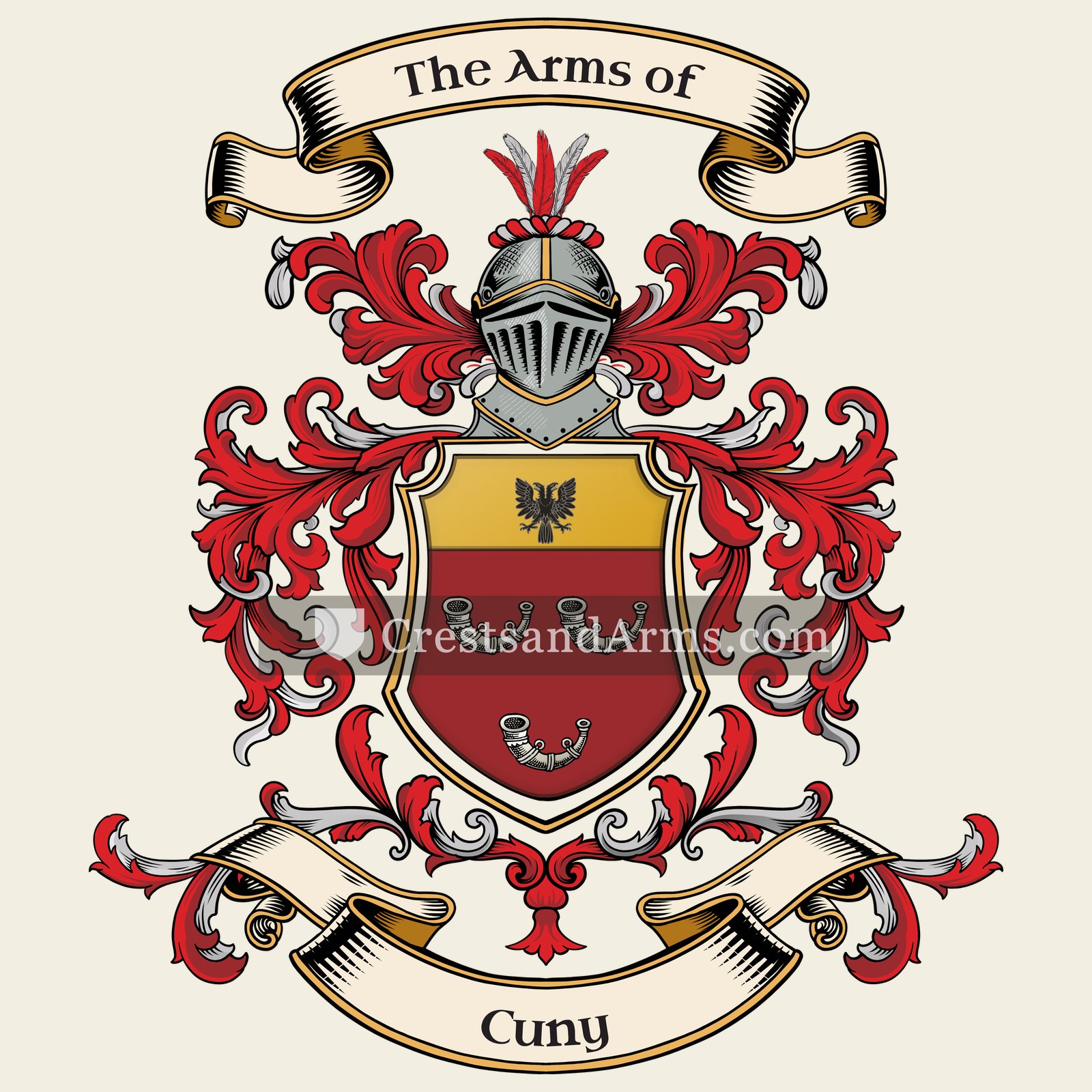
Symbols on this shield
chiefAuthority, wisdom and dominion
hunting horn stringedOne who delights in the chase
eagleNobility, strength and a keen mind
Colours
Red (Gules)Means: Military strength
Gold (Or)Means: Generosity
Silver (Argent)Means: Peace and sincerity
Black (Sable)Means: Constancy
Historical info
Source
J. B. Rietstap, Armorial Général, Gouda: G. B. van Goor Zonen, 1884–87
Blazon (the actual original written record)
“De gu. à trois huchets d'arg., vir. et eng. d'or, les embouchures à dextre; au chef d'or, ch. d'une aigle ép. de sa. Cq. cour. C.: un homme iss. de carn., tort. de gu. et d'arg., donnant dans un huchet de l'écu. L.: à dextre d'or et de sa., à sen. d'arg. et de gu.”
Germanyc. 1840
Digital archive packCoat of arms PNG, gold border print PDF, vector SVG and the certificate of authenticity. Sent to your email in minutes.
Map of Germany showing where the Cuny arms are recorded
The Cuny arms were recorded in Germany, c. 1840.
Arms such as these were typically recorded in Bavaria.
Bavaria was a country of old landed families and walled market towns. Estates passed down the same line for centuries, and both the landowners and the leading townsmen kept arms, which is why so many Bavarian names sit in the registers.
This is where the arms were entered in the register. Families often moved to other parts of the country, so the same name can turn up in more than one region.
The body that granted and recorded arms in Germany in this period.
Frederick William III of Prussia
Sovereign of the period
Frederick William III of Prussia
1797–1840
Reigning in France when the Cuny arms are first recorded.
How Arms Worked in Germany
Prussian heraldry was strictly tied to social rank and noble status rather than being a free choice for every citizen. These symbols were treated as permanent family property that moved through the generations to all legitimate heirs. If a family branch wanted to change their design to stand out, they had to apply for official permission to alter their specific version of the shield.
Granting authority
The Prussian Heroldsamt acted as the central state office that managed and strictly controlled all noble titles and coats of arms.
How they got arms
Families usually obtained their arms through formal royal grants or by proving their long-standing noble status to the state authorities.
Where arms were recorded
All official coats of arms were kept in the rolls of the Prussian Heroldsamt, which functioned from 1706 until 1918.
The family's standing
Recorded among the armigerous families of Germany.
Origin & History of the Cuny Family in Germany
The family name Cuny has deep roots in the German-speaking regions of Europe, particularly within the southern state of Bavaria. By the year 1840, records confirm that members of the Cuny family were well-established in this area, living as part of a society undergoing significant social and industrial change. The name itself is often linked to the historical movement of people across borders, as variations of the name appear in records throughout the Rhine valley and surrounding territories. Families with this name were typically involved in the local agrarian economy or skilled trades, which were the primary ways people supported themselves in nineteenth-century Bavaria. As the region transitioned toward a more modern economy, the Cuny family members were part of a broader demographic shift that saw many individuals move from rural villages into growing urban centers. This history reflects the typical experience of many families in the region who navigated the complex political and social landscape of the German Confederation during the mid-1800s.
Cuny Meaning & Related Branches
Root word
Conrad
Derived from Germanic elements meaning bold or wise counsel.
This name
CunyA diminutive form of the name Conrad, historically common in the Lorraine region.
also spelled
Cunie
Cuni
Kuny
Documented Sources
J. B. Rietstap, Armorial Général, Gouda: G. B. van Goor Zonen, 1884–87
Bouteiller, Ernest de. Dictionnaire topographique de l'ancien département de la Moselle. 1874
Lepage, Henri. Les communes de la Meurthe: journal historique des villes, bourgs, villages, hameaux et censes de ce département. 1853
Archives départementales de Meurthe-et-Moselle, Série B: Cours et juridictions
Archives départementales de la Moselle, Série E: État civil et registres paroissiaux
Digital archive packCoat of arms PNG, gold border print PDF, vector SVG and the certificate of authenticity. Sent to your email in minutes.


 stagPeace and harmony, and one who will not fight unprovoked
 stagPeace and harmony, and one who will not fight unprovoked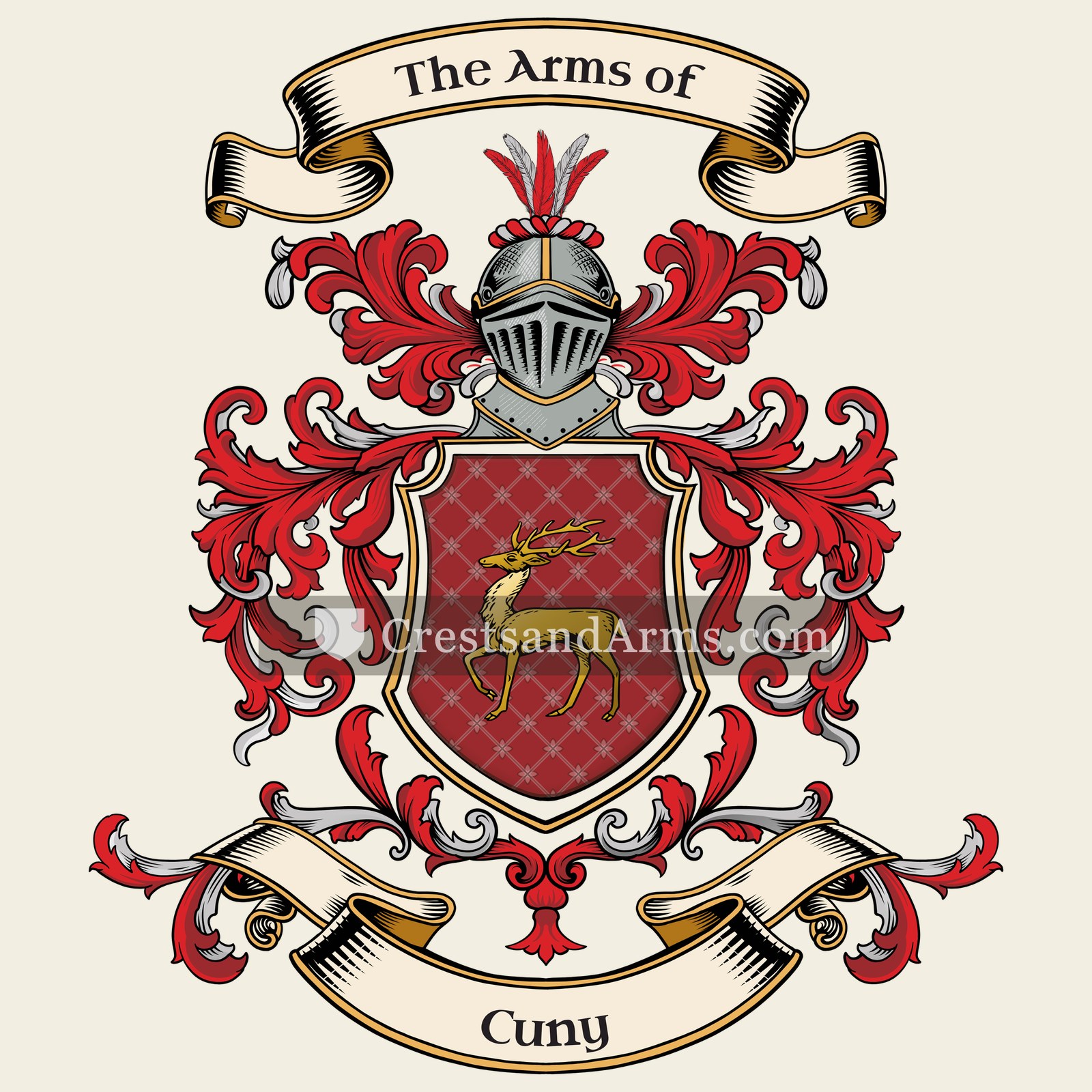


 chiefAuthority, wisdom and dominion
 hunting horn stringedOne who delights in the chase
 eagleNobility, strength and a keen mind