Map of England showing where the Cureno arms are recorded
The Cureno arms were recorded in Cumberland, c. 1664.
Cumberland was rough border country in the north-west, facing Scotland across a disputed line. Its families held land in return for keeping it defended, and men who fought carried shields of their own.
This is where the arms were entered in the register. Families often moved to other parts of the country, so the same name can turn up in more than one region.
The body that granted and recorded arms in England in this period.
Charles II of England
Sovereign of the period
Charles II of England
1660–1685
Reigning in England when the Cureno arms are first recorded.
How Arms Worked in England
English heraldry allowed arms to be shared by all legitimate descendants of the original owner. These symbols were treated as personal property that moved through the generations to all children. While the eldest son kept the original design, other family members could use the same shield without needing to change it or register their own unique versions.
Granting authority
The College of Arms in London has regulated the use of coats of arms throughout England and Wales since 1484.
How they got arms
Families typically obtained their coats of arms through a formal grant from the Crown or by proving their ancient right to them.
Where arms were recorded
All official coats of arms are recorded in the registers kept at the College of Arms, which date back to the fifteenth century.
The family's standing
Recorded among the armigerous families of Cumberland.
Origin & History of the Cureno Family in England
The family name Cureno has roots that trace back to the rugged landscapes of northern England, with documented evidence placing family members in Cumberland as early as 1664. During the seventeenth century, Cumberland was a region defined by its proximity to the Scottish border and its reliance on agriculture and mining. Families living in this area often took surnames based on their specific location, their trade, or descriptive traits that set them apart within their local parish. As the Cureno name appeared in regional records during this period, it suggests that the family was well-established within the local community life of the time. These early ancestors likely navigated the challenges of life in a border county, where shifting political loyalties and the demands of rural survival shaped the development of local family lines. Over time, the name became a permanent marker of their presence in the region, reflecting the history of the families who helped build the foundations of northern English society.
Related Branches & Arms
Root word
Curare
Latin verb meaning to take care of, attend to, or heal.
This name
CurenoAn occupational surname for a caretaker, healer, or someone responsible for managing affairs.
also spelled
Curwin
Curwyn
Curwynn
Documented Sources
Sir Bernard Burke, The General Armory of England, Scotland, Ireland and Wales, London: Harrison & Sons, 1884
Cumberland and Westmorland Antiquarian and Archaeological Society, Transactions of the Cumberland and Westmorland Antiquarian and Archaeological Society, 1866
The National Archives, Quarter Sessions Records for the County of Cumberland, 1664
Digital archive packCoat of arms PNG, gold border print PDF, vector SVG and the certificate of authenticity. Sent to your email in minutes.


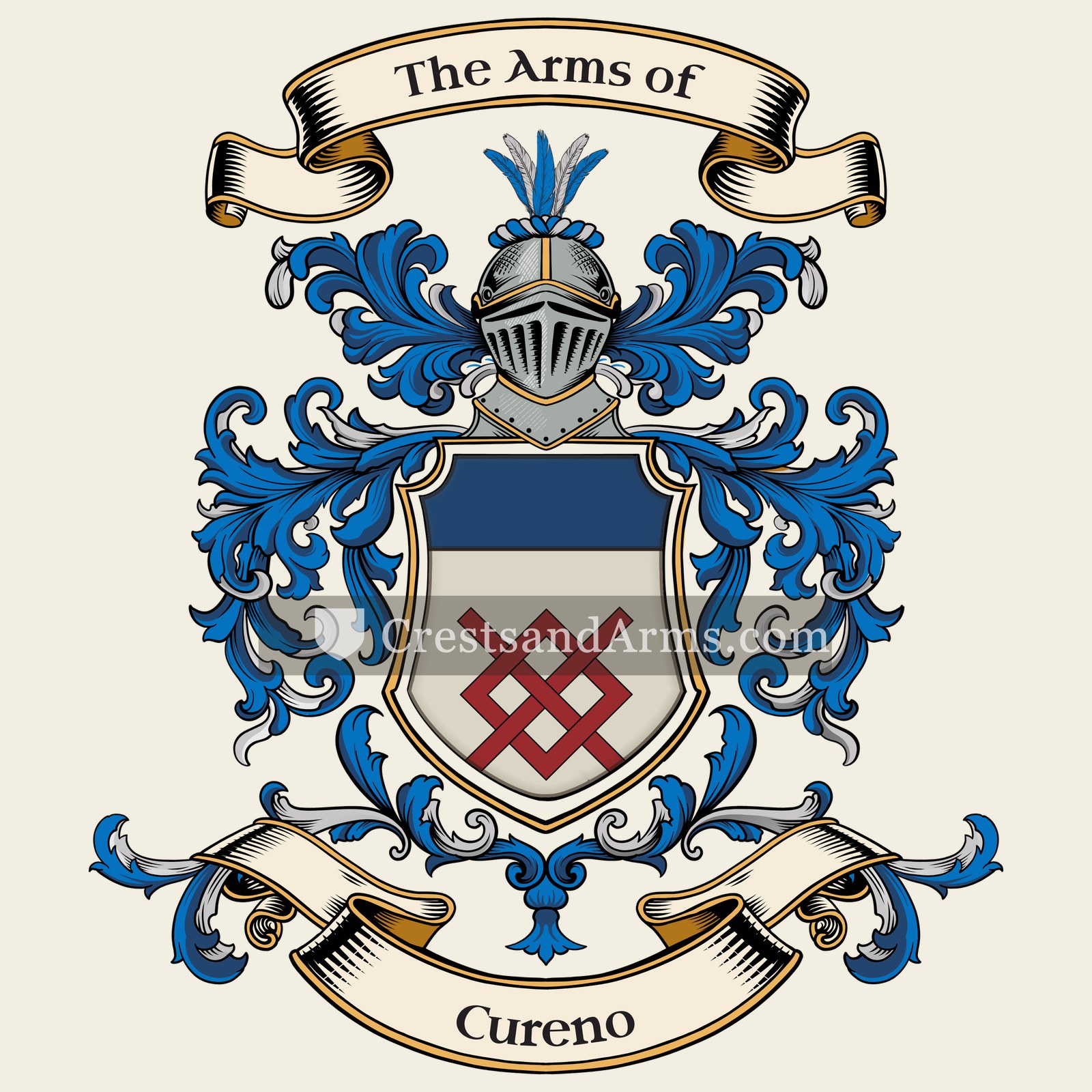
 chiefAuthority, wisdom and dominion
 fretPersuasion, and the net that holds
 chiefAuthority, wisdom and dominion
 fretPersuasion, and the net that holds