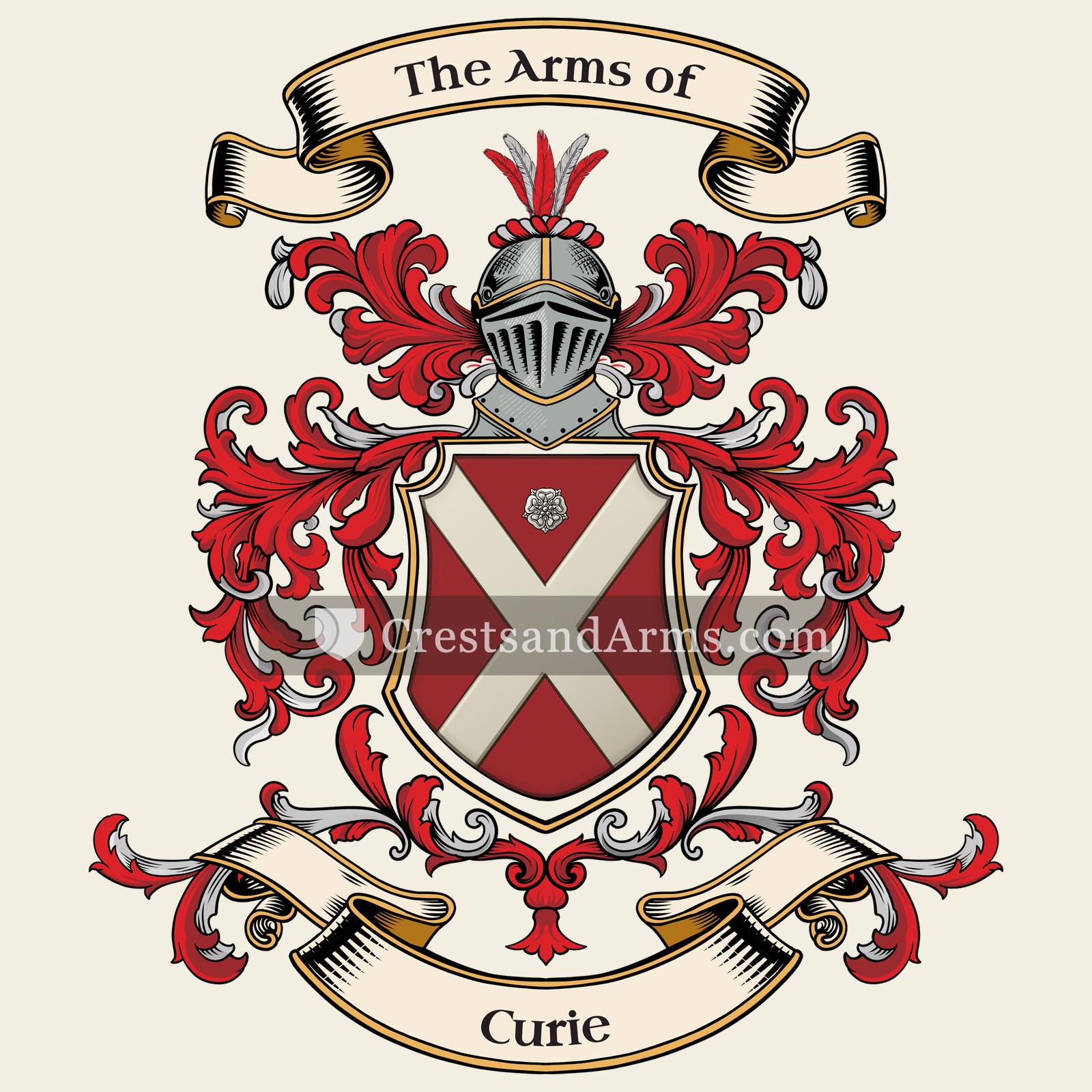
A record of documented arms, meaning and origin, researched for the Curie family of Britain.
Reg. 7420 · Britain, A–C
Coat of Arms & Family Crest Details
Symbols on this shield
saltireResolution, and St Andrew's cross
roseThe seventh son, and beauty with grace
Colours
Red (Gules)Means: Military strength
Silver (Argent)Means: Peace and sincerity
Historical info
Source
J. B. Rietstap, Armorial Général, Gouda: G. B. van Goor Zonen, 1884–87
Blazon (the actual original written record)
“De gu. au saut. alésé d'arg., acc. en chef d'une rose du même, bout. d'or, barbée de sin. C.: un coq au nat., posant la patte dextre sur une rose pareille à celle de l'écu. D.: LARGS.”
KentKent, c. 1846
Digital archive packCoat of arms PNG, gold border print PDF, vector SVG and the certificate of authenticity. Sent to your email in minutes.
Map of Britain showing where the Curie arms are recorded
The Curie arms were recorded in Kent, c. 1846.
Kent sits between London and the short crossing to Europe, and the trade passing through made it wealthy. Merchant families bought land with that money, and it was landowners who took coats of arms.
This is where the arms were entered in the register. Families often moved to other parts of the country, so the same name can turn up in more than one region.
The body that granted and recorded arms in Britain in this period.
Victoria
Sovereign of the period
Victoria
1837–1901
Reigning in Britain when the Curie arms are first recorded.
How Arms Worked in Britain
English heraldry allowed arms to be shared by all legitimate descendants of the original owner. These symbols were treated as personal property that moved through the generations to all children. While the eldest son kept the original design, other family members could use the same shield without needing to change it or register their own unique versions.
Granting authority
The College of Arms in London has regulated the use of coats of arms throughout England and Wales since 1484.
How they got arms
Families typically obtained their coats of arms through a formal grant from the Crown or by proving their ancient right to them.
Where arms were recorded
All official coats of arms are recorded in the registers kept at the College of Arms, which date back to the fifteenth century.
The family's standing
Recorded among the armigerous families of Kent.
Origin & History of the Curie Family in Britain
The family name Curie has roots that stretch back through European history, though its specific presence in England became documented during the nineteenth century. By 1846, records confirm that members of the Curie family were established in the county of Kent. The name itself is thought to be a variation of older French or Latin surnames, often linked to the word for a parish priest or a person associated with a local court. As families moved across borders for work or trade, the spelling of their names often shifted to match the local pronunciation of their new homes. This transition from continental Europe to the English countryside highlights the movement of families during a time of great industrial and social change. By settling in Kent, the early Curie family members became part of the local community, contributing to the agricultural and social fabric of the region during the Victorian era.
Curie Meaning & Related Branches
Root word
Curia
A division of the Roman people or a meeting place.
This name
CurieA topographic name for someone who lived near a parish church or court.
also spelled
Curry
Curie
Currey
Documented Sources
J. B. Rietstap, Armorial Général, Gouda: G. B. van Goor Zonen, 1884–87
Ancestry, England & Wales, Civil Registration Birth Index, 1837-1915, 1846
The National Archives, General Register Office: Births, Marriages and Deaths surrendered in the non-parochial registers, RG 4
Digital archive packCoat of arms PNG, gold border print PDF, vector SVG and the certificate of authenticity. Sent to your email in minutes.


 saltireResolution, and St Andrew's cross
 roseThe seventh son, and beauty with grace
 saltireResolution, and St Andrew's cross
 roseThe seventh son, and beauty with grace