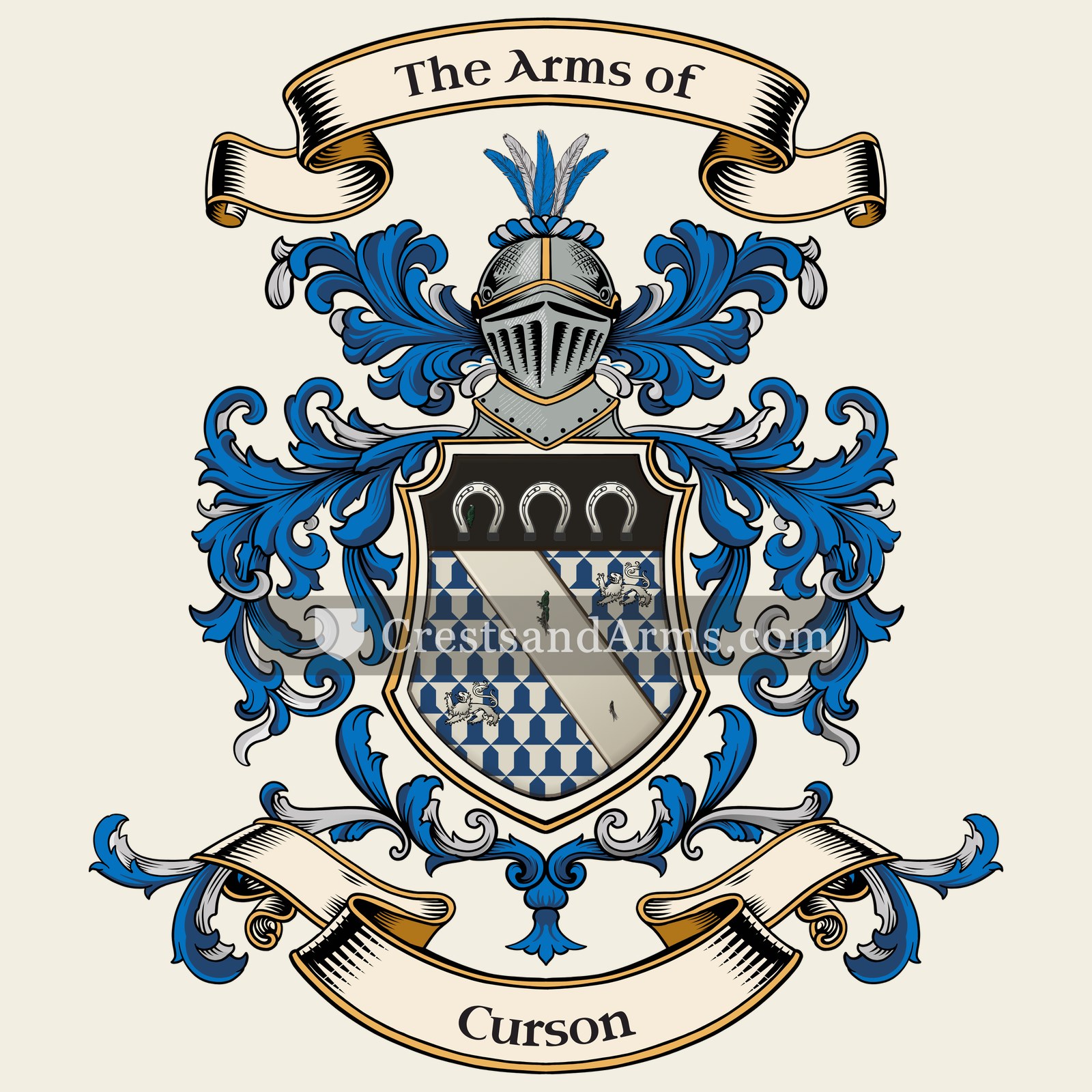
A record of documented arms, meaning and origin, researched for the Curson family of England.
Reg. 0157 · English, A–C
Coat of Arms & Family Crest Details
Symbols on this shield
bendDefence, and the scarf of a commander
chiefAuthority, wisdom and dominion
lionCourage, strength and royalty
parrotEloquence, and travel in distant lands
horseshoeGood fortune and protection from harm
martletA younger son, who must win his own land
Colours
Silver (Argent)Means: Peace and sincerity
Black (Sable)Means: Constancy
Green (Vert)Means: Hope
Historical info
Source
Sir Bernard Burke, The General Armory of England, Scotland, Ireland and Wales, London: Harrison & Sons, 1884
Blazon (the actual original written record)
“Az. on a bend, betw. two lions ramp. ar. three popinjays vert, membered gu. collared or, quartering, vairé or and gu. on a chief sa. three horse shoes ar., and, gu. on a bend ar. three martlets sa”
DerbyCropton · Derby, c. 1568
Digital archive packCoat of arms PNG, gold border print PDF, vector SVG and the certificate of authenticity. Sent to your email in minutes.
Map of England showing where the Curson arms are recorded
The Curson arms were recorded in Derby, c. 1568.
Derbyshire had lead mines in its hills and good grazing in its valleys. Both made steady money, and families who made it bought manors, which is what put their names into the heraldic records.
This is where the arms were entered in the register. Families often moved to other parts of the country, so the same name can turn up in more than one region.
The body that granted and recorded arms in England in this period.
Elizabeth I of England
Sovereign of the period
Elizabeth I of England
1558–1603
Reigning in England when the Curson arms are first recorded.
How Arms Worked in England
English heraldry allowed arms to be shared by all legitimate descendants of the original owner. These symbols were treated as personal property that moved through the generations to all children. While the eldest son kept the original design, other family members could use the same shield without needing to change it or register their own unique versions.
Granting authority
The College of Arms in London has regulated the use of coats of arms throughout England and Wales since 1484.
How they got arms
Families typically obtained their coats of arms through a formal grant from the Crown or by proving their ancient right to them.
Where arms were recorded
All official coats of arms are recorded in the registers kept at the College of Arms, which date back to the fifteenth century.
The family's standing
Recorded among the armigerous families of Derby.
Origin & History of the Curson Family in England
The family name Curson has deep roots in the English Midlands, with historical records confirming that members of the family were well-established in Derby by 1568. The name itself is believed to be a variation of the Old French word "curson," which was a nickname often used to describe a person with a short or cropped hairstyle. During the medieval period, such descriptive nicknames were common ways to distinguish individuals within a growing population. As the family settled in Derbyshire, they became integrated into the local community through land ownership and civic participation. By the late sixteenth century, the Cursons were recognized as a stable and prominent family within the region, reflecting the broader patterns of social development and surname formation seen across England during that era.
Curson Meaning & Related Branches
Root word
cursus
Latin term meaning a course, journey, or running.
This name
CursonDerived from a nickname for a runner or a person who traveled frequently.
also spelled
Curzon
Related arms
Curzonsimilar arms
Corzonvariant spelling
Jervysrecorded with Curson, same area
Documented Sources
Sir Bernard Burke, The General Armory of England, Scotland, Ireland and Wales, London: Harrison & Sons, 1884
Reaney, P.H., A Dictionary of English Surnames, 1958
Cox, J. Charles, Notes on the Churches of Derbyshire, 1877
Derbyshire Record Office, Derby Borough Records: Quarter Sessions and Municipal Papers, 1568
Digital archive packCoat of arms PNG, gold border print PDF, vector SVG and the certificate of authenticity. Sent to your email in minutes.


 bendDefence, and the scarf of a commander
 chiefAuthority, wisdom and dominion
 lionCourage, strength and royalty
 parrotEloquence, and travel in distant lands
 horseshoeGood fortune and protection from harm
 martletA younger son, who must win his own land
 bendDefence, and the scarf of a commander
 chiefAuthority, wisdom and dominion
 lionCourage, strength and royalty
 parrotEloquence, and travel in distant lands
 horseshoeGood fortune and protection from harm
 martletA younger son, who must win his own land