A record of documented arms, meaning and origin, researched for the Curtis family lines. Documented in 2 countries.
Reg. 4305 · English, A–C
Coat of Arms & Family Crest Details
Symbols on this shield
mountThe ground held, and steadfastness upon it
cantonA mark of honour granted by the sovereign
fleur de lisPurity, light, and the sixth son
swordJustice, and military honour
palm treeVictory, and righteousness that flourishes
Colours
Silver (Argent)Means: Peace and sincerity
Black (Sable)Means: Constancy
Red (Gules)Means: Military strength
Green (Vert)Means: Hope
Historical info
Source
Sir Bernard Burke, The General Armory of England, Scotland, Ireland and Wales, London: Harrison & Sons, 1884
Blazon (the actual original written record)
“Per fesse wavy ar. and sa. in chief the rock of Gibraltar surrounded by fortifications and the sea, and in base three fleurs-de-lis of the first, on a canton gu. a sword erect ppr., hilted and pommelled or, entwisted with a palm branch vert”
HantsGatcombe · Hants, c. 1620
Digital archive packCoat of arms PNG, gold border print PDF, vector SVG and the certificate of authenticity. Sent to your email in minutes.
Map of England showing where the Curtis arms are recorded
The Curtis arms were recorded in Hants, c. 1620.
Hampshire had the naval dockyards at Portsmouth on one side and good farmland on the other. Sea money and land money both bought estates, and an estate was what brought a family its coat of arms.
This is where the arms were entered in the register. Families often moved to other parts of the country, so the same name can turn up in more than one region.
The body that granted and recorded arms in England in this period.
James VI and I
Sovereign of the period
James VI and I
1603–1625
Reigning in England when the Curtis arms are first recorded.
How Arms Worked in England
English heraldry allowed arms to be shared by all legitimate descendants of the original owner. These symbols were treated as personal property that moved through the generations to all children. While the eldest son kept the original design, other family members could use the same shield without needing to change it or register their own unique versions.
Granting authority
The College of Arms in London has regulated the use of coats of arms throughout England and Wales since 1484.
How they got arms
Families typically obtained their coats of arms through a formal grant from the Crown or by proving their ancient right to them.
Where arms were recorded
All official coats of arms are recorded in the registers kept at the College of Arms, which date back to the fifteenth century.
The family's standing
Recorded among the armigerous families of Hants.
Origin & History of the Curtis Family in England
The surname Curtis has deep roots in England, originating as a descriptive nickname derived from the Old French word "curteis," which meant courteous or refined. During the Middle Ages, this name was likely bestowed upon individuals who displayed polite manners or served in the households of the nobility. By the early 17th century, the family had established a notable presence in the county of Hampshire. Records from 1620 confirm that members of the Curtis family were settled in this region, where they participated in the local agricultural and social life of the English countryside. As the name spread across the southern counties, it became firmly embedded in the local history of Hampshire, marking the family as a long-standing part of the area's social fabric before many of its members eventually sought new opportunities across the Atlantic.
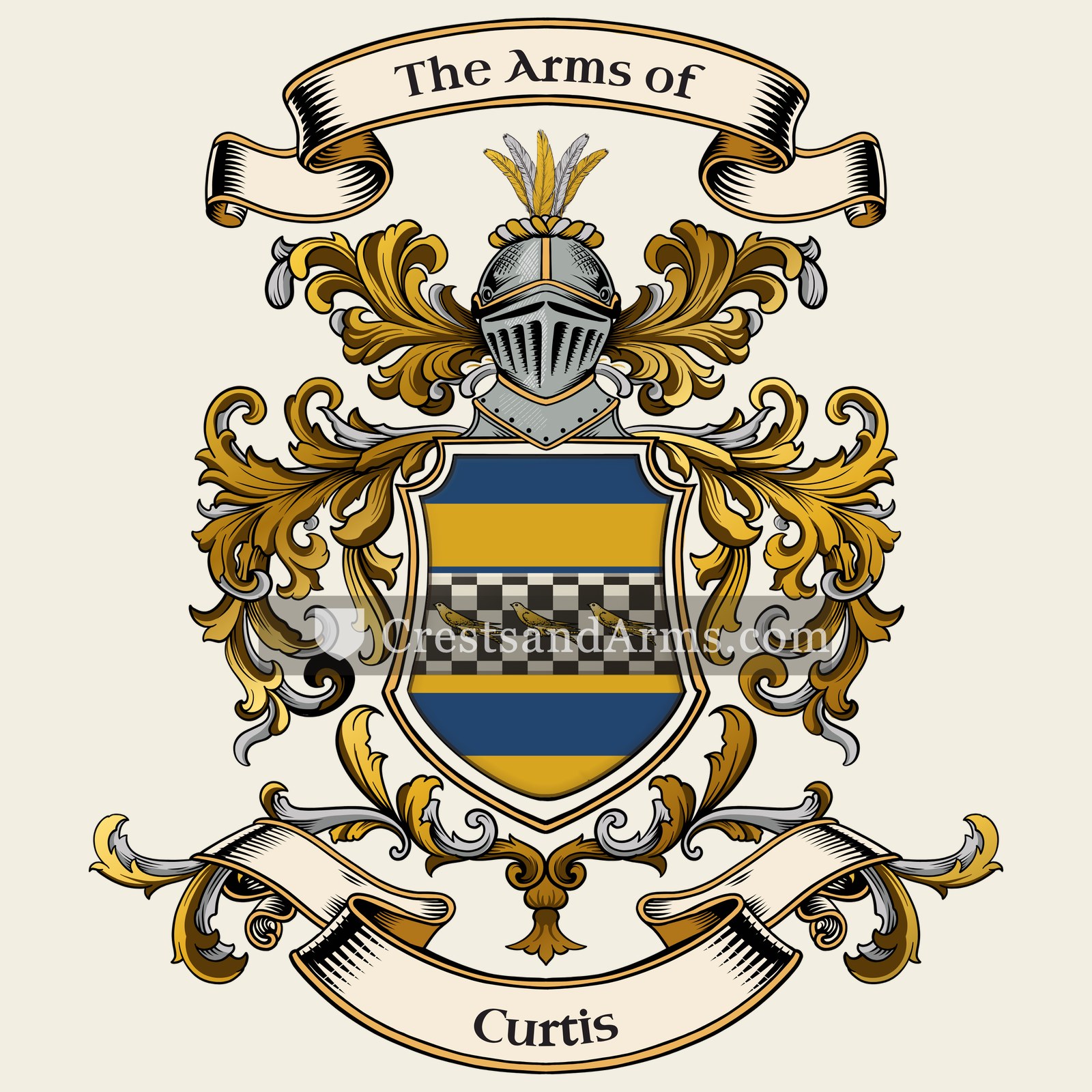
Coat of Arms & Family Crest Details
Symbols on this shield
fessThe military belt, and readiness to serve
chequyConstancy, and the counting-board
martletA younger son, who must win his own land
Colours
Gold (Or)Means: Generosity
Black (Sable)Means: Constancy
Blue (Azure)Means: Loyalty and truth
Historical info
Source
Sir Bernard Burke, The General Armory of England, Scotland, Ireland and Wales, London: Harrison & Sons, 1884
Blazon (the actual original written record)
“Barry of six or and az. on a fesse chequy ar. and sa. three martlets of the first”
TipperaryRoscrea · Tipperary, c. 1712
Digital archive packCoat of arms PNG, gold border print PDF, vector SVG and the certificate of authenticity. Sent to your email in minutes.
Map of Ireland showing where the Curtis arms are recorded
The Curtis arms were recorded in Tipperary, c. 1712.
Tipperary was the best grazing land in Ireland, held by a small number of powerful families. Land of that value stayed in the same hands, and unbroken holding is what puts a name in the records.
This is where the arms were entered in the register. Families often moved to other parts of the country, so the same name can turn up in more than one region.
The body that granted and recorded arms in Ireland in this period.
Anne of Great Britain
Sovereign of the period
Anne of Great Britain
1707–1714
Reigning in England when the Curtis arms are first recorded.
How Arms Worked in Ireland
The Ulster King of Arms granted coats of arms to individuals who proved their social standing and good character. These symbols were typically inherited by all legitimate descendants of the original holder. If a family branch wanted a unique look, they could apply for a specific change to their design through the office to ensure their identity remained distinct.
Granting authority
The Ulster King of Arms acted as the official body that regulated and issued all coats of arms throughout Ireland.
How they got arms
Families obtained their arms through formal grants issued by the office after proving their eligibility and paying the required fees.
Where arms were recorded
All official grants were recorded in the registers held by the Ulster King of Arms starting from the year 1552.
The family's standing
Recorded among the armigerous families of Tipperary.
Origin & History of the Curtis Family in Ireland
The surname Curtis has deep roots in the British Isles, but its presence in Ireland became firmly established through centuries of migration and settlement. While the name is of Norman-French origin, meaning a person who was courteous or refined, it was brought to Ireland by settlers who arrived during periods of significant political and social change. By 1712, records confirm that members of the Curtis family were living in County Tipperary, which suggests they had integrated into the local community as landowners or tenant farmers during the early eighteenth century. At this time, Tipperary was a region defined by a mix of native Gaelic traditions and the influence of new arrivals, and families like the Curtises often played a role in the agricultural and administrative life of the area. Their presence in the region reflects the broader movement of people across the Irish Sea, where they established roots that would persist for generations within the Irish landscape.
Curtis Meaning & Related Branches
Root word
curteis
Derived from the Old French word for courteous or refined.
This name
CurtisRefers to a person who possessed refined manners or was well-bred.
also spelled
Curteis
Curteys
Curtess
Related arms
Cortisvariant spelling
Courteis, or Courtysvariant spelling
Courtisvariant spelling
Curteisvariant spelling
Documented Sources
Sir Bernard Burke, The General Armory of England, Scotland, Ireland and Wales, London: Harrison & Sons, 1884
Reaney, P.H., A Dictionary of English Surnames, 1958
Lower, Mark Antony, Patronymica Britannica: A Dictionary of the Family Names of the United Kingdom, 1860


 mountThe ground held, and steadfastness upon it
 cantonA mark of honour granted by the sovereign
 fleur de lisPurity, light, and the sixth son
 swordJustice, and military honour
 palm treeVictory, and righteousness that flourishes
 mountThe ground held, and steadfastness upon it
 cantonA mark of honour granted by the sovereign
 fleur de lisPurity, light, and the sixth son
 swordJustice, and military honour
 palm treeVictory, and righteousness that flourishes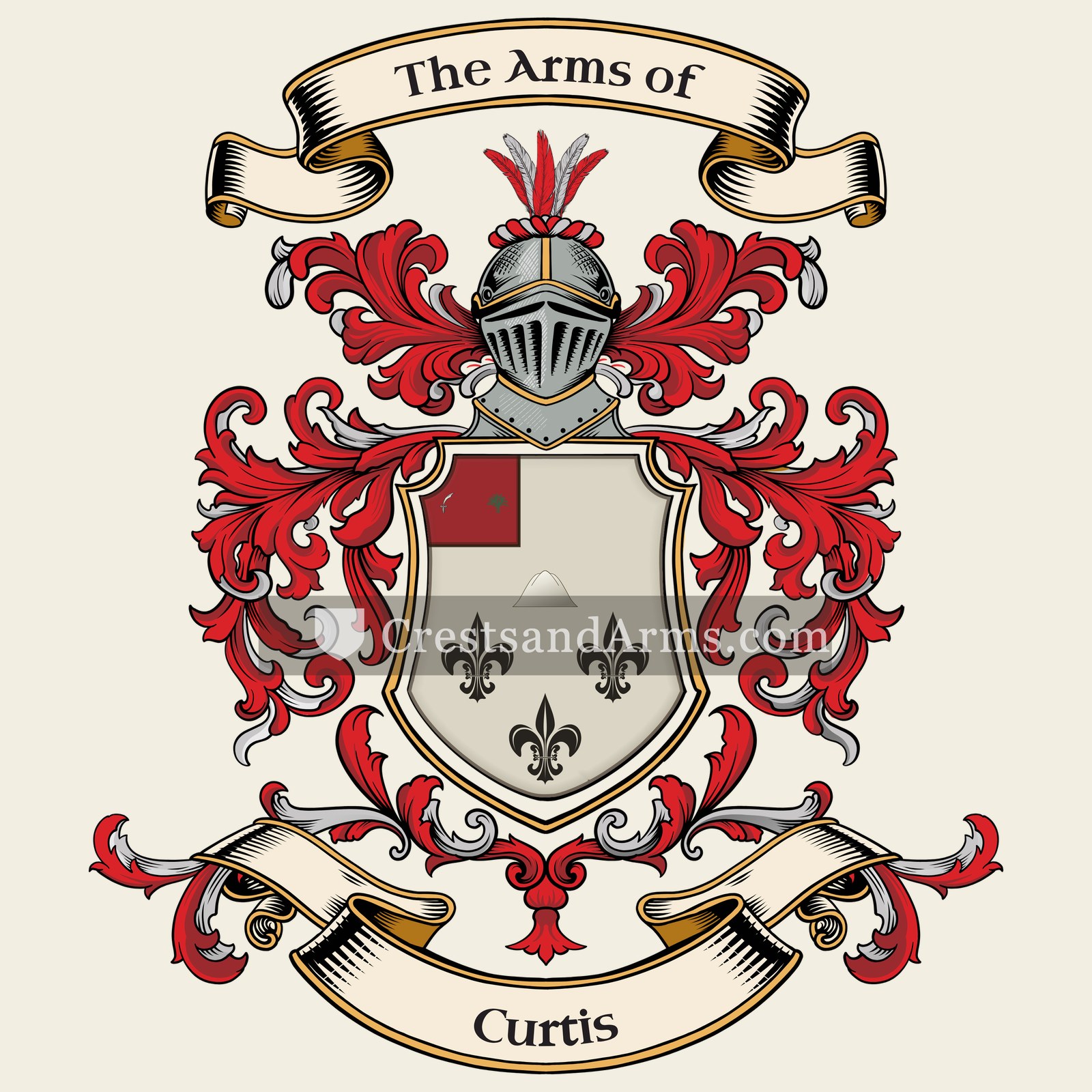


 fessThe military belt, and readiness to serve
 chequyConstancy, and the counting-board
 martletA younger son, who must win his own land