Map of Belgium showing where the Cyphers arms are recorded
The Cyphers arms were recorded in Flandre, c. 1663.
Flandre grew rich on cloth, and its towns were among the busiest in Europe. Merchant families bought land with their profits and took arms to go with it, so trade put as many names in the registers here as land did.
This is where the arms were entered in the register. Families often moved to other parts of the country, so the same name can turn up in more than one region.
The body that granted and recorded arms in Belgium in this period.
Philip IV of Spain
Sovereign of the period
Philip IV of Spain
1621–1665
Reigning in Belgium when the Cyphers arms are first recorded.
How Arms Worked in Belgium
In Belgium, a coat of arms is considered personal property that is passed down through the male line to legitimate descendants. Families often use the same shield design across generations to show their shared heritage. If a branch of the family wants to change the design, they must apply for an official update to their specific version of the arms.
Granting authority
The Conseil héraldique is the official body that regulates and approves all coats of arms in Belgium.
How they got arms
Families obtain their coats of arms through formal royal grants or by confirming their historical right to use existing designs.
Where arms were recorded
All approved coats of arms are officially recorded in the public registers of the Conseil héraldique since 1844.
The family's standing
Recorded among the armigerous families of Flandre.
Origin & History of the Cyphers Family in Belgium
The family name Cyphers finds its early roots in the historical region of Flanders, where records confirm the presence of family members as early as 1663. During this period, the Low Countries were a hub of intense trade and agricultural development, which likely influenced the movement and social standing of the family. The name itself is thought to be a variation of occupational or locational descriptors common in the Dutch-speaking territories of the seventeenth century. As the region navigated the complex political landscape of the Spanish Netherlands, families like the Cyphers were often integrated into the local parish systems. These systems were responsible for documenting births, marriages, and deaths, which allowed the family to maintain a consistent presence in the Flemish landscape for generations. By settling in this area, the early Cyphers participated in the unique cultural and economic life of Flanders, helping to establish a lineage that remained tied to the region throughout the late seventeenth century.
Coat of Arms & Family Crest Details
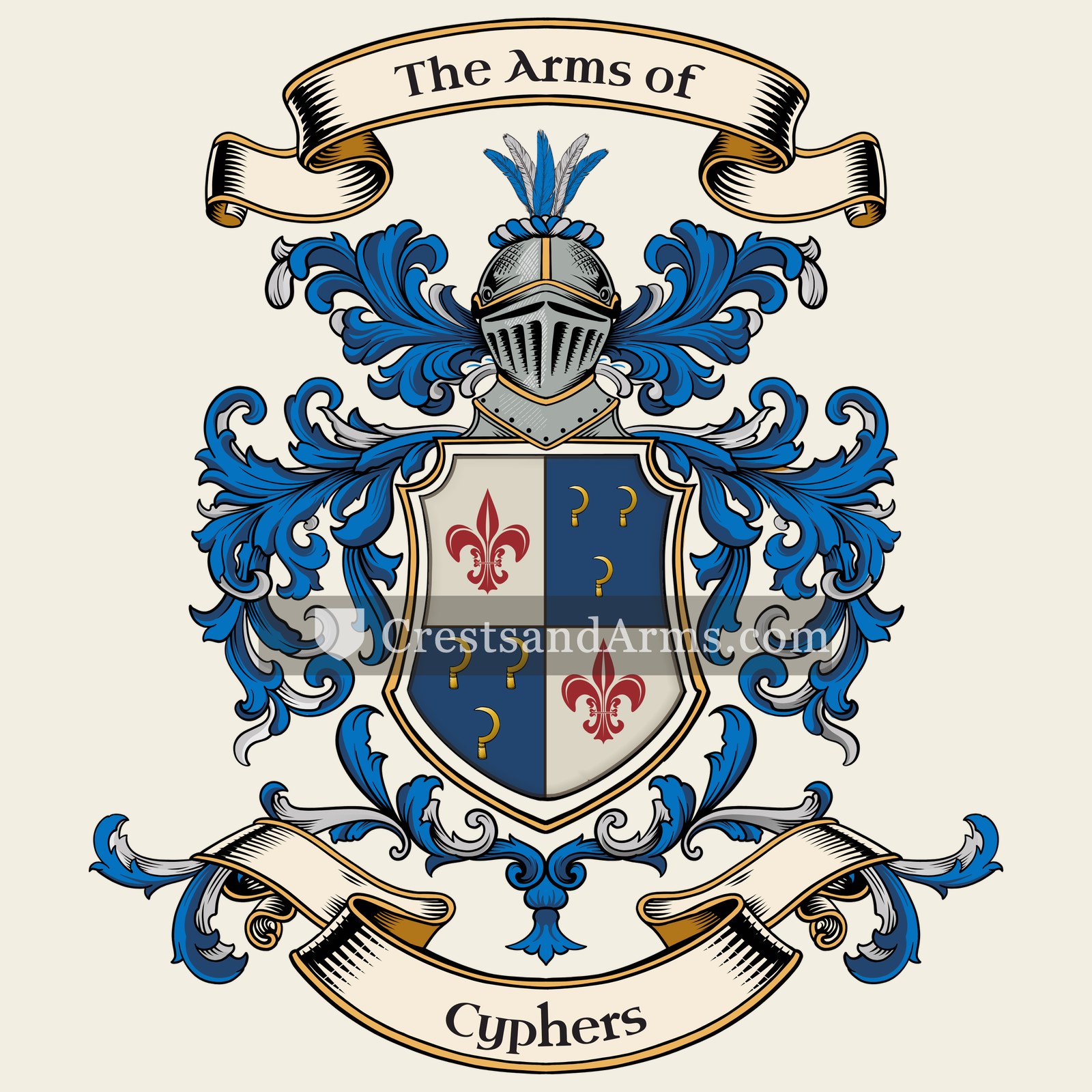
Symbols on this shield
fleur de lisPurity, light, and the sixth son
sickleThe harvest, and the reaping of what was sown
Colours
Silver (Argent)Means: Peace and sincerity
Blue (Azure)Means: Loyalty and truth
Red (Gules)Means: Military strength
Gold (Or)Means: Generosity
Historical info
Source
J. B. Rietstap, Armorial Général, Gouda: G. B. van Goor Zonen, 1884–87
Blazon (the actual original written record)
“Ec.: aux 1 et 4 d'arg. à une fleur-de-lis de gu.; aux 2 et 3 d'azur à trois équerres d'or, posées 7. C.: une fleur-de-lis de gu. L.: à dextre d'arg. et de gu., à sen. d'or et d'azur.”
NetherlandsAmsterdam, c. 1815
Digital archive packCoat of arms PNG, gold border print PDF, vector SVG and the certificate of authenticity. Sent to your email in minutes.
Map of Netherlands showing where the Cyphers arms are recorded
The Cyphers arms were recorded in Amsterdam, c. 1815.
This is where the arms were entered in the register. Families often moved to other parts of the country, so the same name can turn up in more than one region.
Region
Amsterdam
Town
Amsterdam
First recorded
1815
Granting Authority for the Cyphers Arms
Hoge Raad van Adel
Photograph made by me · CC BY-SA 3.0
The body that granted and recorded arms in Netherlands in this period.
William I of the Netherlands
Sovereign of the period
William I of the Netherlands
1815–1840
Reigning in Belgium when the Cyphers arms are first recorded.
How Arms Worked in Netherlands
In the Netherlands, coats of arms were often used by noble families and those who held specific public offices. These arms were passed down through the generations to legitimate descendants. Younger branches of a family usually kept the original design without needing to add special marks. This system ensured that the family identity remained clear and consistent over many years.
Granting authority
The Hoge Raad van Adel is the official body that regulates and manages noble titles and coats of arms in the Netherlands.
How they got arms
Families typically obtained their coats of arms through official royal grants or by proving their long-standing historical use of the symbols.
Where arms were recorded
Coats of arms are officially recorded in the registers held by the Hoge Raad van Adel, which began its work in 1814.
The family's standing
Recorded among the armigerous families of Netherlands.
Origin & History of the Cyphers Family in Netherlands
The family name Cyphers has roots that trace back to the bustling urban environment of Amsterdam in the early nineteenth century. By 1815, the Netherlands was undergoing a period of significant transition as it emerged from French rule to become the United Kingdom of the Netherlands. During this time, the Dutch government began to formalize civil registration systems, which required families to adopt and record consistent surnames for tax and military purposes. The Cyphers family was established in Amsterdam during this era of administrative change. As the city served as a major global hub for trade and navigation, the family likely participated in the vibrant economic life of the port. Their presence in the city records reflects the broader movement of people who settled in Amsterdam to take advantage of the growing opportunities in commerce and craftsmanship during the post-Napoleonic reconstruction of the Dutch state.
Related Branches & Arms
Root word
Cyphra
Derived from the Arabic word sifr meaning empty or zero.
This name
CyphersAn occupational surname for a person who worked with numbers or served as a clerk or accountant.
also spelled
Kuypers
Documented Sources
J. B. Rietstap, Armorial Général, Gouda: G. B. van Goor Zonen, 1884–87
Rijksarchief te Gent, Parochieregisters van het Bisdom Gent
Stadsarchief Antwerpen, Doop-, trouw- en begraafregisters
De Flou, Karel, Woordenboek der Toponymie van westelijk Vlaanderen, Vlaamsch Artesië, het Land van den Hoek, de graafschappen Guines en Boulogne en een gedeelte van het graafschap Ponthieu, 1914
Fruin, Robert, Geschiedenis der Staatsinstellingen in Nederland tot den val der Republiek, 1901
Digital archive packCoat of arms PNG, gold border print PDF, vector SVG and the certificate of authenticity. Sent to your email in minutes.


 chevronProtection, and faithful service completed
 roseThe seventh son, and beauty with grace
 chevronProtection, and faithful service completed
 roseThe seventh son, and beauty with grace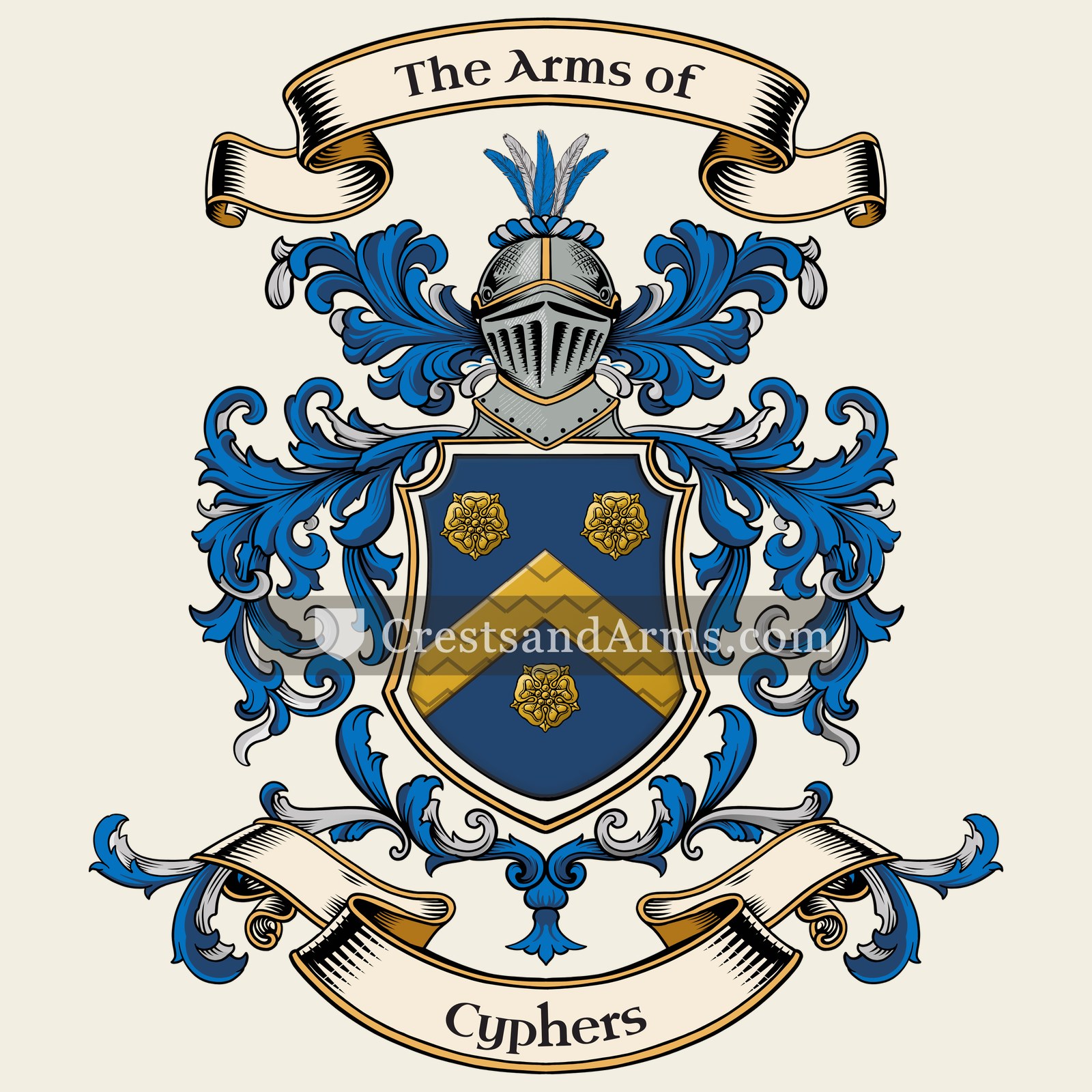


 fleur de lisPurity, light, and the sixth son
 sickleThe harvest, and the reaping of what was sown