Map of Poland showing where the Czechowski arms are recorded
The Czechowski arms were recorded in Prusse, c. 1772.
Arms such as these were typically recorded in Mazovia.
Mazovia held Warsaw, the Polish court and the assemblies where the szlachta met. Poland's nobles were unusually numerous and every one of them bore arms, and Warsaw is where those arms were argued over and recorded.
This is where the arms were entered in the register. Families often moved to other parts of the country, so the same name can turn up in more than one region.
Region
Mazovia
Town
Prusse
First recorded
1772
Granting Authority for the Czechowski Arms
Ennoblement by the Sejm
Author: Olek Remesz · CC BY-SA 3.0
The body that granted and recorded arms in Poland in this period.
Stanisław August Poniatowski
Sovereign of the period
Stanisław August Poniatowski
1764–1795
Reigning in Poland when the Czechowski arms are first recorded.
How Arms Worked in Poland
Polish noble families shared a single coat of arms across many different surnames, creating large clans rather than individual designs. These symbols were held collectively by all members of the clan regardless of their specific family name. When a new family joined the nobility, they were adopted into an existing clan and began using that group's established shield.
Granting authority
The Sejm, which was the Polish parliament, held the power to grant noble status and the right to bear arms.
How they got arms
Families typically received their coat of arms through a formal act of ennoblement granted by the Sejm for distinguished service.
Where arms were recorded
These grants were officially recorded in the Crown Metrica, which served as the central archive for state documents starting in the sixteenth century.
The family's standing
Recorded among the armigerous families of Poland.
Origin & History of the Czechowski Family in Poland
The family name Czechowski is a toponymic surname, which means it was originally derived from a specific place name. In the Polish language, adding the suffix "-owski" to a root word typically indicated that a person or their ancestors came from a village or region with a similar name. By the year 1772, records confirm that the Czechowski family was well-established in the Mazovia region of Poland. This area was the historical heartland of the Polish nobility and local landowners. During the eighteenth century, families in this region often lived on small agricultural estates or served in local administrative roles. The name suggests that the earliest members of the lineage likely originated from a settlement known as Czechów or a similar variation. As the family grew, they became deeply integrated into the social and economic fabric of the Mazovian countryside, maintaining their presence there through generations of farming and community leadership.
Czechowski Meaning & Related Branches
Root word
Czech
A person belonging to the West Slavic ethnic group.
This name
CzechowskiA topographic or habitational name denoting someone from the Czech lands or of Czech descent.
also spelled
Ciechowsky
Ciechovski
Chekowski
Documented Sources
J. B. Rietstap, Armorial Général, Gouda: G. B. van Goor Zonen, 1884–87
Krzysztof Kwaśniewski, Nazwiska polskie, 1999
Kazimierz Rymut, Nazwiska Polaków: Słownik historyczno-etymologiczny, 2001
Archiwum Główne Akt Dawnych, Księgi grodzkie i ziemskie mazowieckie
Digital archive packCoat of arms PNG, gold border print PDF, vector SVG and the certificate of authenticity. Sent to your email in minutes.


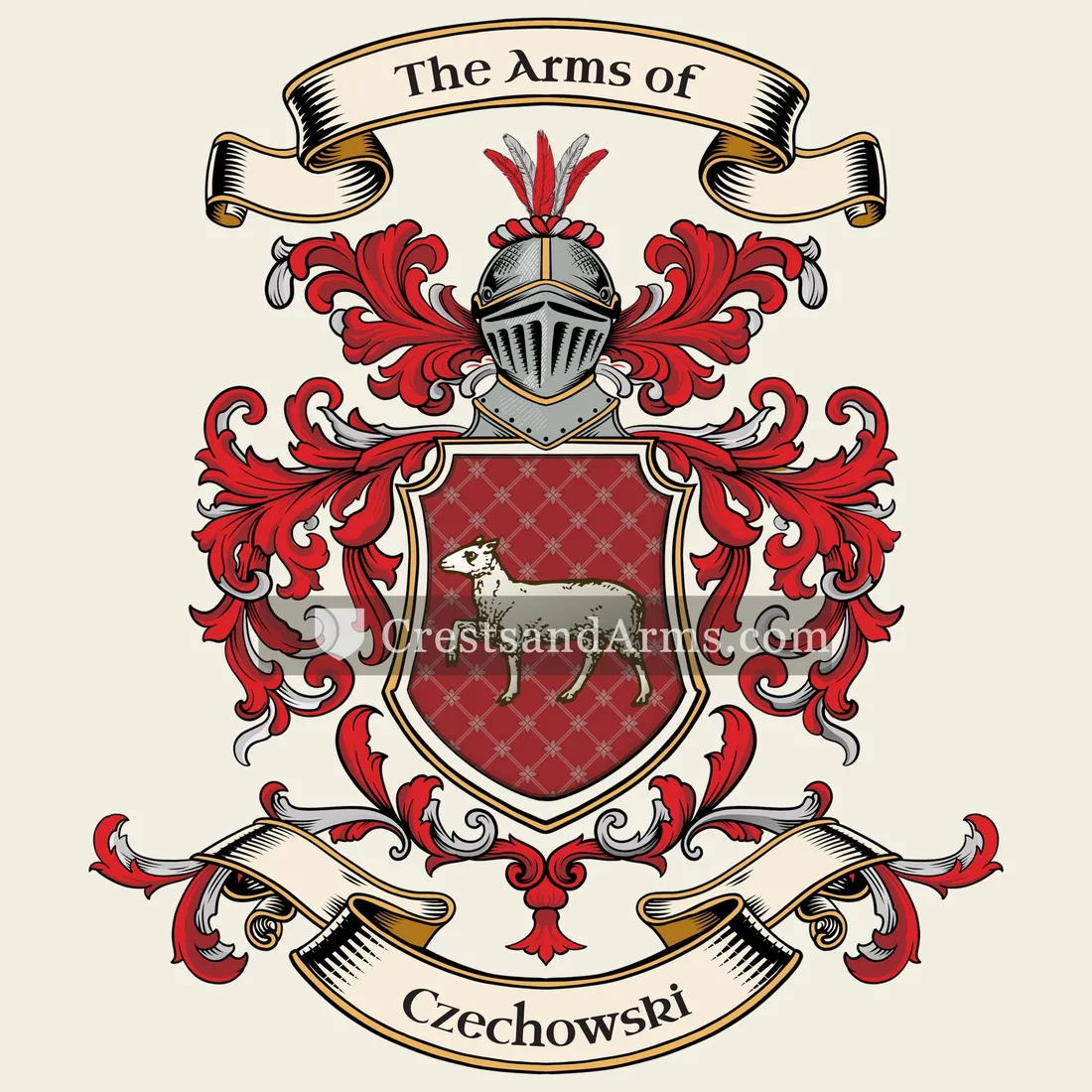
 lambGentleness, patience and faith
 lambGentleness, patience and faith