Map of England showing where the Dade arms are recorded
The Dade arms were recorded in Suffolk, c. 1620.
Suffolk was wool country, and its cloth towns were among the wealthiest in England. Clothier families bought manors with their profits, and holding a manor was the ordinary route to a coat of arms.
This is where the arms were entered in the register. Families often moved to other parts of the country, so the same name can turn up in more than one region.
The body that granted and recorded arms in England in this period.
James VI and I
Sovereign of the period
James VI and I
1603–1625
Reigning in England when the Dade arms are first recorded.
How Arms Worked in England
English heraldry allowed arms to be shared by all legitimate descendants of the original owner. These symbols were treated as personal property that moved through the generations to all children. While the eldest son kept the original design, other family members could use the same shield without needing to change it or register their own unique versions.
Granting authority
The College of Arms in London has regulated the use of coats of arms throughout England and Wales since 1484.
How they got arms
Families typically obtained their coats of arms through a formal grant from the Crown or by proving their ancient right to them.
Where arms were recorded
All official coats of arms are recorded in the registers kept at the College of Arms, which date back to the fifteenth century.
The family's standing
Recorded among the armigerous families of Suffolk.
Origin & History of the Dade Family in England
The family name Dade has deep roots in the English county of Suffolk, where the family was well established by the early seventeenth century. Historians believe the name is likely a variation of the Old English word "dada," which was a common term for a father or a nurse. During the 1600s, the Dades were recognized as members of the landed gentry and played active roles in local governance and agricultural life. Many family members lived in parishes around Ipswich, where they managed estates and participated in the social fabric of the region. As the British Empire began to expand, the family name became part of the migration to the American colonies, helping to spread their influence across the Atlantic. Their presence in Suffolk during the year 1620 marks a period when the family was firmly settled and influential within their local community.
Dade Meaning & Related Branches
Root word
Dada
An Old English pet name or term of endearment for a father.
This name
DadeA patronymic surname derived from a familiar term for a father or a nickname for a child.
also spelled
Daide
Dayde
Daid
Documented Sources
Sir Bernard Burke, The General Armory of England, Scotland, Ireland and Wales, London: Harrison & Sons, 1884
Copinger, Walter Arthur, The Manors of Suffolk: Notes on their History and Devolution, 1905


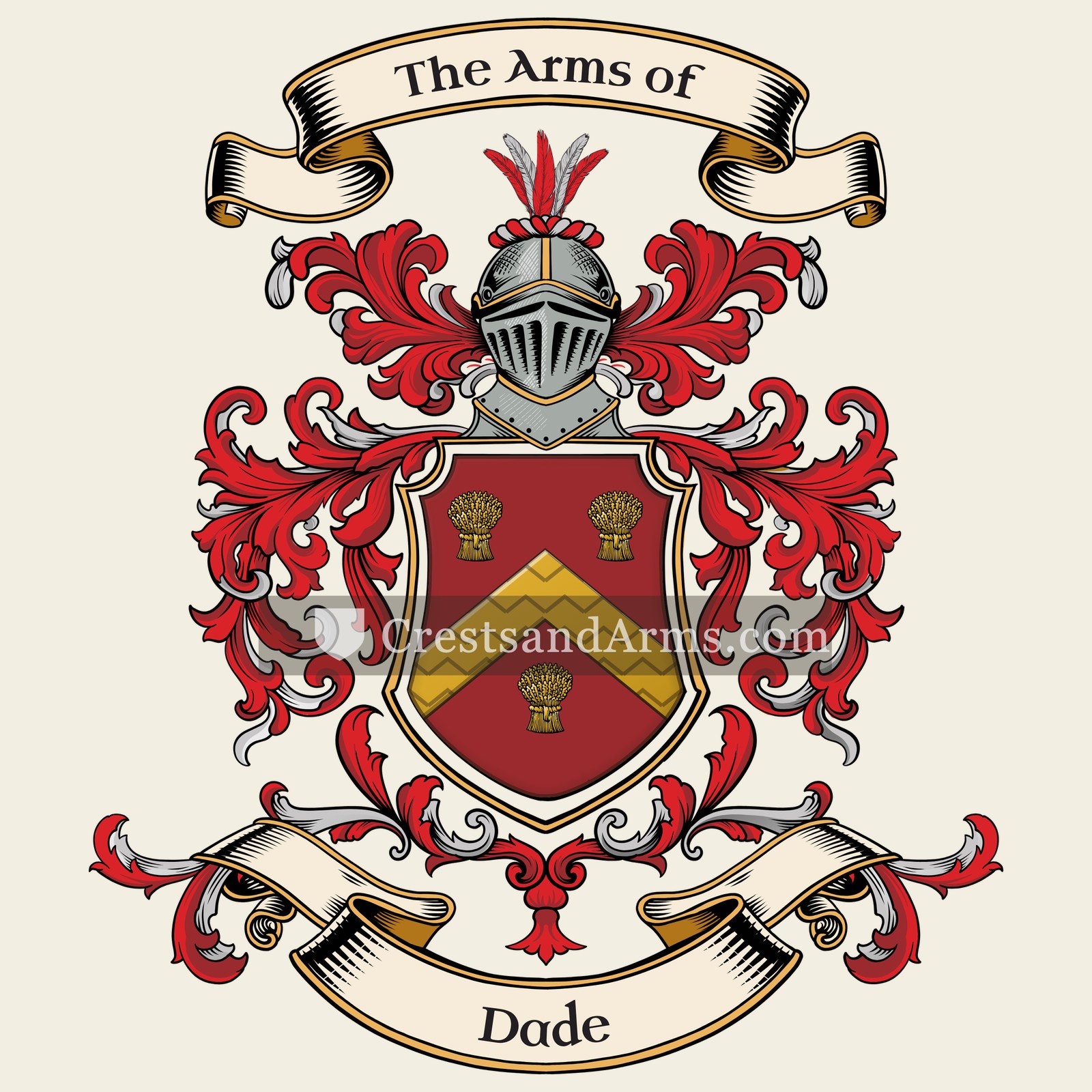
 chevronProtection, and faithful service completed
 wheatsheafPlenty, and the harvest of one's own labour
 chevronProtection, and faithful service completed
 wheatsheafPlenty, and the harvest of one's own labour