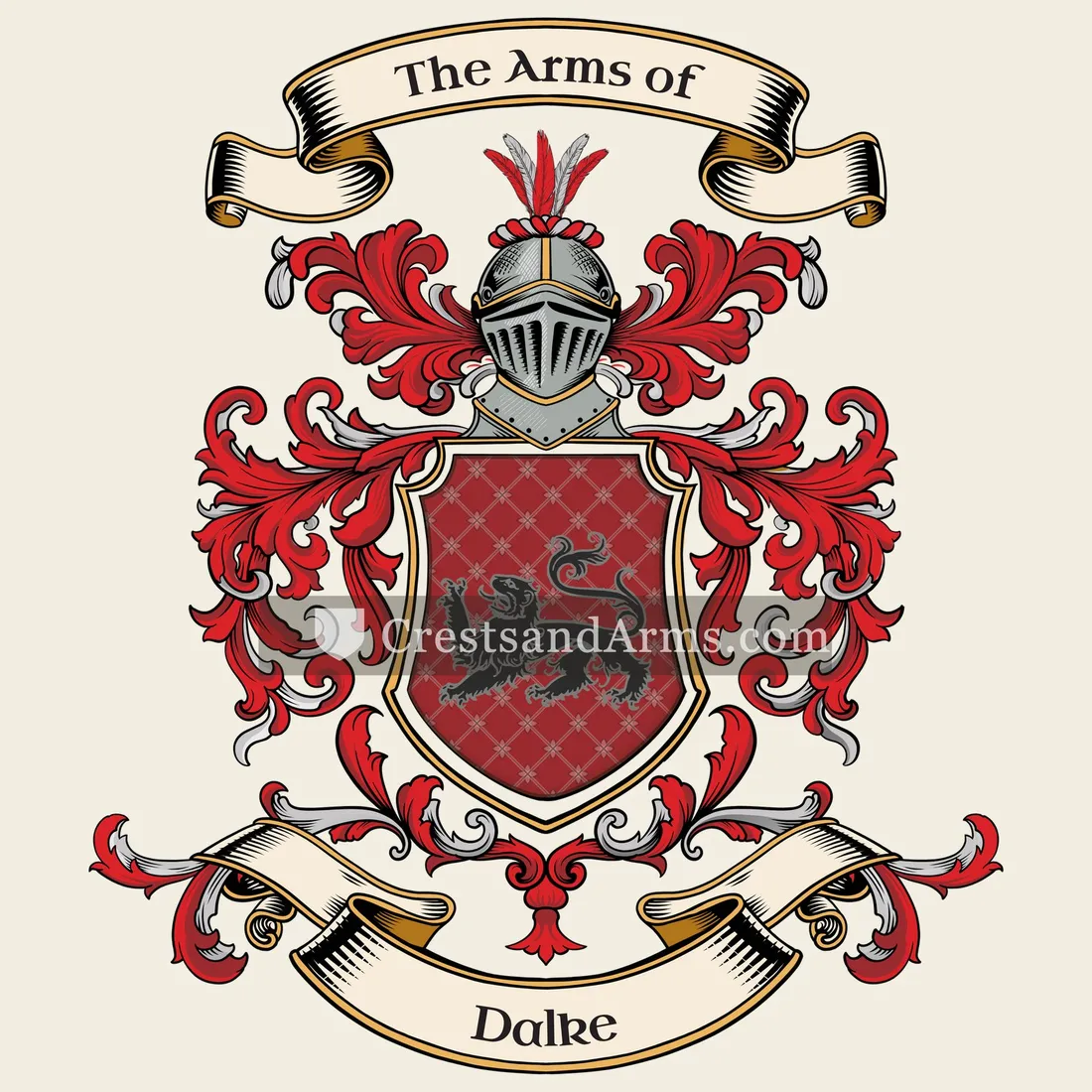
Map of Britain showing where the Dalke arms are recorded
The Dalke arms were recorded in Londres, c. 1862.
Arms such as these were typically recorded in Kent.
Kent sits between London and the short crossing to Europe, and the trade passing through made it wealthy. Merchant families bought land with that money, and it was landowners who took coats of arms.
This is where the arms were entered in the register. Families often moved to other parts of the country, so the same name can turn up in more than one region.
The body that granted and recorded arms in Britain in this period.
Victoria
Sovereign of the period
Victoria
1837–1901
Reigning in Britain when the Dalke arms are first recorded.
How Arms Worked in Britain
English heraldry allowed arms to be shared by all legitimate descendants of the original owner. These symbols were treated as personal property that moved through the generations to all children. While the eldest son kept the original design, other family members could use the same shield without needing to change it or register their own unique versions.
Granting authority
The College of Arms in London has regulated the use of coats of arms throughout England and Wales since 1484.
How they got arms
Families typically obtained their coats of arms through a formal grant from the Crown or by proving their ancient right to them.
Where arms were recorded
All official coats of arms are recorded in the registers kept at the College of Arms, which date back to the fifteenth century.
The family's standing
Recorded among the armigerous families of Britain.
Origin & History of the Dalke Family in Britain
The family name Dalke has roots that trace back to the shifting landscapes of nineteenth-century Britain. While the name is often associated with broader European origins, documented evidence confirms the presence of the Dalke family in the county of Kent by 1862. During this period, Kent was a region defined by its proximity to London and its role as a gateway for trade and migration. Families living in this area often navigated the social changes brought on by the Industrial Revolution, which encouraged movement between rural villages and growing urban centers. By establishing themselves in Kent, early members of the Dalke family became part of the local fabric of Victorian society, likely participating in the agricultural or emerging service economies that characterized the region at the time. This period marked a transition for many families as they settled into specific communities and began to leave behind the official paper trails that allow us to reconstruct their history today.
Meaning of the Dalke family crest colors & symbols
Symbols on this shield
lionCourage, strength and royalty
Colours
Red (Gules)Means: Military strength
Historical info
Source
Sir Bernard Burke, The General Armory of England, Scotland, Ireland and Wales, London: Harrison & Sons, 1884
Blazon (the actual original written record)
“Gu. a lion ramp. per pale ar. and or”
LeicesterKirkby Mallory · Leicester, c. 1574
Digital archive packCoat of arms PNG, gold border print PDF, vector SVG and the certificate of authenticity. Sent to your email in minutes.
Map of England showing where the Dalke arms are recorded
The Dalke arms were recorded in Leicester, c. 1574.
Leicestershire was grazing country, and wool and cattle made steady money rather than spectacular fortunes. Steady money bought manors, and manors are what brought families into the registers.
This is where the arms were entered in the register. Families often moved to other parts of the country, so the same name can turn up in more than one region.
The body that granted and recorded arms in England in this period.
Elizabeth I of England
Sovereign of the period
Elizabeth I of England
1558–1603
Reigning in Britain when the Dalke arms are first recorded.
How Arms Worked in England
English heraldry allowed arms to be shared by all legitimate descendants of the original owner. These symbols were treated as personal property that moved through the generations to all children. While the eldest son kept the original design, other family members could use the same shield without needing to change it or register their own unique versions.
Granting authority
The College of Arms in London has regulated the use of coats of arms throughout England and Wales since 1484.
How they got arms
Families typically obtained their coats of arms through a formal grant from the Crown or by proving their ancient right to them.
Where arms were recorded
All official coats of arms are recorded in the registers kept at the College of Arms, which date back to the fifteenth century.
The family's standing
Recorded among the armigerous families of Leicester.
Origin & History of the Dalke Family in England
The surname Dalke has roots that trace back to the English Midlands, with documented evidence placing the family in Leicester as early as 1574. During the sixteenth century, Leicester was a growing market town where trade and craftsmanship defined the daily lives of its residents. Families like the Dalkes often established themselves through local commerce or skilled labor, becoming integrated into the social fabric of the parish. Because surnames were still evolving in their spelling during this period, the name likely appeared in various forms in church registers and tax records as scribes wrote it down based on how it sounded. By settling in a central hub like Leicester, these early ancestors were part of a period of significant economic transition in England, where families began to leave a more permanent mark on local government and community life through their recorded presence in legal and religious documents.
Dalke Meaning & Related Branches
Root word
Dalkeith
A place name derived from Gaelic meaning narrow valley or glen.
This name
DalkeA habitational surname denoting someone who originated from the town of Dalkeith in Midlothian, Scotland.
also spelled
Dilk
Dilkee
Dilkey
Dylke
Dylkes
Documented Sources
J. B. Rietstap, Armorial Général, Gouda: G. B. van Goor Zonen, 1884–87
General Register Office, England and Wales Civil Registration Birth Index, 1862
Kent Archives, Kent Parish Registers, 1862
Digital archive packCoat of arms PNG, gold border print PDF, vector SVG and the certificate of authenticity. Sent to your email in minutes.


 lionCourage, strength and royalty
 lionCourage, strength and royalty