Map of England showing where the D'Alton arms are recorded
The D'Alton arms were recorded in Lancaster, c. 1389.
Lancashire was divided among a great many small landed families, more than most northern counties. Estates were passed down whole rather than split up, so the same names hold the same ground for centuries in the records.
This is where the arms were entered in the register. Families often moved to other parts of the country, so the same name can turn up in more than one region.
The body that granted and recorded arms in England in this period.
Richard II of England
Sovereign of the period
Richard II of England
1377–1399
Reigning in England when the D'Alton arms are first recorded.
How Arms Worked in England
English heraldry allowed arms to be shared by all legitimate descendants of the original owner. These symbols were treated as personal property that moved through the generations to all children. While the eldest son kept the original design, other family members could use the same shield without needing to change it or register their own unique versions.
Granting authority
The College of Arms in London has regulated the use of coats of arms throughout England and Wales since 1484.
How they got arms
Families typically obtained their coats of arms through a formal grant from the Crown or by proving their ancient right to them.
Where arms were recorded
All official coats of arms are recorded in the registers kept at the College of Arms, which date back to the fifteenth century.
The family's standing
Recorded among the armigerous families of Lancaster.
Origin & History of the D'Alton Family in England
The family name D'Alton traces its roots in England to the late fourteenth century, with documented evidence placing members of the family in Lancaster by 1389. The name itself is locative, meaning it was originally used to identify individuals who came from a specific place known as Alton. During the medieval period, surnames often emerged as a way to distinguish people in growing towns, and the prefix "D'" suggests an association with a location or a specific estate. By establishing themselves in Lancaster, the early D'Altons became part of the social and economic fabric of Northern England during a time of significant transition. As the family settled into the region, they likely participated in the local trade and agricultural life that defined the Lancashire landscape. This early presence in Lancaster serves as a foundational point for the family history, marking their transition from regional residents to a recognized name within the English records.
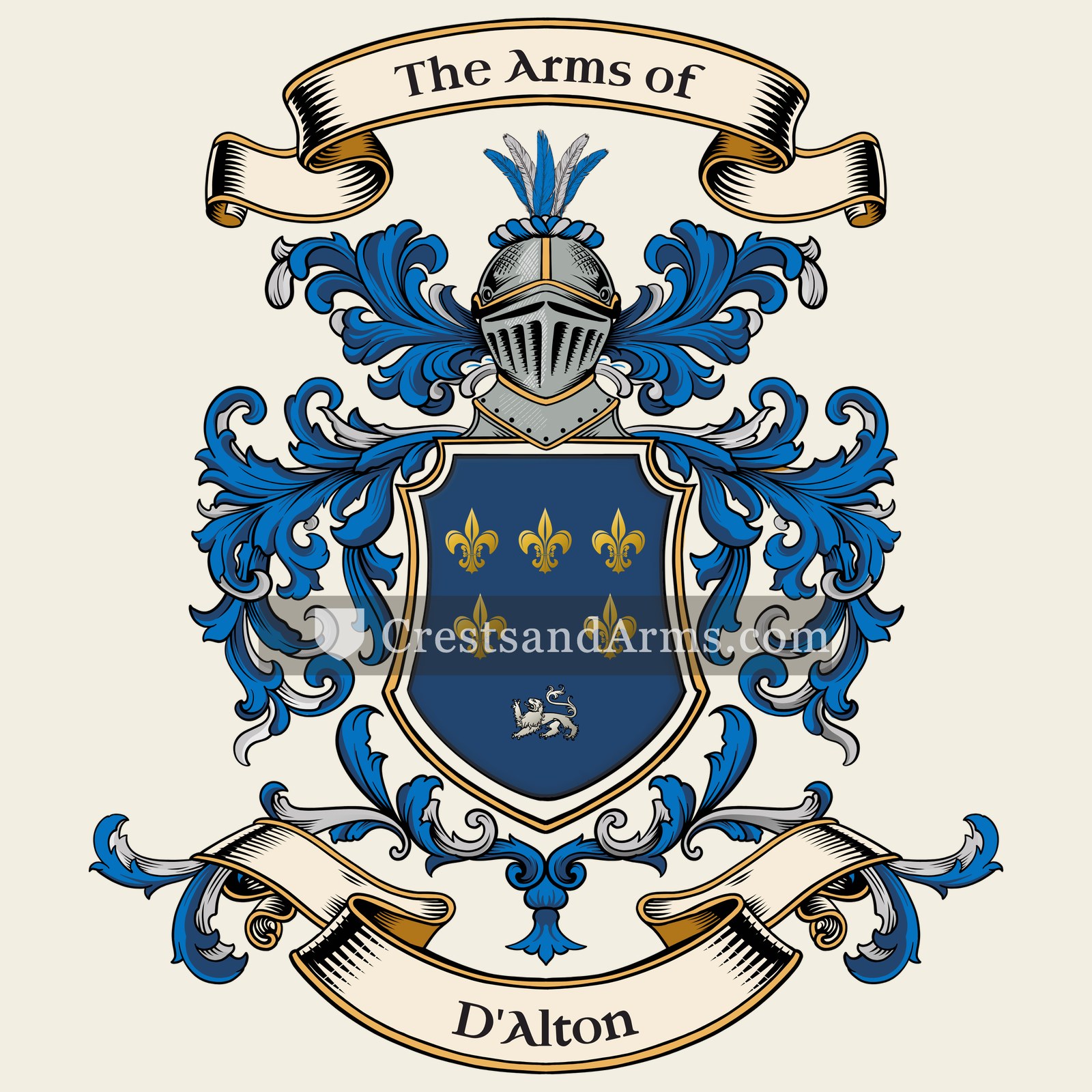
Coat of Arms & Family Crest Details
Symbols on this shield
lionCourage, strength and royalty
fleur de lisPurity, light, and the sixth son
Colours
Blue (Azure)Means: Loyalty and truth
Silver (Argent)Means: Peace and sincerity
Gold (Or)Means: Generosity
Historical info
Source
Sir Bernard Burke, The General Armory of England, Scotland, Ireland and Wales, London: Harrison & Sons, 1884
Blazon (the actual original written record)
“Az. a lion ramp. guard. ar. charged on the shoulder with a crescent sa. betw. five fleurs-de-lis or”
WestmeathDundonell · Westmeath, c. 1636
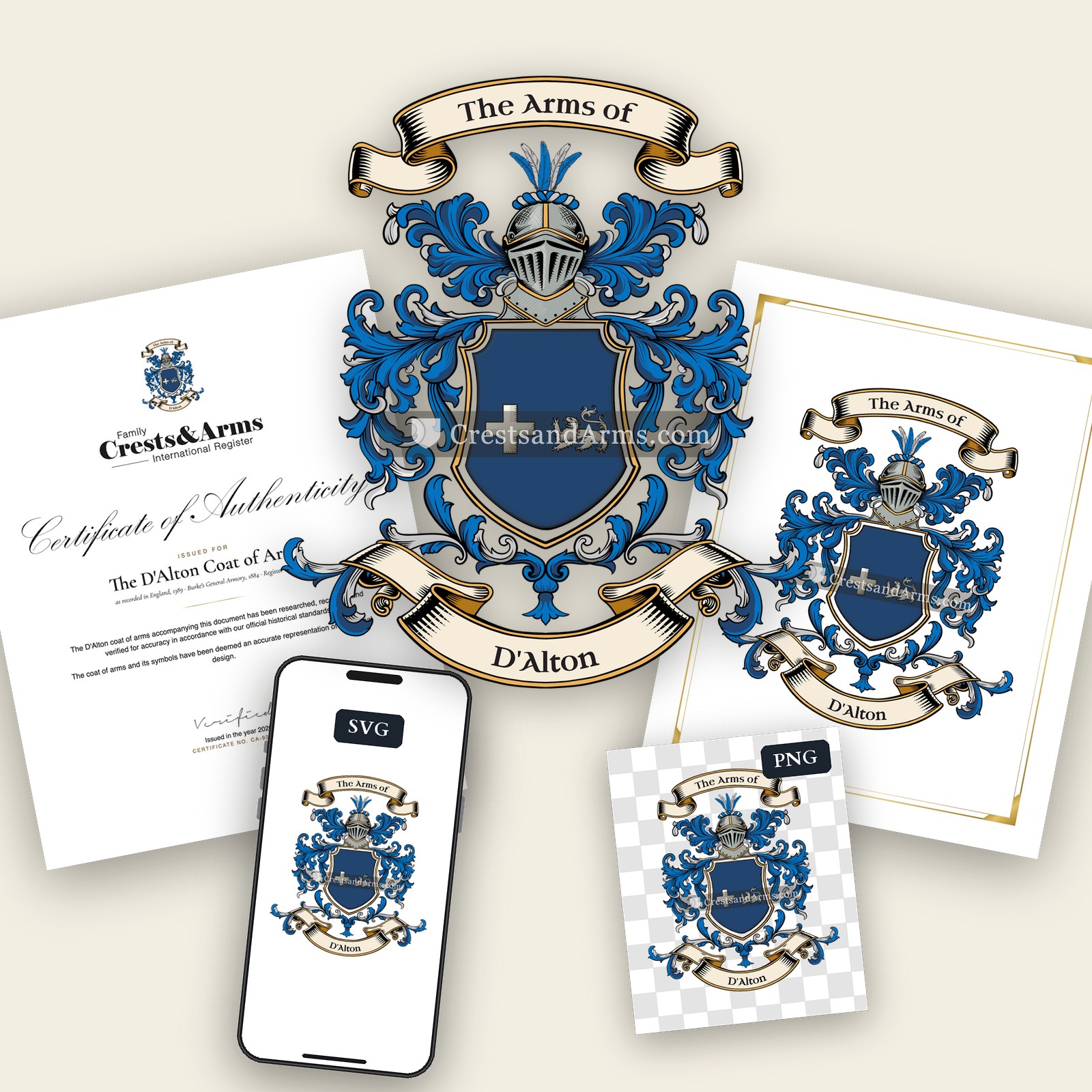
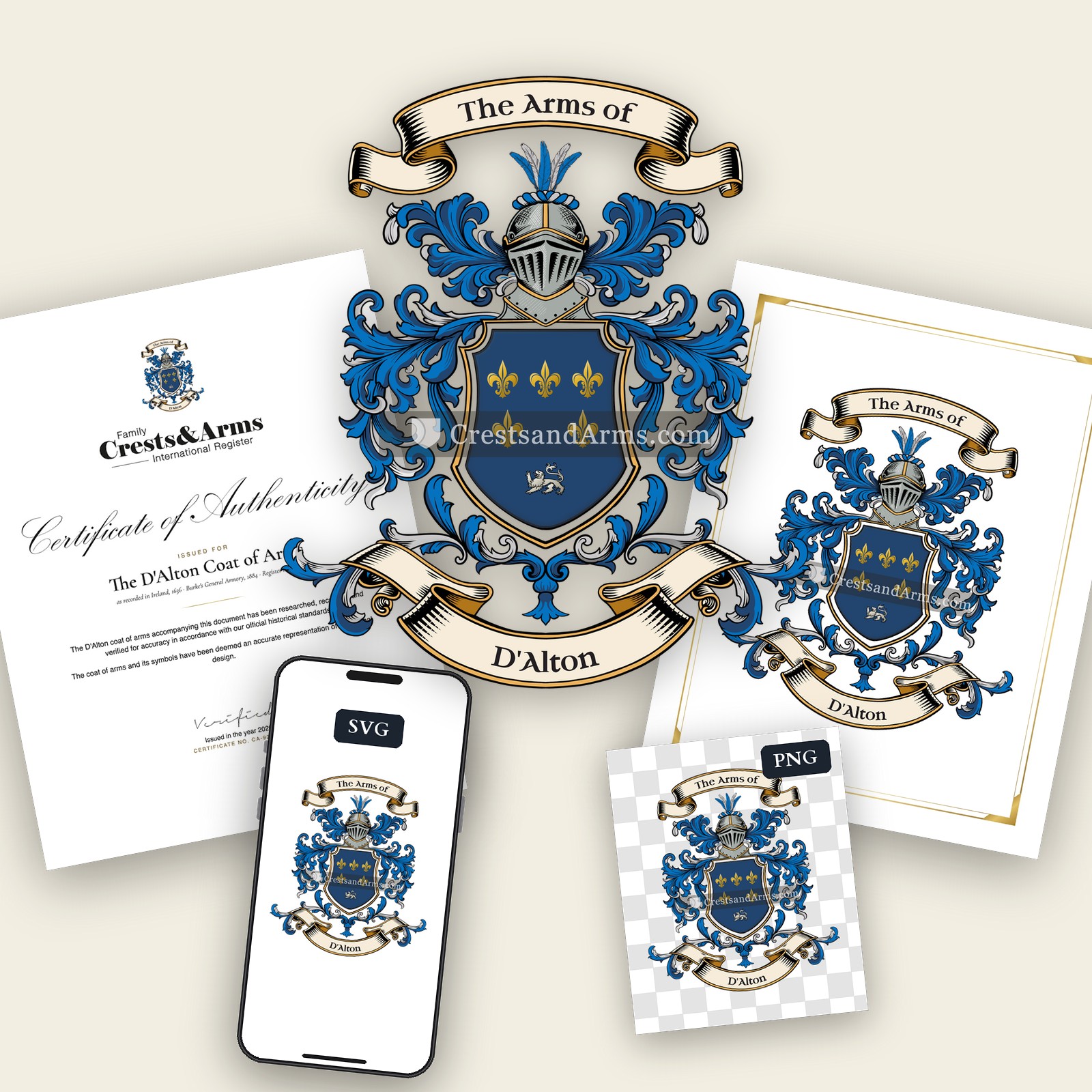
Digital archive packCoat of arms PNG, gold border print PDF, vector SVG and the certificate of authenticity. Sent to your email in minutes.
Map of Ireland showing where the D'Alton arms are recorded
The D'Alton arms were recorded in Westmeath, c. 1636.
Westmeath was midland grazing country in Ireland, taken by Norman families and held for centuries. Its estates were large and passed down whole, and unbroken tenure brought arms with it.
This is where the arms were entered in the register. Families often moved to other parts of the country, so the same name can turn up in more than one region.
The body that granted and recorded arms in Ireland in this period.
Charles I of England
Sovereign of the period
Charles I of England
1625–1649
Reigning in England when the D'Alton arms are first recorded.
How Arms Worked in Ireland
The Ulster King of Arms granted coats of arms to individuals who proved their social standing and good character. These symbols were typically inherited by all legitimate descendants of the original holder. If a family branch wanted a unique look, they could apply for a specific change to their design through the office to ensure their identity remained distinct.
Granting authority
The Ulster King of Arms acted as the official body that regulated and issued all coats of arms throughout Ireland.
How they got arms
Families obtained their arms through formal grants issued by the office after proving their eligibility and paying the required fees.
Where arms were recorded
All official grants were recorded in the registers held by the Ulster King of Arms starting from the year 1552.
The family's standing
Recorded among the armigerous families of Westmeath.
Origin & History of the D'Alton Family in Ireland
The D’Alton family name arrived in Ireland during the period of the Anglo-Norman expansion, eventually establishing deep roots in the Irish midlands. By the early seventeenth century, the family had become prominent landowners in County Westmeath, a region where they maintained significant influence. Historical records confirm their presence in this area by 1636, a time when the family was deeply integrated into the local social and political landscape. As members of the landed gentry, the D’Altons navigated the complex shifts in Irish land ownership and religious politics that defined the seventeenth century. Their history reflects the broader experience of families who moved from continental Europe to Ireland, gradually adopting the customs and culture of their new home while holding onto their distinct ancestral identity.
D'Alton Meaning & Related Branches
Root word
Alton
Old English for an estate or settlement near a river source.
This name
D'AltonA locational surname indicating origin from a town or settlement near a river.
also spelled
Daltoun
Daltonne
Related arms
Chaytorrecorded with D'Alton, same area
Clervauxrecorded with D'Alton, same area
Clutterbuckrecorded with D'Alton, same area
Cockerrecorded with D'Alton, same area
Documented Sources
Sir Bernard Burke, The General Armory of England, Scotland, Ireland and Wales, London: Harrison & Sons, 1884
Farrer, William and Brownbill, John, The Victoria History of the County of Lancaster, 1906
The National Archives, Close Rolls, Richard II, 1385-1389
Digital archive packCoat of arms PNG, gold border print PDF, vector SVG and the certificate of authenticity. Sent to your email in minutes.


 cross symbolChristian faith and service
 lionCourage, strength and royalty
 cross symbolChristian faith and service
 lionCourage, strength and royalty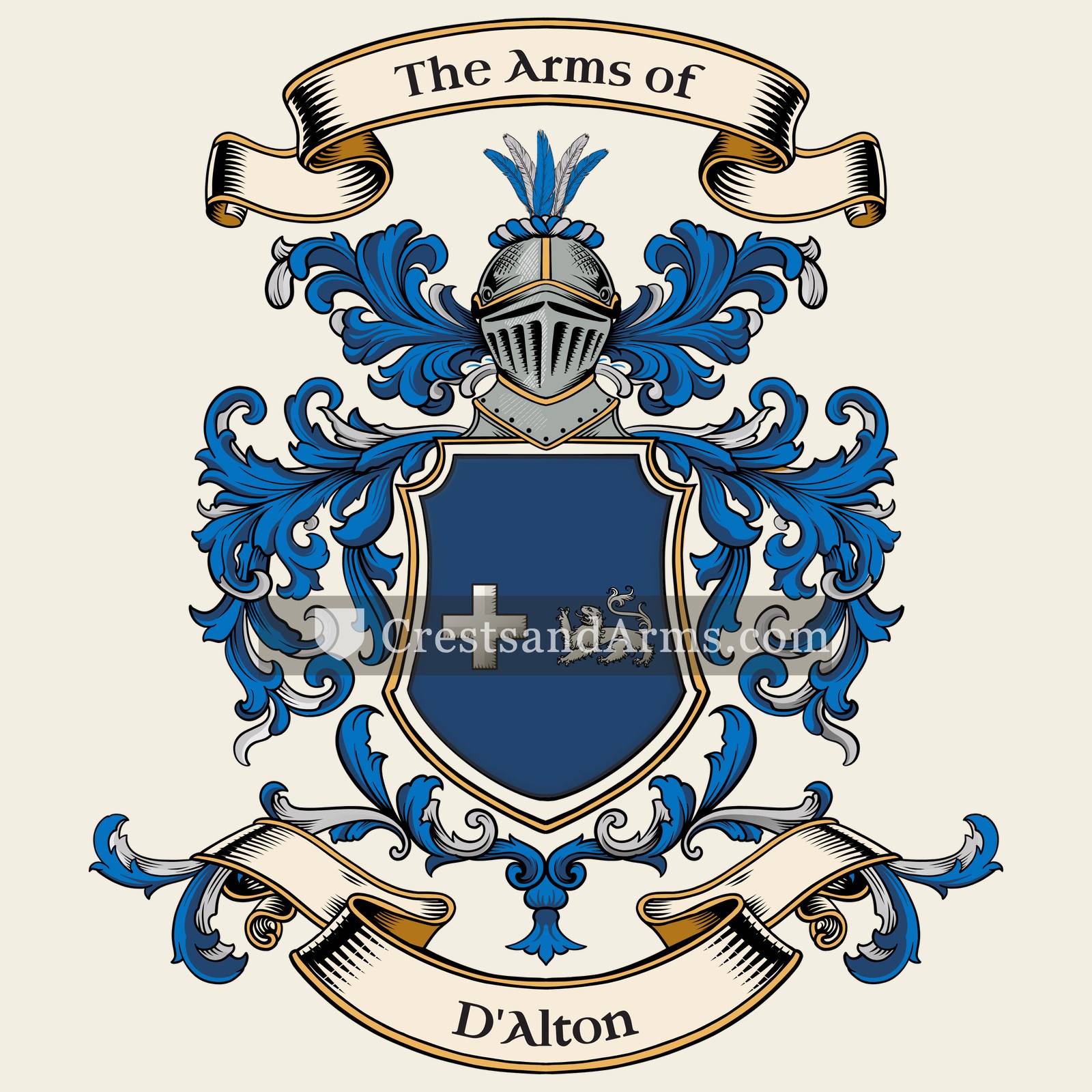


 fleur de lisPurity, light, and the sixth son